


#Short Answer
Explains What Is AI in Education, including the core definition, how it works, practical examples, and limitations.
#Infobox
#History / Background
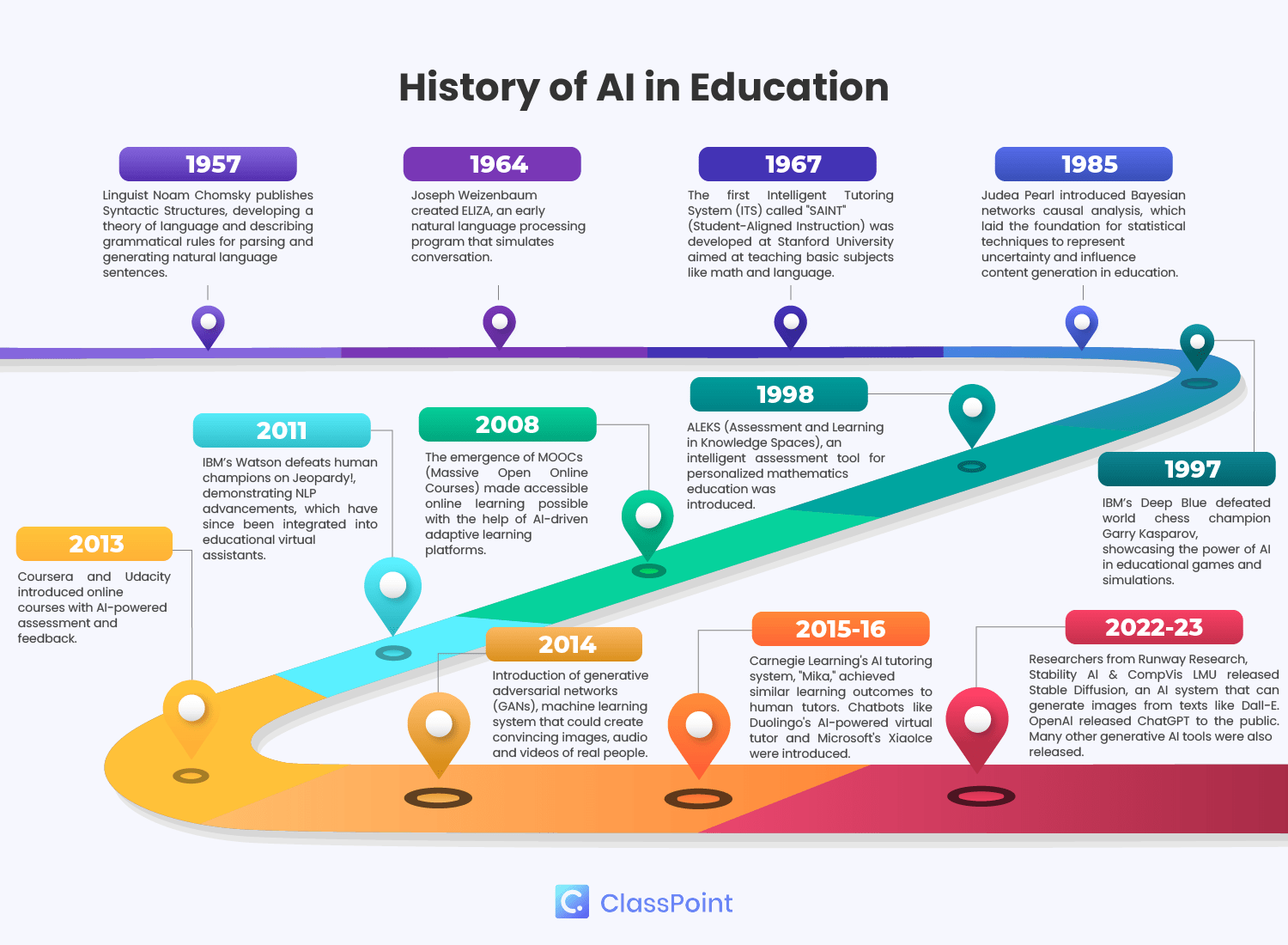
Early Developments (1950s–1980s) The concept of AI in education dates back to the 1950s, with early experiments in computer-assisted instruction (CAI). One of the first notable examples was PLATO (Programmed Logic for Automated Teaching Operations), developed at the University of Illinois in 1960. PLATO used mainframe computers to deliver interactive lessons, marking a significant step toward automated education. During the 1970s and 1980s, AI researchers began exploring expert systems—AI programs designed to mimic human expertise in specific domains. These systems laid the groundwork for intelligent tutoring systems (ITS), which provided personalized feedback to students based on their responses.
The Rise of Intelligent Tutoring Systems (1990s–2000s) The 1990s saw the emergence of intelligent tutoring systems (ITS), which combined AI techniques with educational psychology to create adaptive learning environments. Notable examples included Cognitive Tutor and ALEKS (Assessment and Learning in Knowledge Spaces), both of which used machine learning to tailor instruction to individual student needs. The proliferation of the internet in the late 1990s and early 2000s further accelerated the development of AIEd. Online learning platforms such as Khan Academy and Coursera began incorporating AI-driven features like automated grading and personalized learning paths.
Modern Era (2010s–Present) The 2010s marked a turning point for AI in education, fueled by breakthroughs in deep learning and natural language processing (NLP). AI-powered tools such as Duolingo (for language learning) and Socratic (for homework assistance) became widely adopted. Additionally, learning management systems (LMS) like Blackboard and Canvas integrated AI features to enhance course delivery and student engagement. The COVID-19 pandemic (2020–2022) further accelerated the adoption of AIEd, as educational institutions worldwide transitioned to remote learning. AI-driven platforms like Zoom with AI transcription and Google Classroom’s automated grading became essential tools for educators and students alike. Today, AIEd continues to evolve, with emerging technologies such as generative AI (e.g., AI chatbots like ChatGPT) and augmented reality (AR) being explored for their potential to revolutionize education.
#How It Works
Core Technologies AI in education relies on several key technologies:
- Machine Learning (ML) - ML algorithms analyze student data (e.g., test scores, interaction logs) to identify patterns and predict outcomes.
- Supervised learning is commonly used for tasks like automated grading, where the system is trained on labeled datasets.
- Reinforcement learning helps adaptive learning systems adjust difficulty levels based on student performance.
- Natural Language Processing (NLP) - NLP enables AI systems to understand and generate human language, facilitating applications like chatbots and automated essay grading. - Tools like Grammarly and Turnitin use NLP to provide real-time feedback on writing assignments.
- Computer Vision - Computer vision is used in applications such as automated attendance tracking (via facial recognition) and interactive whiteboards that respond to gestures.
- Predictive Analytics - AI systems analyze historical data to predict student performance, dropout risks, and optimal learning paths. - Institutions use these insights to intervene early and provide targeted support.
Key Applications
- Personalized Learning: AI adapts content, pacing, and assessments to individual student needs (e.g., DreamBox for math).
- Automated Grading: AI tools like Gradescope and Automark grade assignments, quizzes, and even essays.
- Intelligent Tutoring Systems (ITS): Systems like ScootPad provide step-by-step guidance and feedback.
- Chatbots and Virtual Assistants: AI-powered assistants (e.g., Georgia State University’s "Pounce") answer student queries 24/7.
- Content Creation: AI generates educational materials, such as quiz questions or summaries of textbooks.
- Accessibility Tools: AI enhances accessibility through features like real-time captioning and text-to-speech for students with disabilities.
#Important Facts
- Personalization at Scale AI enables educators to tailor instruction to each student’s learning style, pace, and preferences, addressing the limitations of traditional one-size-fits-all approaches.
- Efficiency in Administration AI automates repetitive tasks such as grading, scheduling, and attendance tracking, freeing up educators to focus on teaching and mentoring.
- Early Intervention Predictive analytics can identify at-risk students early, allowing institutions to provide timely interventions and reduce dropout rates.
- Global Accessibility AI-powered platforms like Khan Academy and edX make high-quality education accessible to learners worldwide, regardless of geographic or socioeconomic barriers.
- Ethical Considerations The use of AI in education raises concerns about data privacy, algorithmic bias, and over-reliance on technology. Institutions must implement robust ethical guidelines and transparency measures.
- Cost and Infrastructure While AIEd offers long-term benefits, the initial costs of implementation—including software, training, and infrastructure—can be prohibitive for some schools and universities.
- Teacher Augmentation, Not Replacement AI is designed to assist educators, not replace them. The role of teachers is evolving to include mentoring, facilitation, and human-centered interactions that AI cannot replicate.
#Timeline
- Foundational ideas
Core concepts and early methods shape What Is AI in Education?.
- Practical use
Tools, examples, and real-world deployments make the topic easier to evaluate.
- Responsible implementation
Current work focuses on reliability, governance, performance, and measurable impact.
#Related Terms
#FAQ
What does What Is AI in Education? cover?
Explains What Is AI in Education, including the core definition, how it works, practical examples, and limitations.
Why is What Is AI in Education? important?
It helps readers understand key concepts, compare practical use cases, and evaluate how Education Technology decisions affect outcomes, risks, and implementation choices.
What should readers verify before applying this topic?
Readers should compare benefits, limitations, data requirements, and related themes such as AI, Education, Machine Learning before using the ideas in real projects.
#References
- What Is AI in Education? terminology and background research
- What Is AI in Education? use cases, implementation examples, and limitations
- Education Technology best practices, standards, and risk guidance
- AI case studies, benchmarks, and current industry analysis

Comments
No comments yet. Start the discussion with a useful note.