

#Short Answer
Covers facts about ai in education, including core concepts, practical examples, benefits, limitations, and risks in Education Technology.
#Infobox
#Overview
AI in education encompasses the use of machine learning, natural language processing, and other AI technologies to support teaching, learning, and administrative tasks. The primary goal is to create more efficient, personalized, and accessible educational experiences. AI systems analyze student performance data to tailor instruction, automate routine tasks such as grading, and provide real-time feedback. This integration is reshaping traditional education models by making them more adaptive and responsive to individual learner needs. The adoption of AI in education has accelerated due to advancements in computing power, the proliferation of digital learning platforms, and the growing demand for flexible, lifelong learning opportunities. Institutions worldwide are leveraging AI to bridge gaps in access, improve engagement, and optimize resource allocation.
#History / Background
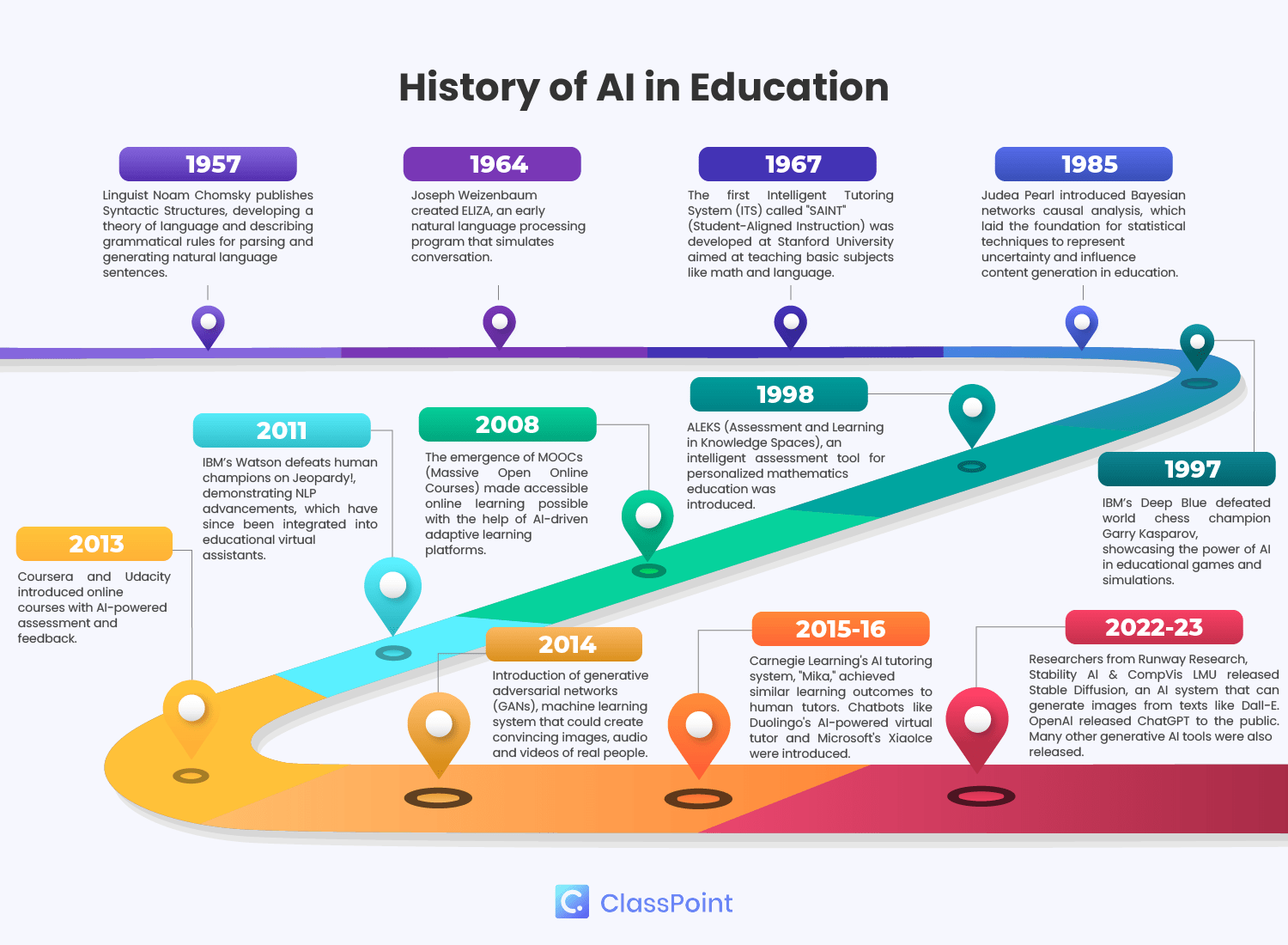
The concept of AI in education dates back to the 1960s and 1970s, with early experiments in computer-assisted instruction (CAI). One of the first notable systems was PLATO (Programmed Logic for Automatic Teaching Operations), developed at the University of Illinois in 1960. PLATO used mainframe computers to deliver interactive lessons, laying the groundwork for modern AI-driven educational tools. In the 1980s and 1990s, AI research in education focused on intelligent tutoring systems (ITS), which aimed to mimic human tutors by providing personalized feedback. Systems like SCHOLAR (1970) and Cognitive Tutor (1990s) demonstrated the potential of AI to enhance learning outcomes by adapting to individual student needs. The 2000s saw a surge in AI applications with the rise of the internet and digital learning platforms. Companies like Khan Academy and Duolingo integrated AI to personalize learning experiences. The introduction of MOOCs (Massive Open Online Courses) further expanded AI’s role in education by enabling scalable, data-driven instruction. In recent years, AI has become more sophisticated with the advent of deep learning and large language models (LLMs). Tools like ChatGPT and Google’s Bard are now being explored for their potential to assist in tutoring, content creation, and administrative tasks. Governments and educational institutions are increasingly investing in AI to address challenges such as teacher shortages and unequal access to quality education.
#How It Works
AI in education operates through several key mechanisms, each designed to enhance different aspects of the learning process:
#
- Adaptive Learning Adaptive learning systems use AI algorithms to analyze student performance data and adjust the difficulty, pace, and content of lessons in real time. Platforms like DreamBox and ALEKS employ machine learning to identify gaps in knowledge and provide targeted interventions. These systems rely on:
- Data collection: Tracking student interactions, quiz scores, and time spent on tasks.
- Pattern recognition: Identifying trends in learning behaviors and knowledge retention.
- Personalized feedback: Recommending specific exercises or resources based on individual needs.
#
- Automated Grading and Assessment AI-powered grading tools, such as Gradescope and Turnitin, automate the evaluation of assignments, essays, and multiple-choice tests. These systems use:
- Natural language processing (NLP): Analyzing written responses for coherence, grammar, and content accuracy.
- Computer vision: Scanning and grading handwritten or printed assignments.
- Rubric-based scoring: Applying predefined criteria to assess student work consistently.
#
- Intelligent Tutoring Systems (ITS) ITS platforms, like Socratic and Carnegie Learning, act as virtual tutors by providing step-by-step guidance and explanations. They function through:
- Rule-based systems: Following predefined logic to solve problems.
- Machine learning models: Improving responses over time based on user interactions.
- Interactive problem-solving: Engaging students in dialogue to deepen understanding.
#
- Chatbots and Virtual Assistants AI chatbots, such as Woebot for mental health support or Duolingo’s chatbot for language learning, simulate human conversation to assist students. These tools use:
- NLP: Understanding and generating human-like responses.
- Contextual awareness: Adapting to the user’s level of knowledge and emotional state.
- 24/7 availability: Providing immediate support outside of traditional classroom hours.
#
- Predictive Analytics Educational institutions use AI to predict student outcomes, such as dropout risks or academic performance. Tools like IBM Watson Education analyze:
- Historical data: Past grades, attendance, and behavioral patterns.
- Demographic factors: Socioeconomic status, prior education, and learning disabilities.
- Real-time alerts: Notifying educators of students who may need additional support.
#
- Content Creation and Curation AI generates educational content, such as quizzes, lesson plans, and even textbooks. Platforms like Content Technologies Inc. (CTI) use:
- Generative AI: Creating original content from prompts or existing materials.
- Semantic analysis: Ensuring content aligns with curriculum standards.
- Customization: Tailoring materials to specific grade levels or learning objectives.
#Important Facts
#1. Growth and Adoption - The global AI in education market is projected to reach $25.7 billion by 2030, growing at a compound annual growth rate (CAGR) of 36.0% from 2023 to 2030 (Grand View Research).
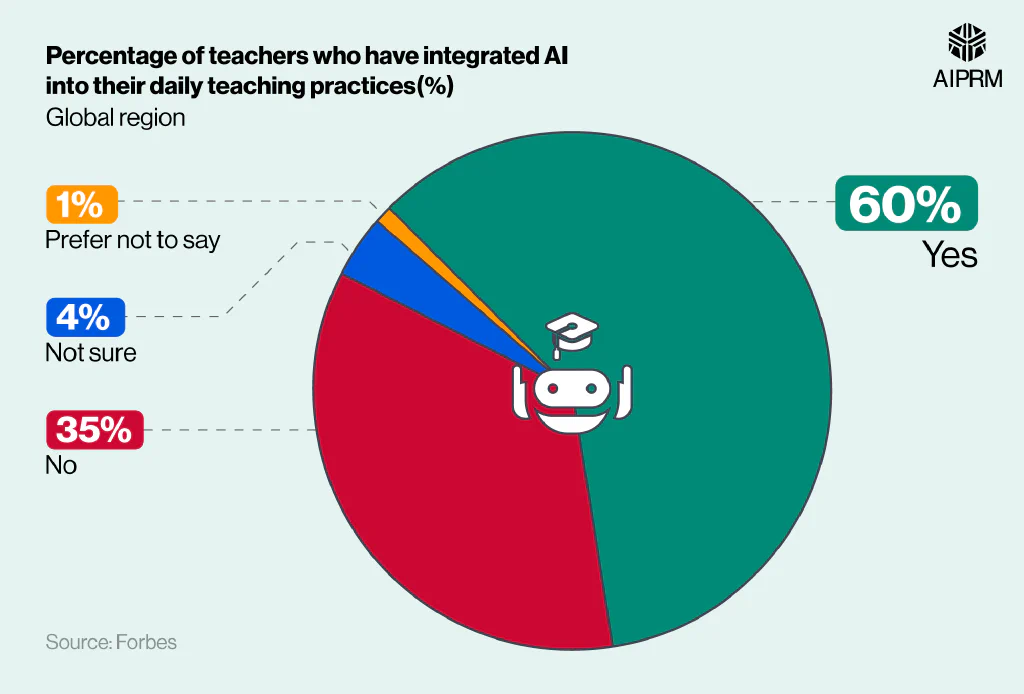
- 60% of educators believe AI will have a significant impact on education within the next five years (OECD, 2021).
- China leads in AI education adoption, with over 50% of schools using AI tools, followed by the United States and India.
#2. Personalization and Engagement - AI-powered adaptive learning can improve test scores by up to 30% compared to traditional methods (RAND Corporation). - Students using AI tutors show a 40% increase in engagement and a 25% reduction in learning time (McKinsey & Company).
- Duolingo, a language-learning app, uses AI to personalize lessons for over 500 million users worldwide.
#3. Efficiency and Cost Savings - Automated grading can save teachers up to 10 hours per week (EdWeek Research Center). - AI reduces administrative costs by 20-30% in large educational institutions (Deloitte).
- Georgia State University used AI to identify at-risk students, reducing summer melt (students not enrolling after admission) by 22%.
#4. Accessibility and Inclusion - AI tools like text-to-speech and speech-to-text assist students with disabilities, including those with visual impairments or dyslexia.
- AI-powered translation tools break language barriers, enabling non-native speakers to access educational content.
- AI-driven captioning in videos improves accessibility for deaf or hard-of-hearing students.
#5. Challenges and Limitations
- Data privacy concerns: 72% of parents worry about how student data is used by AI systems (Pew Research Center).
- Bias in algorithms: AI systems may perpetuate racial, gender, or socioeconomic biases present in training data.
- Teacher resistance: Only 34% of teachers feel adequately trained to use AI tools in the classroom (EdWeek).
- Digital divide: Students in low-income or rural areas may lack access to AI-powered devices or high-speed internet.
#6. Ethical Considerations
- Surveillance concerns: AI systems in schools may monitor student behavior, raising ethical questions about privacy.
- Over-reliance on AI: There is a risk of reducing human interaction, which is critical for social and emotional development.
- Accountability: Who is responsible when an AI system makes an incorrect decision, such as misgrading an assignment?
#Timeline
- Foundational ideas
Core concepts and early methods shape Facts About AI in Education.
- Practical use
Tools, examples, and real-world deployments make the topic easier to evaluate.
- Responsible implementation
Current work focuses on reliability, governance, performance, and measurable impact.
#Related Terms
#FAQ
What does Facts About AI in Education cover?
Covers facts about ai in education, including core concepts, practical examples, benefits, limitations, and risks in Education Technology.
Why is Facts About AI in Education important?
It helps readers understand key concepts, compare practical use cases, and evaluate how Education Technology decisions affect outcomes, risks, and implementation choices.
What should readers verify before applying this topic?
Readers should compare benefits, limitations, data requirements, and related themes such as Facts, About, AI before using the ideas in real projects.
#References
- Facts About AI in Education terminology and background research
- Facts About AI in Education use cases, implementation examples, and limitations
- Education Technology best practices, standards, and risk guidance
- Facts case studies, benchmarks, and current industry analysis


Comments
No comments yet. Start the discussion with a useful note.