

#Short Answer
Traces timeline of ai in education, highlighting major milestones, context, examples, and future implications.
#Infobox
#Overview
Artificial Intelligence (AI) in education refers to the application of machine learning, natural language processing, and data analytics to enhance teaching, learning, and administrative processes. Over the decades, AI has evolved from experimental tools to integral components of modern educational ecosystems. Today, AI powers intelligent tutoring systems, adaptive learning platforms, automated grading tools, and virtual teaching assistants, enabling personalized and scalable education. The integration of AI in education aims to address persistent challenges such as resource scarcity, teacher shortages, and the need for differentiated instruction. By leveraging predictive analytics and real-time feedback, AI systems help educators identify student needs, tailor content delivery, and improve learning outcomes. However, the adoption of AI also raises concerns regarding data privacy, equity, and the preservation of human-centric teaching approaches.
#History / Background
#Early Foundations (1950s–1970s)
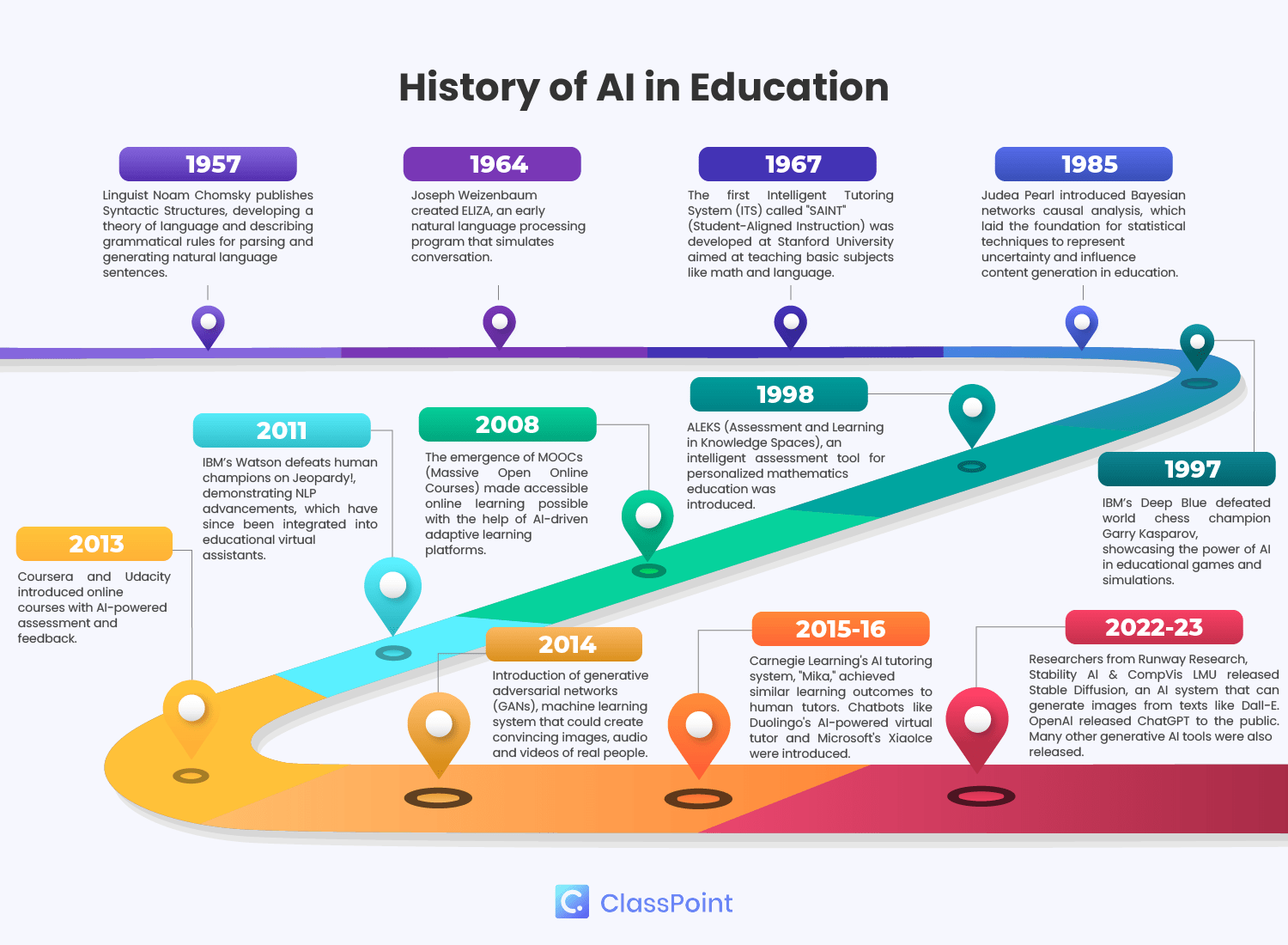
The conceptual roots of AI in education can be traced to the post-World War II era, when early computer scientists began exploring the potential of machines to simulate human learning. In 1950, Alan Turing proposed the "Turing Test," which laid the groundwork for intelligent machines capable of interacting with humans. The first notable educational AI application emerged in 1960 with PLATO (Programmed Logic for Automatic Teaching Operations), developed at the University of Illinois. PLATO was one of the first computer-assisted instruction (CAI) systems, using mainframe computers to deliver interactive lessons and quizzes. It introduced features like touch-sensitive screens and online forums, foreshadowing modern learning management systems. In 1972, SHRDLU, developed by Terry Winograd at MIT, demonstrated natural language understanding by enabling a computer to manipulate virtual blocks using verbal commands. While not an educational tool, SHRDLU showcased the potential of AI to interpret and respond to human language—a critical capability for future educational chatbots.
#The Rise of Intelligent Tutoring Systems (1980s–1990s)
The 1980s marked a turning point with the development of Intelligent Tutoring Systems (ITS), which combined AI with educational psychology to create adaptive learning environments. Carnegie Mellon University became a hub for this research, leading to systems like Cognitive Tutors, which used cognitive models to provide step-by-step guidance in mathematics and science. Another influential project was SCHOLAR, developed by Jaime Carbonell in 1970, which used semantic networks to teach geography. It was one of the first systems to employ AI techniques for educational purposes, emphasizing interactive dialogue and knowledge representation. During this period, AI in education remained largely confined to research labs and universities. However, the advent of personal computers in the late 1980s and early 1990s began to democratize access to educational software, paving the way for broader adoption.
#Expansion and Commercialization (2000s–2010s)
The 2000s saw the commercialization of AI-driven educational tools, driven by advances in machine learning and the growth of the internet. Adaptive learning platforms such as Knewton and DreamBox emerged, using data analytics to personalize learning paths based on student performance. In 2011, IBM Watson made headlines by competing on the quiz show Jeopardy!, demonstrating its ability to understand and generate human language. This sparked interest in using Watson for educational applications, including tutoring and content creation. The proliferation of Massive Open Online Courses (MOOCs) platforms like Coursera and edX integrated AI to enhance course recommendations, automate assessments, and provide personalized feedback. Meanwhile, automated essay scoring (AES) systems, such as those developed by the Educational Testing Service (ETS), began to gain traction in high-stakes testing environments.
#The AI Revolution (2020s–Present)
The 2020s have witnessed an unprecedented acceleration in AI adoption within education, fueled by the COVID-19 pandemic and the rise of generative AI. Tools like Duolingo’s AI-powered chatbots, Grammarly’s writing assistant, and Socratic by Google have become widely used in classrooms and self-directed learning. Generative AI models, such as those based on large language models (LLMs), have enabled the creation of AI tutors that can engage in natural conversations, explain concepts, and generate customized learning materials. Platforms like ** Khan Academy’s Khanmigo** and Socratic exemplify this trend, offering real-time support to students. Moreover, AI is increasingly used for predictive analytics to identify at-risk students, optimize curriculum design, and streamline administrative tasks such as scheduling and resource allocation. Governments and educational institutions are investing in AI literacy programs to prepare students for a future where AI is ubiquitous.
#How It Works
AI in education operates through several core technologies and methodologies:
#
- Machine Learning and Adaptive Learning AI systems analyze vast amounts of student data—such as performance metrics, engagement levels, and learning preferences—to create personalized learning experiences. Adaptive learning platforms adjust the difficulty and type of content based on real-time feedback, ensuring that each student receives instruction tailored to their needs.
#
- Natural Language Processing (NLP) NLP enables AI to understand and generate human language, facilitating interactions through chatbots, virtual assistants, and automated grading systems. For example, AI tutors use NLP to answer student queries, provide explanations, and even simulate classroom discussions.
#
- Computer Vision Computer vision is employed in educational tools to analyze visual inputs, such as handwritten answers, diagrams, and even facial expressions to assess engagement. Systems like automated grading tools use computer vision to evaluate handwritten responses and drawings.
#
- Predictive Analytics By processing historical and real-time data, AI can predict student outcomes, such as the likelihood of dropping out or excelling in a subject. Schools use these insights to intervene early and provide targeted support.
#
- Generative AI Generative AI models, such as large language models, can create educational content, including quizzes, lesson plans, and explanations. They also power AI writing assistants that help students improve their writing skills.
#
- Intelligent Tutoring Systems (ITS) ITS combines AI with educational psychology to simulate one-on-one tutoring. These systems track student progress, identify misconceptions, and provide corrective feedback. Examples include Cognitive Tutors for math and ALEKS for adaptive learning in various subjects.
#Important Facts
- PLATO (1960) was the first computer-assisted instruction system, used to teach students via mainframe computers.
- SHRDLU (1972) demonstrated the potential of natural language processing, though it was not an educational tool.
- Cognitive Tutors (1980s), developed at Carnegie Mellon, are among the most successful ITS, improving student performance in math by up to 50%.
- Knewton (2008) pioneered adaptive learning platforms, later acquired by Pearson, and influenced modern edtech tools.
- IBM Watson (2011) showcased the potential of AI in education through its ability to process and generate human language.
- Duolingo (2011–present) uses AI to personalize language learning, with over 500 million users worldwide.
- Automated Essay Scoring (AES) systems, such as those by ETS, can grade essays with accuracy comparable to human graders.
- Generative AI (2020s) has enabled AI tutors to engage in natural conversations, explain concepts, and generate educational content.
- AI literacy is now a growing focus in curricula, with organizations like UNESCO advocating for AI education in schools.
- Ethical concerns around AI in education include data privacy, algorithmic bias, and the potential for AI to replace human teachers.
#Timeline
- Foundational ideas
Core concepts and early methods shape Timeline of AI in Education.
- Practical use
Tools, examples, and real-world deployments make the topic easier to evaluate.
- Responsible implementation
Current work focuses on reliability, governance, performance, and measurable impact.
#Related Terms
#FAQ
What does Timeline of AI in Education cover?
Traces timeline of ai in education, highlighting major milestones, context, examples, and future implications.
Why is Timeline of AI in Education important?
It helps readers understand key concepts, compare practical use cases, and evaluate how Education Technology decisions affect outcomes, risks, and implementation choices.
What should readers verify before applying this topic?
Readers should compare benefits, limitations, data requirements, and related themes such as Timeline, AI, Education before using the ideas in real projects.
#References
- Timeline of AI in Education terminology and background research
- Timeline of AI in Education use cases, implementation examples, and limitations
- Education Technology best practices, standards, and risk guidance
- Timeline case studies, benchmarks, and current industry analysis


Comments
No comments yet. Start the discussion with a useful note.