


#Short Answer
Covers meaning of ai in education, including core concepts, practical examples, benefits, limitations, and risks in Education Technology.
#Infobox
#Overview
Artificial Intelligence (AI) in education represents a paradigm shift in how teaching and learning are delivered. By leveraging AI-driven tools, educators can tailor instruction to individual student needs, automate routine tasks, and provide real-time feedback. This integration of AI into educational ecosystems aims to address longstanding challenges such as resource constraints, diverse learning paces, and the need for continuous assessment. AI in education encompasses a wide range of applications, from intelligent tutoring systems that adapt to a student’s learning style to chatbots that assist with administrative queries. These technologies not only enhance the efficiency of educational institutions but also democratize access to quality education by breaking geographical and socioeconomic barriers. For instance, AI-powered platforms can offer personalized learning paths, ensuring that students grasp concepts at their own pace while receiving targeted support where needed. Moreover, AI facilitates the analysis of vast amounts of educational data, enabling educators to identify trends, predict student performance, and intervene early to prevent academic struggles. This data-driven approach transforms traditional classrooms into dynamic, responsive learning environments where decisions are informed by evidence rather than intuition.
#History / Background
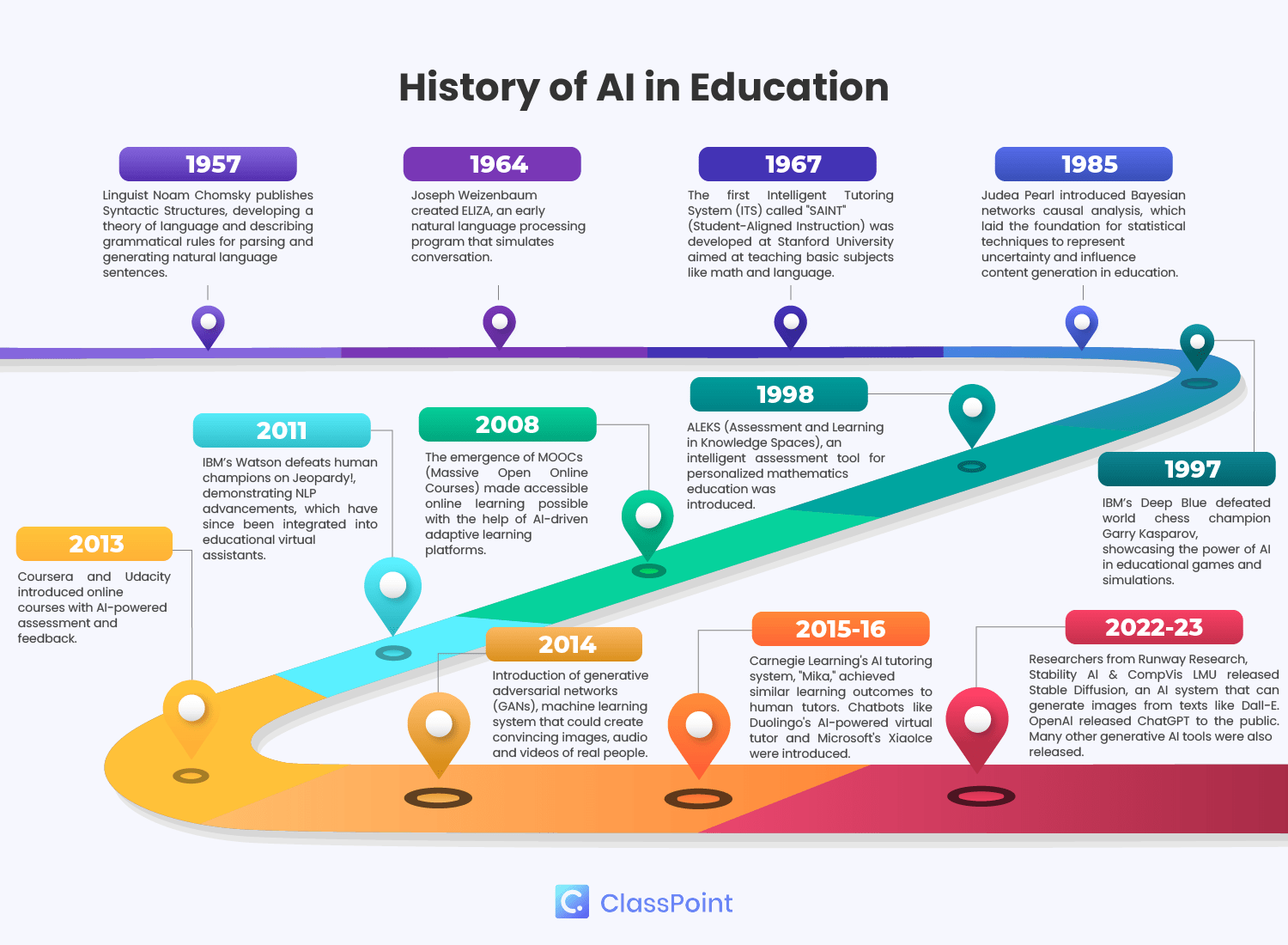
The concept of AI in education traces its roots to the mid-20th century, with early experiments in computer-assisted instruction (CAI) in the 1950s and 1960s. One of the pioneering projects was PLATO (Programmed Logic for Automatic Teaching Operations), developed at the University of Illinois in 1960. PLATO used mainframe computers to deliver interactive lessons, marking one of the first attempts to automate education. The 1970s and 1980s saw the rise of Intelligent Tutoring Systems (ITS), which incorporated AI techniques to provide personalized feedback. Systems like SCHOLAR (1970) and GUIDON (1979) demonstrated the potential of AI to simulate human tutoring by adapting to student responses. However, these early systems were limited by the computational power of the time and the lack of sophisticated algorithms. The 1990s brought significant advancements with the advent of the internet and more powerful computers. Projects like Cognitive Tutor (developed by Carnegie Mellon University) and ALEKS (Assessment and Learning in Knowledge Spaces) emerged, offering adaptive learning experiences. These systems used AI to assess student knowledge and adjust instruction accordingly, laying the groundwork for modern adaptive learning platforms. The 21st century has witnessed an explosion of AI applications in education, driven by breakthroughs in machine learning, big data analytics, and natural language processing. The proliferation of smartphones and internet connectivity has further accelerated this trend, enabling AI tools to reach students globally. Today, AI is integrated into everything from MOOCs (Massive Open Online Courses) to learning management systems (LMS) like Blackboard and Canvas, as well as specialized platforms such as Duolingo for language learning and Khan Academy for K-12 education.
#How It Works
AI in education operates through a combination of advanced technologies and methodologies designed to enhance learning and administrative processes. The core mechanisms include:
#
- Personalized Learning AI systems analyze student performance data, including quiz scores, time spent on tasks, and interaction patterns, to create customized learning paths. Algorithms identify strengths and weaknesses, recommending specific resources or exercises tailored to individual needs. For example, platforms like DreamBox use adaptive learning to adjust the difficulty of math problems in real time based on a student’s responses.
#
- Intelligent Tutoring Systems (ITS) ITS mimics human tutors by providing step-by-step guidance and feedback. These systems use knowledge tracing to model a student’s understanding of a subject and natural language processing (NLP) to interpret and respond to student queries. For instance, Socratic by Google uses NLP to break down complex questions into simpler components, helping students understand underlying concepts.
#
- Automated Grading and Assessment AI-powered tools like Gradescope and Turnitin automate the grading process for assignments, quizzes, and even essays. Machine learning models evaluate responses based on predefined criteria, reducing the workload for educators while ensuring consistency. Some systems can also detect plagiarism by comparing submissions against a vast database of academic content.
#
- Natural Language Processing (NLP) for Language Learning NLP enables AI to understand and generate human-like language, making it invaluable for language education. Tools like Duolingo use speech recognition and NLP to assess pronunciation and grammar, providing instant feedback. Chatbots, such as Woebot for mental health support, also leverage NLP to engage students in conversational learning.
#
- Predictive Analytics AI systems analyze historical data to predict student outcomes, such as the likelihood of dropping out or needing additional support. Schools and universities use these insights to implement early intervention strategies, such as targeted tutoring or counseling. For example, IBM Watson Education helps institutions identify at-risk students by analyzing engagement metrics and academic performance.
#
- Virtual and Augmented Reality (VR/AR) AI enhances VR/AR experiences by personalizing content and providing interactive simulations. For instance, medical students can use AI-driven VR platforms to practice surgeries in a risk-free environment, while history students can explore ancient civilizations through immersive simulations.
#
- Administrative Automation AI streamlines administrative tasks such as scheduling, resource allocation, and student enrollment. Chatbots handle routine inquiries, freeing up staff time for more critical functions. For example, Georgia State University uses an AI chatbot named Pounce to assist prospective students with admissions questions, reducing response times and improving user experience.
#Important Facts
- Market Growth: The global AI in education market is projected to reach $25.7 billion by 2030, growing at a compound annual growth rate (CAGR) of 36.0% from 2023 to 2030 (Grand View Research).
- Adoption Rates: A 2023 survey by HolonIQ found that 63% of higher education institutions are actively investing in AI technologies, with 42% already implementing AI-driven tools.
- Student Performance: A study by RAND Corporation revealed that students using AI-powered adaptive learning platforms improved their test scores by 15-20% compared to traditional methods.
- Accessibility: AI tools like text-to-speech and speech-to-text have made education more accessible for students with disabilities, enabling them to engage with content in ways that suit their needs.
- Teacher Support: AI can automate up to 40% of administrative tasks, allowing educators to focus more on teaching and student interaction (McKinsey & Company).
- Ethical Concerns: A 2022 UNESCO report highlighted concerns about data privacy, algorithmic bias, and the dehumanization of education as critical challenges in AI adoption.
- Global Reach: AI-powered platforms like Khan Academy and Coursera have reached millions of learners worldwide, including in regions with limited access to traditional education.
- Cost Savings: Schools using AI for administrative tasks can reduce operational costs by up to 30% (Deloitte).
#Timeline
- Foundational ideas
Core concepts and early methods shape Meaning of AI in Education.
- Practical use
Tools, examples, and real-world deployments make the topic easier to evaluate.
- Responsible implementation
Current work focuses on reliability, governance, performance, and measurable impact.
#Related Terms
#FAQ
What does Meaning of AI in Education cover?
Covers meaning of ai in education, including core concepts, practical examples, benefits, limitations, and risks in Education Technology.
Why is Meaning of AI in Education important?
It helps readers understand key concepts, compare practical use cases, and evaluate how Education Technology decisions affect outcomes, risks, and implementation choices.
What should readers verify before applying this topic?
Readers should compare benefits, limitations, data requirements, and related themes such as Meaning, AI, Education before using the ideas in real projects.
#References
- Meaning of AI in Education terminology and background research
- Meaning of AI in Education use cases, implementation examples, and limitations
- Education Technology best practices, standards, and risk guidance
- Meaning case studies, benchmarks, and current industry analysis

Comments
No comments yet. Start the discussion with a useful note.