


#Short Answer
Explains how education uses ai: case studies, including the main process, tools, examples, risks, and practical implementation steps.
#Infobox
#Overview
Artificial Intelligence (AI) is transforming education by introducing adaptive, data-driven solutions that cater to individual student needs. Unlike traditional one-size-fits-all approaches, AI enables personalized learning paths, real-time feedback, and automated administrative tasks, freeing educators to focus on mentorship and complex instruction. The integration of AI spans from K-12 classrooms to higher education and corporate training, addressing challenges such as student disengagement, resource constraints, and accessibility gaps. AI in education leverages technologies like machine learning (ML) to analyze student performance, natural language processing (NLP) for language learning and assessment, and computer vision for interactive learning environments. These tools not only enhance academic outcomes but also democratize education by providing scalable solutions for diverse learners, including those with disabilities or in remote locations.
#History / Background
#Early Foundations (1950s–1980s)
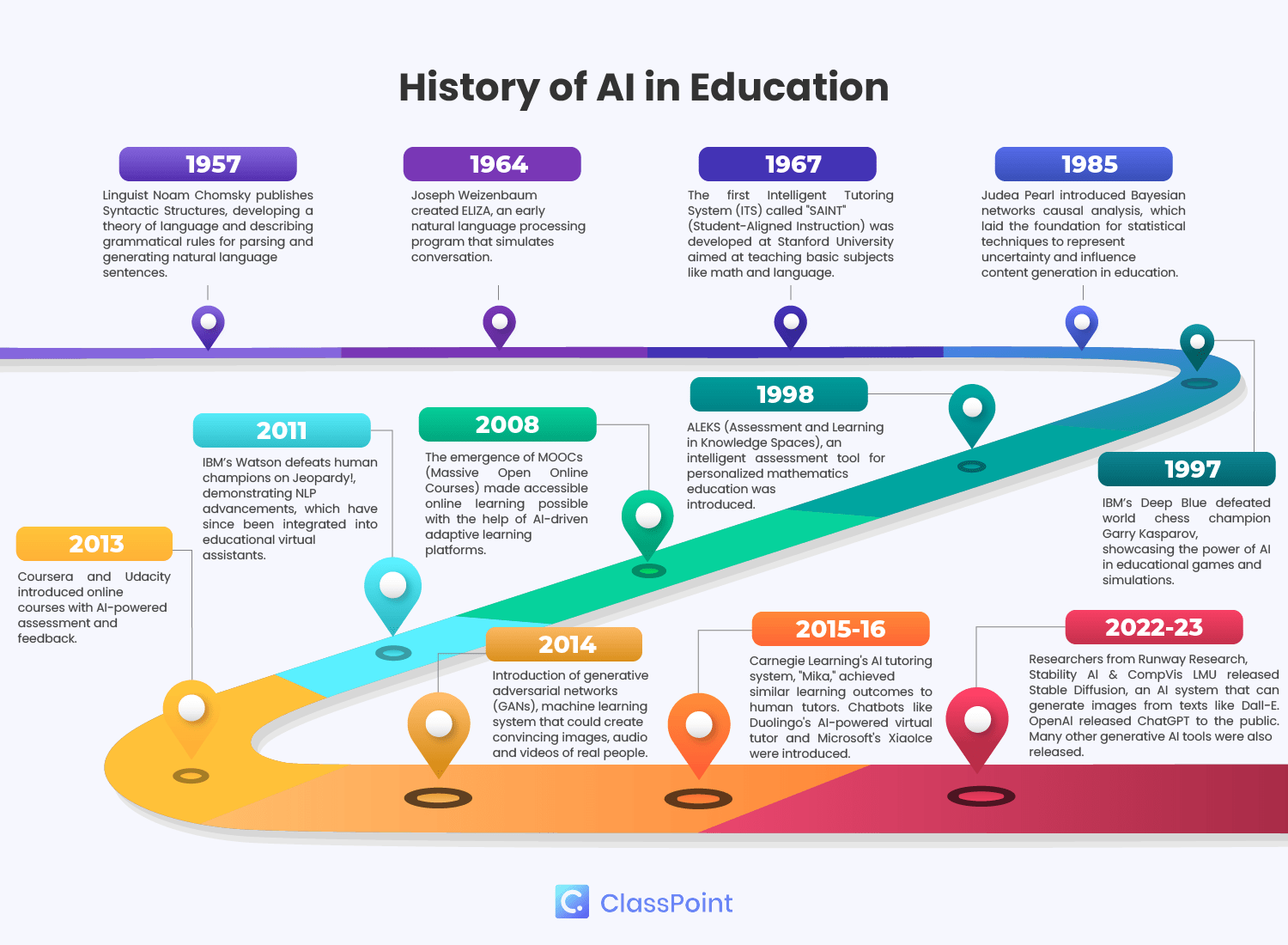
The concept of AI in education traces back to the mid-20th century, with early experiments in computer-assisted instruction (CAI). In 1956, the term "artificial intelligence" was coined at the Dartmouth Conference, laying the groundwork for AI applications. By the 1960s and 1970s, projects like PLATO (Programmed Logic for Automatic Teaching Operations) and SCHOLAR (an early intelligent tutoring system) demonstrated the potential of AI to deliver interactive, adaptive learning experiences.
#The Rise of Intelligent Tutoring Systems (1980s–2000s)
The 1980s saw the development of Intelligent Tutoring Systems (ITS), which used AI to simulate human tutors. Systems like Cognitive Tutor and ALEKS (Assessment and Learning in Knowledge Spaces) provided step-by-step guidance to students, adapting to their learning pace. These systems were among the first to use ML algorithms to track student progress and tailor instruction.
#The Digital Revolution (2000s–2010s)
The proliferation of the internet and mobile devices in the 2000s accelerated AI adoption in education. Platforms like Khan Academy (2008) and Duolingo (2011) incorporated AI to personalize learning experiences. The rise of MOOCs (Massive Open Online Courses) further expanded AI's role, with platforms like Coursera and edX using algorithms to recommend courses and assess student performance.
#The Modern Era (2010s–Present)
Advancements in deep learning and big data analytics have propelled AI in education to new heights. Tools like Socratic by Google (2019) and Carnegie Learning use NLP to answer student questions and provide instant feedback. AI-driven analytics now help educators identify at-risk students early, enabling timely interventions. Additionally, AI-powered chatbots and virtual assistants are being used to streamline administrative tasks, such as admissions and student support.
#How It Works
#Personalized Learning AI systems analyze student data—such as quiz scores, time spent on tasks, and interaction patterns—to create customized learning paths. For example, DreamBox and ALEKS use adaptive algorithms to adjust the difficulty of problems based on a student's performance, ensuring optimal challenge and engagement.
#Automated Grading and Feedback AI automates the grading of multiple-choice and short-answer questions, reducing the workload for educators. Tools like Gradescope and Turnitin use ML to detect plagiarism and provide feedback on writing assignments. For subjective assessments, such as essays, AI models like OpenAI's GPT-4 can analyze structure, coherence, and content, though human oversight remains essential.
#Intelligent Tutoring Systems (ITS)
ITS platforms simulate one-on-one tutoring by using AI to diagnose student misconceptions and provide targeted explanations. For instance, Carnegie Learning's MATHia adapts to a student's problem-solving strategies, offering hints and alternative approaches when errors are detected.
#Natural Language Processing (NLP) in Education NLP enables AI to understand and generate human language, facilitating applications like:
- Language Learning: Apps like Duolingo use NLP to correct pronunciation, suggest vocabulary, and adapt lessons based on user performance.
- Chatbots for Student Support: Virtual assistants like Georgia State University's "Pounce" use NLP to answer student queries about admissions, financial aid, and course registration.
- Automated Essay Scoring: Systems like Educational Testing Service's (ETS) e-rater analyze essays for grammar, style, and content, providing scores comparable to human graders.
#Data Analytics and Predictive Modeling AI-driven analytics help educators identify trends in student performance, such as declining engagement or difficulty with specific topics. Predictive models can flag students at risk of dropping out, allowing for early interventions. For example, IBM Watson Education uses AI to analyze student data and recommend personalized learning strategies.
#Accessibility and Inclusion AI enhances accessibility by providing tools for students with disabilities:
- Speech-to-Text and Text-to-Speech: Tools like Google's Live Transcribe and NaturalReader convert spoken words to text and vice versa, aiding students with hearing or visual impairments.
- Sign Language Avatars: AI-powered avatars, such as those developed by SignAll, translate spoken language into sign language in real time.
- Cognitive Assistants: AI tools like Microsoft's Immersive Reader help students with dyslexia by adjusting text spacing, font size, and background color.
#Important Facts
- Market Growth: The global AI in education market is projected to reach $25.7 billion by 2027, growing at a CAGR of 47% from 2020 to 2027 (Source: MarketsandMarkets).
- Student Engagement: AI-powered gamification, such as in Duolingo, increases student engagement by up to 60% compared to traditional methods (Source: Journal of Educational Psychology).
- Teacher Efficiency: AI can automate up to 40% of administrative tasks, allowing teachers to spend more time on instruction and mentorship (Source: McKinsey & Company).
- Bias in Algorithms: Studies have shown that AI grading systems can exhibit bias, particularly against non-native English speakers or students from underrepresented backgrounds (Source: MIT Technology Review).
- Early Intervention: AI-driven predictive analytics can identify at-risk students with 80% accuracy up to two semesters before they drop out (Source: Educause).
- Global Reach: AI-powered platforms like Khan Academy and Coursera serve millions of learners worldwide, with Khan Academy reporting over 120 million registered users as of 2023.
- Cost Savings: Schools using AI for administrative tasks report 30% reductions in operational costs (Source: Deloitte).
#Timeline
- Foundational ideas
Core concepts and early methods shape How Education Uses AI: Case Studies.
- Practical use
Tools, examples, and real-world deployments make the topic easier to evaluate.
- Responsible implementation
Current work focuses on reliability, governance, performance, and measurable impact.
#Related Terms
#FAQ
What does How Education Uses AI: Case Studies cover?
Explains how education uses ai: case studies, including the main process, tools, examples, risks, and practical implementation steps.
Why is How Education Uses AI: Case Studies important?
It helps readers understand key concepts, compare practical use cases, and evaluate how Education Technology decisions affect outcomes, risks, and implementation choices.
What should readers verify before applying this topic?
Readers should compare benefits, limitations, data requirements, and related themes such as Education, Uses, AI before using the ideas in real projects.
#References
- How Education Uses AI: Case Studies terminology and background research
- How Education Uses AI: Case Studies use cases, implementation examples, and limitations
- Education Technology best practices, standards, and risk guidance
- Education case studies, benchmarks, and current industry analysis


Comments
No comments yet. Start the discussion with a useful note.