

#Short Answer
Traces timeline of ai in manufacturing, highlighting major milestones, context, examples, and future implications.
#Infobox
#Overview
Artificial intelligence (AI) has become a cornerstone of modern manufacturing, revolutionizing how products are designed, produced, and maintained. Unlike traditional automation, which relies on rigid programming, AI systems adapt to changing conditions, learn from data, and optimize processes in real time. The integration of AI in manufacturing spans multiple domains, including predictive maintenance, quality control, supply chain management, and generative design. The adoption of AI in manufacturing has accelerated due to advancements in computational power, big data analytics, and edge computing, enabling machines to process vast amounts of information with minimal latency. Industries such as automotive, aerospace, and electronics have been early adopters, leveraging AI to enhance precision, reduce defects, and lower operational costs. As AI continues to evolve, its role in manufacturing is expected to expand further, with emerging technologies like digital twins and autonomous robotics poised to redefine industrial production.
#History / Background
#Early Foundations (1950s–1970s)
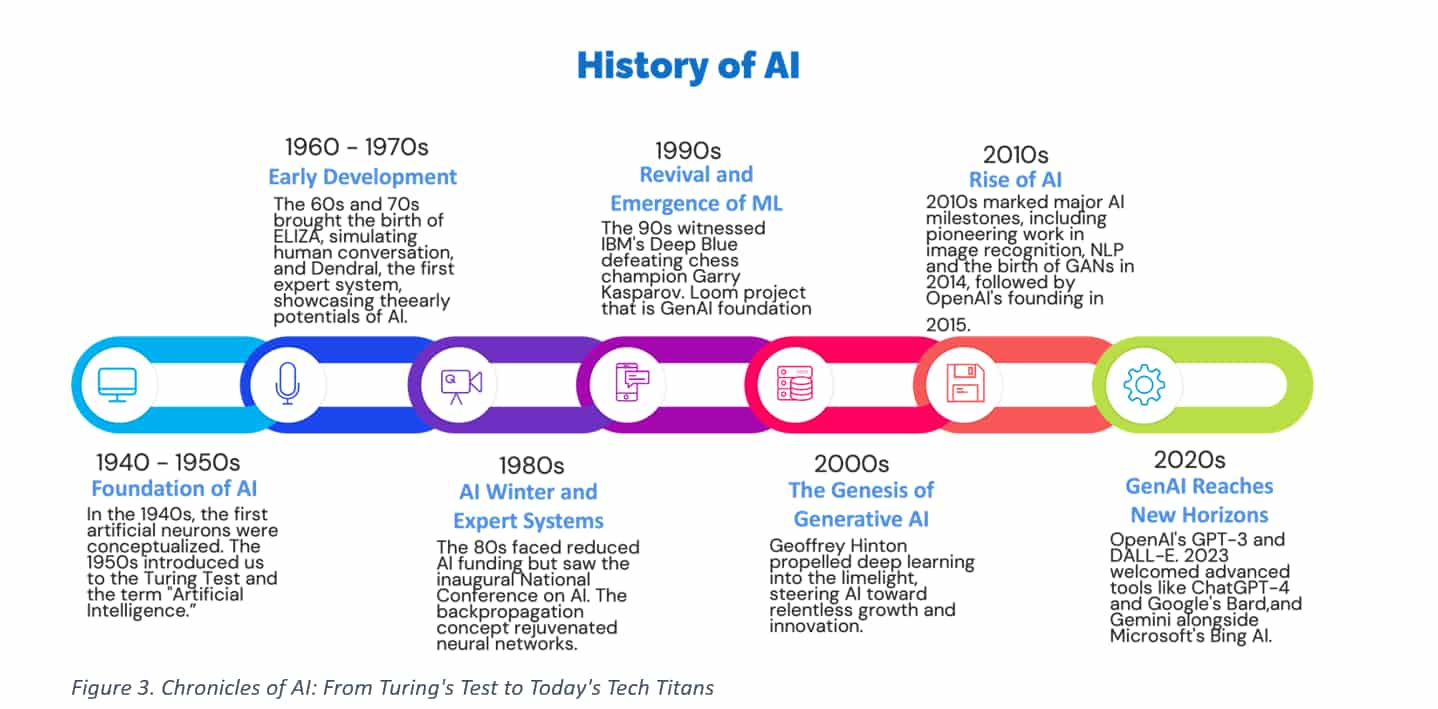
The roots of AI in manufacturing can be traced back to the post-World War II era, when the first industrial robots were introduced. In 1954, George Devol patented the Unimate, the first programmable robotic arm, which was later deployed by General Motors in 1961 for die-casting and welding tasks. This marked the beginning of automation in manufacturing, though early systems lacked the sophistication of modern AI. During the 1960s and 1970s, AI research focused on expert systems—rule-based programs designed to mimic human decision-making. While these systems were limited in scope, they laid the groundwork for later AI applications in manufacturing. The 1970s also saw the rise of computer-aided design (CAD) and computer-aided manufacturing (CAM), which automated drafting and machining processes.
#The AI Winter and Revival (1980s–1990s)
The 1980s brought renewed interest in AI, driven by Japan’s Fifth Generation Computer Systems initiative and advancements in neural networks. However, the AI winter of the late 1980s and early 1990s slowed progress due to overhyped expectations and technical limitations. Despite this, manufacturing continued to benefit from programmable logic controllers (PLCs) and numerical control (NC) machines, which improved precision and repeatability. The 1990s saw the emergence of machine learning techniques, particularly support vector machines (SVMs) and genetic algorithms, which were applied to process optimization and fault detection. Companies like Siemens and Rockwell Automation began integrating AI-driven predictive maintenance systems to monitor equipment health.
#The Digital Revolution (2000s–2010s)
The 2000s ushered in the Industry 4.0 era, characterized by the fusion of cyber-physical systems (CPS), IoT (Internet of Things), and AI. Key milestones included:
- 2006: The introduction of deep learning by Geoffrey Hinton and colleagues, which later enabled breakthroughs in computer vision and natural language processing (NLP).
- 2010s: The rise of collaborative robots (cobots), such as Universal Robots’ UR5, which could work alongside humans safely.
- 2014: Amazon’s acquisition of Kiva Systems, which revolutionized warehouse automation using AI-powered robots. During this period, predictive maintenance became a critical application, with companies like GE Aviation and Siemens deploying AI models to forecast equipment failures before they occurred.
#The AI-Driven Era (2020s–Present)
The 2020s have seen AI become ubiquitous in manufacturing, driven by:
- Generative AI: Tools like DALL·E and Stable Diffusion are being used for product design optimization.
- Digital Twins: Virtual replicas of physical assets (e.g., Siemens MindSphere) enable real-time simulation and testing.
- Autonomous Factories: Companies like Tesla and Foxconn are developing lights-out manufacturing—fully automated factories with minimal human intervention.
- Edge AI: On-device AI processing reduces latency, enabling real-time quality control and adaptive manufacturing. Governments and industry consortia, such as Germany’s Plattform Industrie 4.0 and China’s Made in China 2025, have prioritized AI adoption to maintain global competitiveness.
#How It Works
#Core AI Technologies in Manufacturing
- Machine Learning (ML)
- Supervised Learning: Used for defect detection (e.g., training models on labeled images of faulty products).
- Unsupervised Learning: Identifies anomalies in production data without prior labeling.
- Reinforcement Learning (RL): Optimizes supply chain logistics and robot path planning by learning from rewards/penalties.
- Computer Vision
- Convolutional Neural Networks (CNNs) analyze visual data from cameras to inspect products for defects (e.g., crack detection in metal parts).
- 3D vision systems enable bin picking—robots identifying and grasping randomly placed objects.
- Natural Language Processing (NLP)
- Chatbots assist workers with troubleshooting (e.g., Siemens MindSphere Assistant).
- Voice commands control machinery in hands-free environments.
- Predictive Analytics
- Time-series forecasting (e.g., LSTM networks) predicts equipment failures by analyzing sensor data (vibration, temperature, pressure).
- Digital twins simulate production lines to test scenarios before implementation.
- Robotics and Automation
- Industrial Robots: Articulated arms (e.g., ABB IRB 6700) perform welding, assembly, and packaging.
- Cobots: Universal Robots UR10 work alongside humans for precision tasks.
- Autonomous Mobile Robots (AMRs): Amazon Kiva robots navigate warehouses to transport goods.
- Generative AI
- Generative Adversarial Networks (GANs) create new product designs by learning from existing ones.
- Large Language Models (LLMs) assist in technical documentation and process optimization.
#Integration with Manufacturing Systems AI systems in manufacturing are typically integrated with:
- Manufacturing Execution Systems (MES): Track production in real time.
- Enterprise Resource Planning (ERP): Manage supply chains and inventory.
- Supervisory Control and Data Acquisition (SCADA): Monitor industrial processes.
- IoT Sensors: Collect data from machines, tools, and environments.
#Workflow Example: AI-Powered Quality Control
- Data Collection: Cameras and sensors capture images of products.
- Preprocessing: Noise reduction and normalization.
- Model Training: A CNN is trained on labeled defect/non-defect images.
- Inference: The model classifies new products in real time.
- Action: Defective items are flagged for rejection or rework.
#Important Facts
- Cost Savings: AI-driven predictive maintenance can reduce unplanned downtime by up to 50% (McKinsey).
- Energy Efficiency: AI optimizes energy consumption in factories, cutting costs by 10–20% (BCG).
- Labor Shortages: By 2030, the manufacturing sector may face a global labor gap of 7.9 million workers (Deloitte), making AI-driven automation critical.
- Safety Improvements: AI-powered collaborative robots reduce workplace injuries by 40% (IFR).
- Customization: AI enables mass personalization, allowing manufacturers to produce lot sizes of one efficiently.
- Regulatory Compliance: AI helps manufacturers adhere to strict quality standards (e.g., ISO 9001, FDA regulations).
- Supply Chain Resilience: AI models predict disruptions (e.g., COVID-19, semiconductor shortages) and suggest alternative sourcing strategies.
#Timeline
- Foundational ideas
Core concepts and early methods shape Timeline of AI in Manufacturing.
- Practical use
Tools, examples, and real-world deployments make the topic easier to evaluate.
- Responsible implementation
Current work focuses on reliability, governance, performance, and measurable impact.
#Related Terms
#FAQ
What does Timeline of AI in Manufacturing cover?
Traces timeline of ai in manufacturing, highlighting major milestones, context, examples, and future implications.
Why is Timeline of AI in Manufacturing important?
It helps readers understand key concepts, compare practical use cases, and evaluate how AI Trends decisions affect outcomes, risks, and implementation choices.
What should readers verify before applying this topic?
Readers should compare benefits, limitations, data requirements, and related themes such as Timeline, AI, Manufacturing before using the ideas in real projects.
#References
- Timeline of AI in Manufacturing terminology and background research
- Timeline of AI in Manufacturing use cases, implementation examples, and limitations
- AI Trends best practices, standards, and risk guidance
- Timeline case studies, benchmarks, and current industry analysis


Comments
No comments yet. Start the discussion with a useful note.