

#Short Answer
Explains how ai is changing the world, including the main process, tools, examples, risks, and practical implementation steps.
#Infobox
#Overview
Artificial Intelligence refers to the simulation of human intelligence in machines programmed to think and learn. Unlike traditional software, AI systems improve over time through exposure to data, enabling them to perform tasks such as natural language processing, image recognition, and predictive analytics with increasing accuracy. The field encompasses subdomains like machine learning (ML), deep learning, natural language processing (NLP), and robotics, each contributing to AI's broad applicability. AI's impact spans multiple sectors:
- Healthcare: Accelerates drug discovery, personalizes treatment plans, and improves diagnostic accuracy.
- Finance: Enhances fraud detection, automates trading, and optimizes risk assessment.
- Transportation: Powers autonomous vehicles and optimizes logistics.
- Education: Enables personalized learning and automates administrative tasks.
- Entertainment: Drives recommendation algorithms (e.g., Netflix, Spotify) and generates synthetic media (e.g., deepfakes). The global AI market is projected to reach $1.8 trillion by 2030, driven by advancements in computing power, big data, and algorithmic innovations.
#History / Background
#Early Foundations (1950s–1970s)
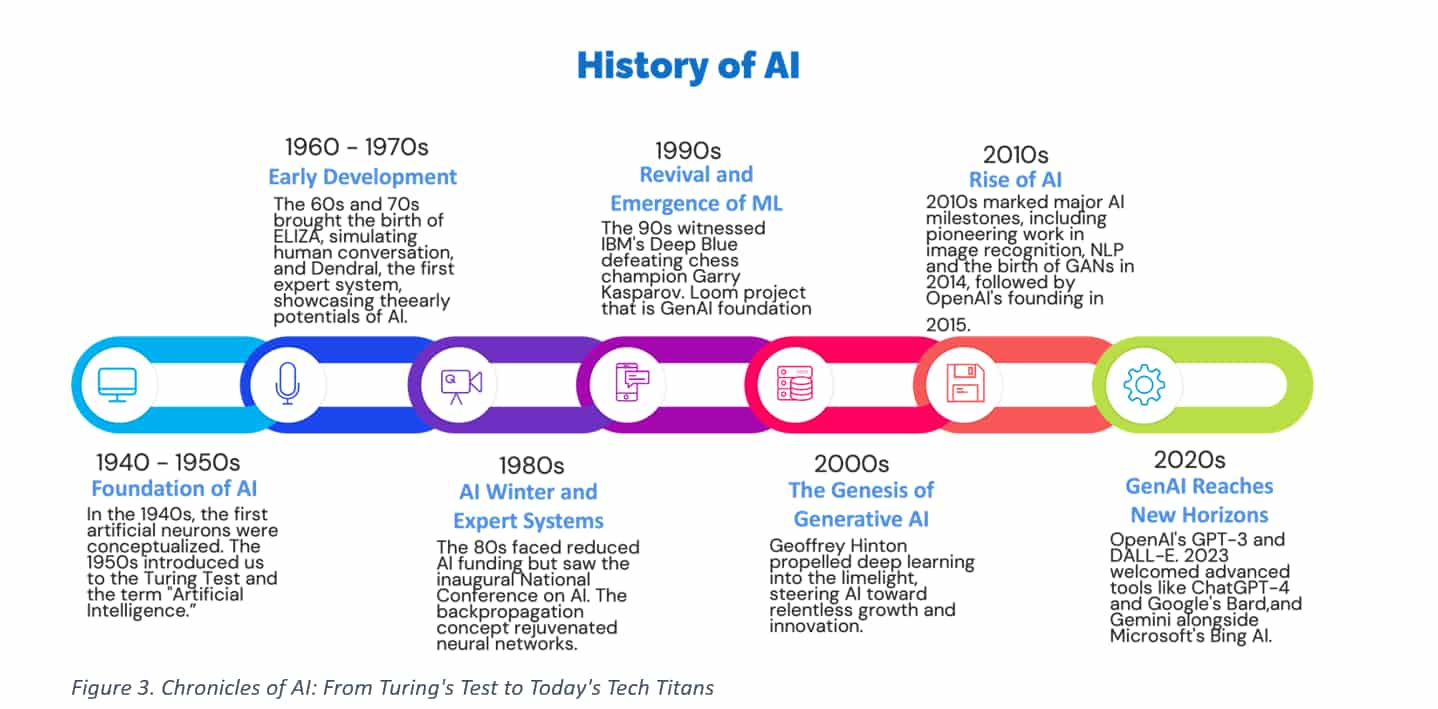
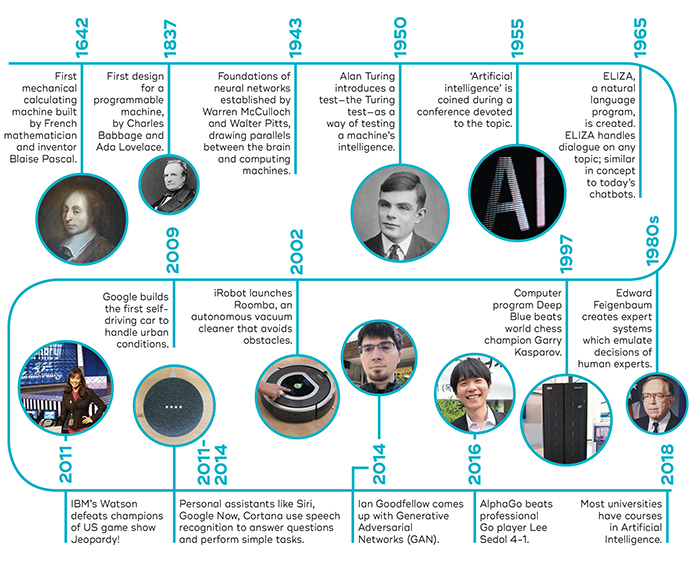
- 1950: Alan Turing proposes the Turing Test, a criterion for machine intelligence.
- 1956: The term "Artificial Intelligence" is coined at the Dartmouth Conference, marking AI's formal inception.
- 1959: Arthur Samuel develops the first self-learning program (checkers-playing AI).
- 1966: ELIZA, an early NLP program, simulates conversation, laying groundwork for chatbots.
- 1970s: AI research stalls due to limited computing power and unrealistic expectations (the "AI Winter").
#Revival and Expert Systems (1980s–1990s)
- 1980s: Expert systems (rule-based AI) gain traction in industries like medicine and finance.
- 1997: IBM's Deep Blue defeats world chess champion Garry Kasparov, demonstrating AI's potential in strategic games.
- 1997: Dragon NaturallySpeaking launches, pioneering speech recognition technology.
#The Big Data and Deep Learning Era (2000s–Present)
- 2011: IBM Watson wins Jeopardy!, showcasing AI's ability to process unstructured data.
- 2012: AlexNet, a deep learning model, achieves breakthroughs in image recognition, sparking the deep learning revolution.
- 2016: AlphaGo defeats a world champion Go player, highlighting AI's mastery of complex decision-making.
- 2018: Generative Adversarial Networks (GANs) enable realistic synthetic media creation.
- 2020s: AI integrates into smart cities, climate modeling, and personalized medicine, with advancements in transformer models (e.g., BERT, GPT-3).
#How It Works
#Core Principles AI systems rely on algorithms and data to perform tasks. The two primary approaches are:
- Rule-Based AI: Uses predefined rules (e.g., early chatbots like ELIZA).
- Machine Learning (ML): Systems learn patterns from data without explicit programming.
#Key Techniques
- Supervised Learning: Trains models on labeled data (e.g., spam detection).
- Unsupervised Learning: Identifies patterns in unlabeled data (e.g., customer segmentation).
- Reinforcement Learning: Learns through trial and error (e.g., robotics, game AI).
- Deep Learning: Uses neural networks with multiple layers to model complex data (e.g., image recognition, NLP).
#Neural Networks A neural network mimics the human brain's structure, with layers of interconnected nodes (neurons). Key components:
- Input Layer: Receives raw data (e.g., pixels in an image).
- Hidden Layers: Process data through weighted connections.
- Output Layer: Produces predictions (e.g., "cat" or "dog"). Backpropagation adjusts weights based on errors, improving accuracy over time.
#Natural Language Processing (NLP)
NLP enables machines to understand and generate human language. Techniques include:
- Tokenization: Breaking text into words/phrases.
- Sentiment Analysis: Classifying text as positive/negative.
- Transformers: Models like BERT and GPT-3 use attention mechanisms to contextualize language.
#Computer Vision AI interprets visual data via:
- Convolutional Neural Networks (CNNs): Detect features in images (e.g., facial recognition).
- Object Detection: Identifies and locates objects in photos/videos.
#Important Facts
#AI's Economic Impact
- Productivity: AI could contribute $15.7 trillion to the global economy by 2030 (PwC).
- Job Displacement: Up to 30% of tasks in 60% of occupations could be automated (McKinsey).
- Investment: Global AI funding reached $93.5 billion in 2021 (CB Insights).
#Ethical and Societal Concerns
- Bias: AI systems can perpetuate discrimination (e.g., biased hiring algorithms).
- Privacy: Facial recognition and data collection raise surveillance concerns.
- Job Loss: Automation threatens roles in manufacturing, customer service, and data entry.
- Deepfakes: AI-generated fake media can spread misinformation.
#Environmental Impact
- Energy Consumption: Training large AI models (e.g., GPT-3) consumes significant electricity, comparable to a small town.
- Green AI: Efforts to reduce AI's carbon footprint include efficient algorithms and renewable energy-powered data centers.
#Limitations
- Hallucinations: AI models (e.g., LLMs) may generate false or nonsensical outputs.
- Explainability: "Black box" models (e.g., deep learning) lack transparency.
- Data Dependency: AI performance hinges on quality and quantity of training data.
#Timeline
- Foundational ideas
Core concepts and early methods shape How AI Is Changing the World.
- Practical use
Tools, examples, and real-world deployments make the topic easier to evaluate.
- Responsible implementation
Current work focuses on reliability, governance, performance, and measurable impact.
#Related Terms
#FAQ
What does How AI Is Changing the World cover?
Explains how ai is changing the world, including the main process, tools, examples, risks, and practical implementation steps.
Why is How AI Is Changing the World important?
It helps readers understand key concepts, compare practical use cases, and evaluate how AI Trends decisions affect outcomes, risks, and implementation choices.
What should readers verify before applying this topic?
Readers should compare benefits, limitations, data requirements, and related themes such as AI, Changing, World before using the ideas in real projects.
#References
- How AI Is Changing the World terminology and background research
- How AI Is Changing the World use cases, implementation examples, and limitations
- AI Trends best practices, standards, and risk guidance
- AI case studies, benchmarks, and current industry analysis

Comments
No comments yet. Start the discussion with a useful note.