

#Short Answer
Traces timeline of ai, highlighting major milestones, context, examples, and future implications.
#Infobox
#Overview
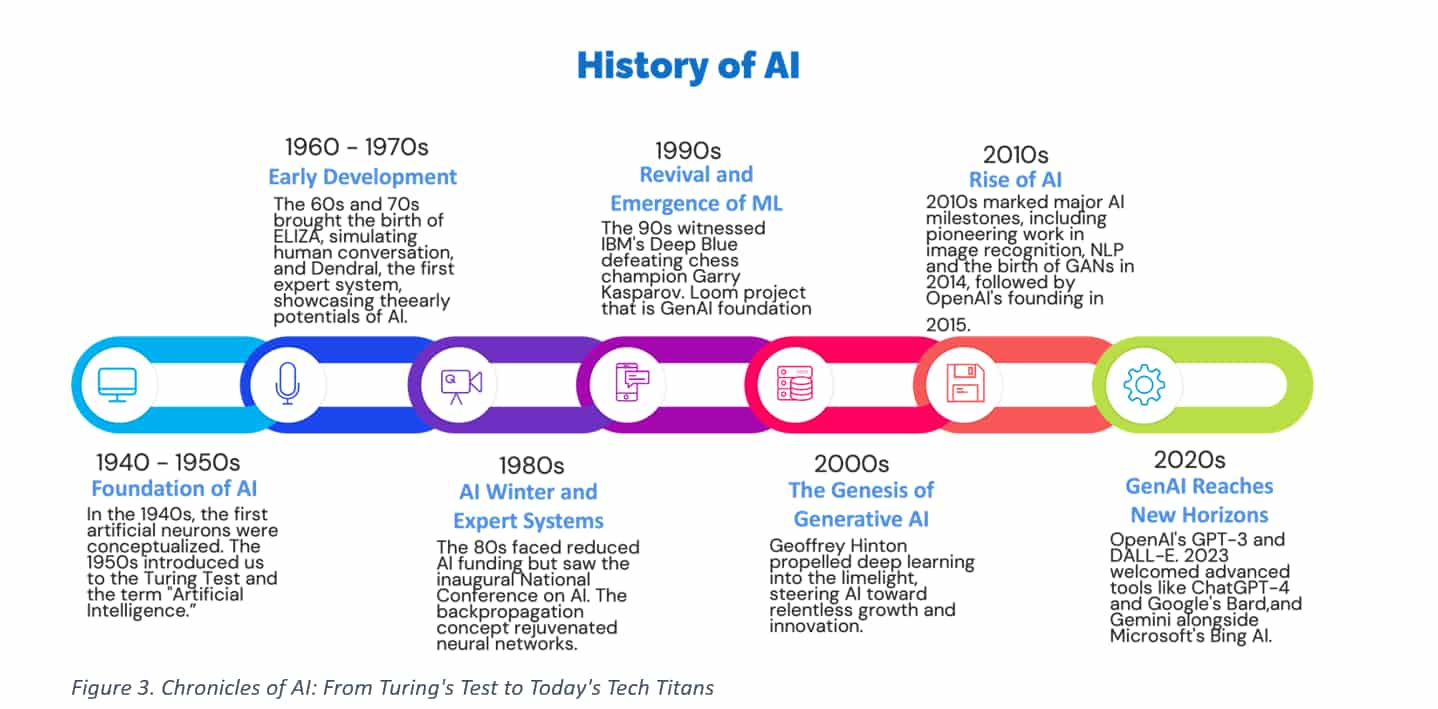
Artificial Intelligence (AI) refers to the simulation of human intelligence in machines, enabling them to perform tasks such as reasoning, learning, problem-solving, and decision-making. The Timeline of AI documents the progression of AI from theoretical foundations to practical applications, reflecting advancements in algorithms, computational power, and data availability. This timeline is divided into distinct eras, each marked by breakthroughs that have shaped the field.
#History / Background
#Early Foundations (Pre-1950s)
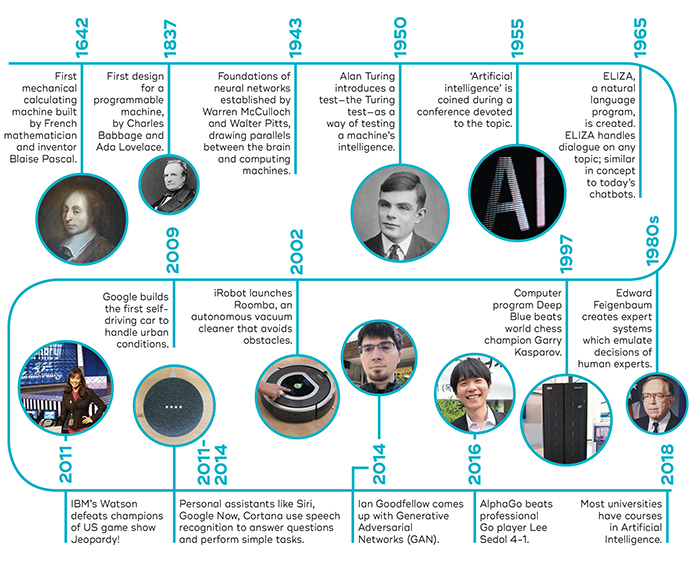
The concept of AI predates modern computing. Philosophers and mathematicians like Aristotle (with syllogistic logic) and René Descartes (with mechanistic views of animals) laid early groundwork. In the 19th century, George Boole introduced Boolean algebra, which became fundamental to digital logic. Alan Turing (1936) formalized the idea of computation with the Turing Machine, while his Turing Test (1950) proposed a criterion for machine intelligence.
#The Birth of AI (1950–1970)
The term "Artificial Intelligence" was coined in 1956 at the Dartmouth Conference, where pioneers like John McCarthy, Marvin Minsky, and Claude Shannon gathered to explore the potential of machines to simulate human intelligence. Key developments included:
- Logic Theorist (1956): Developed by Allen Newell and Herbert Simon, it proved mathematical theorems using symbolic logic.
- General Problem Solver (1957): An early AI program designed to mimic human problem-solving.
- ELIZA (1966): An early natural language processing program that simulated conversation, created by Joseph Weizenbaum.
#The AI Winter (1970–1980)
Funding and interest in AI declined due to unrealized promises and technical limitations. The Lighthill Report (1973) criticized AI research, leading to reduced government and private sector support. However, research continued in specialized areas like expert systems.
#The Expert Systems Era (1980–1990)
AI research revived with the development of expert systems, which mimicked human expertise in specific domains. Notable examples include:
- MYCIN (1970s): A medical expert system for diagnosing bacterial infections.
- XCON (1980): A rule-based system used by Digital Equipment Corporation to configure computer systems. This period also saw the rise of Japan’s Fifth Generation Computer Systems (FGCS) project (1982), which aimed to create AI-powered supercomputers, though it ultimately fell short of expectations.
#The Revival and Machine Learning (1990–2010)
Advancements in machine learning (ML) and statistical methods revitalized AI. Key milestones included:
- Backpropagation Algorithm (1986): Enabled neural networks to learn from data, popularized by Geoffrey Hinton.
- IBM’s Deep Blue (1997): Defeated world chess champion Garry Kasparov, showcasing AI’s potential in complex decision-making.
- Support Vector Machines (SVMs) (1990s): Improved classification tasks in ML.
- Big Data and the Internet (2000s): The explosion of digital data and computing power facilitated AI applications in search engines, recommendation systems, and speech recognition.
#The Deep Learning Revolution (2010–Present)
The 2010s marked a paradigm shift with the rise of deep learning, a subset of ML that uses neural networks with multiple layers. Key breakthroughs include:
- AlexNet (2012): A deep convolutional neural network that won the ImageNet competition, demonstrating the power of GPUs in training deep models.
- AlphaGo (2016): Developed by DeepMind, it defeated the world champion Go player, Lee Sedol, using reinforcement learning.
- Generative Pre-trained Transformer (GPT) Models (2018–Present): Large language models like GPT-3 and GPT-4 have revolutionized natural language processing, enabling applications like chatbots, translation, and content generation.
- Computer Vision and Robotics: Advances in convolutional neural networks (CNNs) have enabled breakthroughs in image recognition, autonomous vehicles, and medical imaging.
#How It Works
AI systems operate through a combination of algorithms, data, and computational power. The core methodologies include:
#Machine Learning (ML)
ML enables systems to learn from data without explicit programming. Key techniques include:
- Supervised Learning: Models are trained on labeled data (e.g., classification, regression).
- Unsupervised Learning: Models identify patterns in unlabeled data (e.g., clustering, dimensionality reduction).
- Reinforcement Learning (RL): Agents learn by interacting with an environment to maximize rewards (e.g., AlphaGo, robotics).
#Neural Networks and Deep Learning Inspired by the human brain, neural networks consist of interconnected nodes (neurons) that process data in layers. Deep learning uses multi-layered networks to model complex patterns:
- Convolutional Neural Networks (CNNs): Optimized for image and video processing.
- Recurrent Neural Networks (RNNs): Suitable for sequential data like time series or text.
- Transformer Models: Use attention mechanisms to process sequential data efficiently (e.g., GPT, BERT).
#Natural Language Processing (NLP)
NLP enables machines to understand, interpret, and generate human language. Techniques include:
- Tokenization: Breaking text into words or subwords.
- Word Embeddings: Representing words as vectors (e.g., Word2Vec, GloVe).
- Attention Mechanisms: Allowing models to focus on relevant parts of input data (e.g., Transformers).
#Robotics and Autonomous Systems AI integrates with robotics to enable autonomous navigation, object recognition, and decision-making in physical environments. Applications include:
- Self-driving cars (e.g., Tesla, Waymo).
- Industrial robots for manufacturing and logistics.
- Medical robots for surgery and diagnostics.
#Important Facts
- AI’s Dual-Use Nature: AI technologies have applications in both beneficial and harmful contexts, such as deepfakes, autonomous weapons, and surveillance systems.
- Bias in AI: Machine learning models can perpetuate biases present in training data, leading to discriminatory outcomes in hiring, lending, and law enforcement.
- Explainability: Many AI models, especially deep learning, operate as "black boxes," making it difficult to interpret their decisions.
- Energy Consumption: Training large AI models (e.g., GPT-3) requires significant computational resources, contributing to environmental concerns.
- Regulation: Governments worldwide are developing AI policies to address ethical, safety, and privacy concerns (e.g., EU’s AI Act, U.S. AI Executive Order).
#Timeline
- Foundational ideas
Core concepts and early methods shape Timeline of AI.
- Practical use
Tools, examples, and real-world deployments make the topic easier to evaluate.
- Responsible implementation
Current work focuses on reliability, governance, performance, and measurable impact.
#Related Terms
#FAQ
What does Timeline of AI cover?
Traces timeline of ai, highlighting major milestones, context, examples, and future implications.
Why is Timeline of AI important?
It helps readers understand key concepts, compare practical use cases, and evaluate how AI Trends decisions affect outcomes, risks, and implementation choices.
What should readers verify before applying this topic?
Readers should compare benefits, limitations, data requirements, and related themes such as Timeline, AI, Machine Learning before using the ideas in real projects.
#References
- Timeline of AI terminology and background research
- Timeline of AI use cases, implementation examples, and limitations
- AI Trends best practices, standards, and risk guidance
- Timeline case studies, benchmarks, and current industry analysis


Comments
No comments yet. Start the discussion with a useful note.