

#Short Answer
Covers the science behind ai ethics, including core concepts, practical examples, benefits, limitations, and risks in AI Ethics.
#Infobox
#Overview
Artificial Intelligence (AI) has become a transformative force across industries, from healthcare and finance to transportation and entertainment. However, its rapid advancement has raised significant ethical concerns, prompting the emergence of AI Ethics as a critical discipline. AI Ethics seeks to address the moral, social, and legal implications of AI systems, ensuring they are developed and deployed in ways that prioritize human welfare, fairness, and accountability. The field encompasses a broad range of topics, including algorithmic bias, data privacy, autonomous decision-making, and the potential for AI to exacerbate social inequalities. Ethical AI frameworks aim to balance innovation with responsibility, fostering trust between developers, users, and society at large. As AI systems grow more sophisticated, the need for robust ethical guidelines becomes increasingly urgent to prevent misuse and unintended consequences.
#History / Background
#Early Foundations (1940s–1990s)
The conceptual roots of AI Ethics can be traced back to early discussions on the ethical implications of artificial intelligence. In 1942, science fiction writer Isaac Asimov introduced the Three Laws of Robotics in his short story Runaround, which laid the groundwork for ethical guidelines in AI. These laws emphasized the importance of preventing harm to humans, obeying orders, and protecting one's own existence—principles that continue to influence modern AI ethics debates. During the 1960s and 1970s, philosophers and computer scientists began exploring the ethical dimensions of AI. Joseph Weizenbaum, a pioneer in AI research, criticized the uncritical acceptance of AI systems in his 1976 book Computer Power and Human Reason, arguing that AI should not replace human judgment in critical areas like healthcare and law.
#Formalization and Growth (2000s–2010s)
The 2000s saw a surge in academic and policy discussions on AI ethics. In 2009, the European Robotics Research Network (EURON) published a report on ethical guidelines for robotics, emphasizing the need for transparency and accountability. The IEEE Global Initiative on Ethics of Autonomous Systems, launched in 2016, became a leading force in developing ethical standards for AI and robotics. Major tech companies and governments also began addressing AI ethics. In 2018, Google published its AI Principles, outlining ethical guidelines for AI development, including fairness, accountability, and transparency. The same year, the European Union released its AI Ethics Guidelines, which later influenced the EU AI Act—a landmark regulation aimed at governing AI systems based on risk levels.
#Contemporary Developments (2020s–Present)
The 2020s have marked a period of heightened focus on AI ethics, driven by high-profile controversies and regulatory advancements. The AI Now Institute and Partnership on AI have published influential reports highlighting issues such as algorithmic bias, surveillance, and the ethical use of AI in law enforcement. Governments worldwide are increasingly prioritizing AI ethics in policy-making. The United States introduced the AI Bill of Rights in 2022, outlining principles for fair, transparent, and accountable AI systems. Meanwhile, the United Nations and OECD have developed global frameworks to promote ethical AI development.
#How It Works
AI Ethics operates through a combination of principles, frameworks, and practices designed to guide the development and deployment of AI systems. Below are the key components of how AI ethics functions:
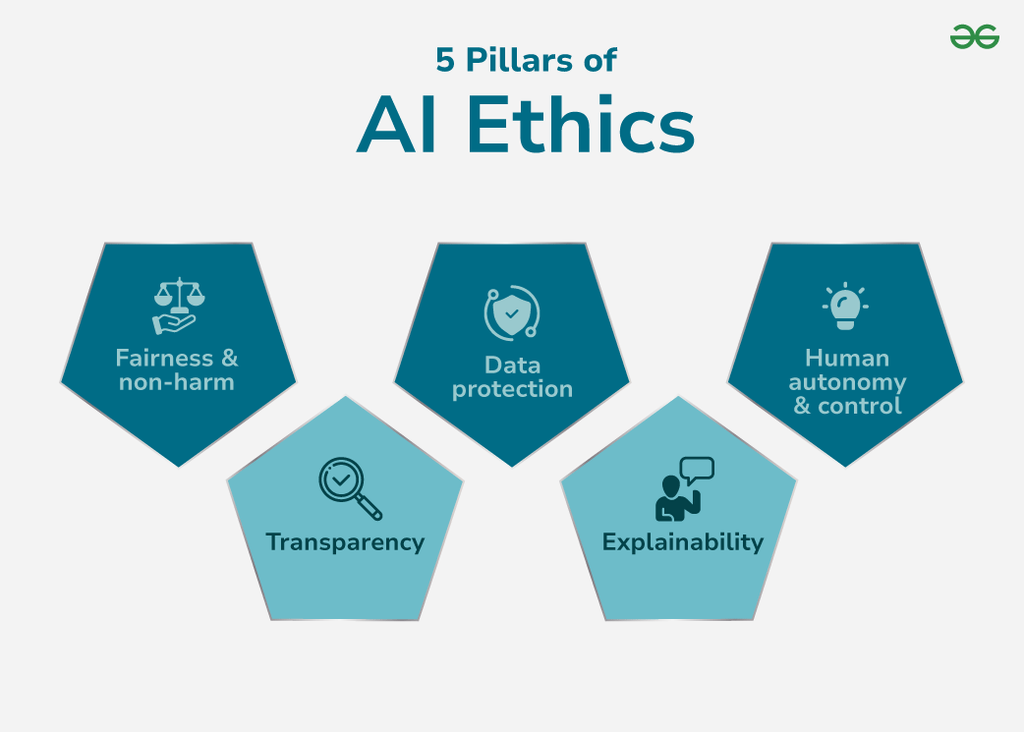
#Core Principles AI ethics is built on several foundational principles, often derived from moral philosophy and human rights frameworks:
- Beneficence: AI systems should act in the best interest of humans and society, promoting well-being and positive outcomes.
- Non-maleficence: AI should avoid causing harm, whether intentional or unintentional.
- Autonomy: Individuals should have control over AI systems that affect their lives, with the right to opt out or contest decisions.
- Justice: AI should be fair and equitable, avoiding discrimination and ensuring equal access to benefits.
- Explicability: AI systems should be transparent and understandable, allowing users to comprehend how decisions are made.
#Ethical Frameworks and Guidelines Several frameworks provide structured approaches to implementing AI ethics:
- IEEE Global Initiative on Ethics of Autonomous Systems: Develops standards for ethical AI, including guidelines for transparency, accountability, and bias mitigation.
- EU AI Act: Classifies AI systems into risk categories (unacceptable, high, limited, minimal) and imposes obligations on developers and users based on risk level.
- OECD AI Principles: A set of five principles adopted by 42 countries, emphasizing inclusive growth, human-centered values, transparency, robustness, and accountability.
- Asimov’s Laws of Robotics: A fictional but influential framework that has inspired real-world ethical guidelines for autonomous systems.
#Practical Implementation AI ethics is applied through various mechanisms:
- Bias Mitigation: Techniques such as fairness-aware machine learning and diverse training datasets are used to reduce bias in AI models.
- Explainable AI (XAI): Methods like LIME (Local Interpretable Model-agnostic Explanations) and SHAP (SHapley Additive exPlanations) help make AI decisions more interpretable.
- Privacy-Preserving AI: Techniques such as federated learning and differential privacy protect user data while enabling AI training.
- Ethics Review Boards: Many organizations establish internal ethics committees to oversee AI projects and ensure compliance with ethical standards.
- Regulatory Compliance: Adherence to laws and regulations, such as the EU General Data Protection Regulation (GDPR) and California Consumer Privacy Act (CCPA), is essential for ethical AI deployment.
#Challenges in Implementation Despite these efforts, several challenges hinder the effective implementation of AI ethics:
- Lack of Standardization: Ethical guidelines vary across regions and industries, leading to inconsistencies in enforcement.
- Trade-offs Between Ethics and Performance: Optimizing for fairness or transparency may reduce a model’s accuracy or efficiency.
- Black Box Problem: Many advanced AI models (e.g., deep neural networks) operate as "black boxes," making it difficult to explain their decisions.
- Global Disparities: Ethical standards in one country may conflict with those in another, complicating cross-border AI deployment.
#Important Facts
- Algorithmic Bias: AI systems can perpetuate or amplify biases present in training data. For example, facial recognition systems have been shown to have higher error rates for people with darker skin tones.
- Autonomous Weapons: The development of lethal autonomous weapons systems (LAWS) raises ethical concerns about accountability and the potential for unintended escalation in conflicts.
- AI in Healthcare: Ethical dilemmas arise when AI systems make life-or-death decisions, such as in diagnostic tools or treatment recommendations.
- Deepfakes and Misinformation: AI-generated deepfakes can be used to spread disinformation, posing threats to democracy and public trust.
- Job Displacement: AI-driven automation may lead to significant job losses, requiring ethical considerations around workforce transitions and social safety nets.
- AI in Criminal Justice: Predictive policing tools have been criticized for reinforcing racial biases in law enforcement.
- Environmental Impact: Training large AI models consumes significant energy, contributing to carbon emissions and raising sustainability concerns.
#Timeline
- Foundational ideas
Core concepts and early methods shape The Science Behind AI Ethics.
- Practical use
Tools, examples, and real-world deployments make the topic easier to evaluate.
- Responsible implementation
Current work focuses on reliability, governance, performance, and measurable impact.
#Related Terms
#FAQ
What does The Science Behind AI Ethics cover?
Covers the science behind ai ethics, including core concepts, practical examples, benefits, limitations, and risks in AI Ethics.
Why is The Science Behind AI Ethics important?
It helps readers understand key concepts, compare practical use cases, and evaluate how AI Ethics decisions affect outcomes, risks, and implementation choices.
What should readers verify before applying this topic?
Readers should compare benefits, limitations, data requirements, and related themes such as Science, Behind, AI before using the ideas in real projects.
#References
- The Science Behind AI Ethics terminology and background research
- The Science Behind AI Ethics use cases, implementation examples, and limitations
- AI Ethics best practices, standards, and risk guidance
- Science case studies, benchmarks, and current industry analysis


Comments
No comments yet. Start the discussion with a useful note.