

#Short Answer
Explores the future of ai ethics, including emerging trends, practical impacts, risks, and important signals to watch.
#Infobox
#Overview
Artificial Intelligence (AI) has transformed industries, economies, and daily life, but its rapid advancement has also raised profound ethical questions. The future of AI ethics is a multidisciplinary field that examines how AI systems can be designed, deployed, and regulated to prioritize human well-being, fairness, and accountability. Unlike traditional ethics, AI ethics must address unique challenges posed by autonomous systems, such as opacity in decision-making, unintended consequences, and the potential for misuse. The ethical landscape of AI is shaped by both technological progress and societal values. As AI systems become more integrated into critical sectors—healthcare, finance, law enforcement, and education—the stakes for ethical governance grow higher. The future of AI ethics will likely be defined by efforts to balance innovation with safeguards, ensuring that AI serves as a tool for societal benefit rather than a source of harm.
#History / Background
#Early Foundations (1950s–2000s)
The ethical implications of AI were first discussed in the mid-20th century, alongside the field’s inception. Early pioneers like Alan Turing and Norbert Wiener pondered the societal impact of intelligent machines. In 1950, Turing’s seminal paper "Computing Machinery and Intelligence" posed the question: "Can machines think?"—a precursor to debates about machine autonomy and ethics. By the 1960s and 1970s, concerns about AI’s potential to replace human labor and disrupt social structures emerged. Joseph Weizenbaum’s 1976 critique of AI in "Computer Power and Human Reason" highlighted the dangers of uncritical reliance on machines. Meanwhile, Isaac Asimov’s Three Laws of Robotics (1942) introduced fictional ethical guidelines for AI, influencing later discussions.
#The Rise of Ethical AI (2010s–Present)
The 2010s marked a turning point, as AI’s real-world applications—from facial recognition to predictive policing—began to expose ethical flaws. High-profile incidents, such as racial bias in facial recognition algorithms (e.g., Microsoft’s Tay chatbot in 2016) and gender bias in hiring tools (Amazon’s abandoned AI recruiter in 2018), underscored the need for ethical oversight. Key milestones in AI ethics history include:
- 2017: The Asilomar AI Principles, a set of 23 guidelines for ethical AI development, were published by the Future of Life Institute.
- 2018: The EU’s General Data Protection Regulation (GDPR) introduced "right to explanation" provisions, requiring transparency in automated decision-making.
- 2020: The IEEE Global Initiative on Ethics of Autonomous and Intelligent Systems released the Ethically Aligned Design framework.
- 2021: The EU AI Act proposed a risk-based regulatory approach, classifying AI systems by their potential harm (e.g., unacceptable, high-risk, low-risk).
#Contemporary Shifts Today, AI ethics is no longer a niche concern but a global priority. Governments, corporations, and civil society are increasingly collaborating to establish norms. The UNESCO Recommendation on the Ethics of AI (2021) and the White House Blueprint for an AI Bill of Rights (2022) reflect this growing consensus. Meanwhile, grassroots movements, such as Black in AI and Women in Machine Learning, advocate for diversity and inclusion in AI development to mitigate bias.
#How It Works
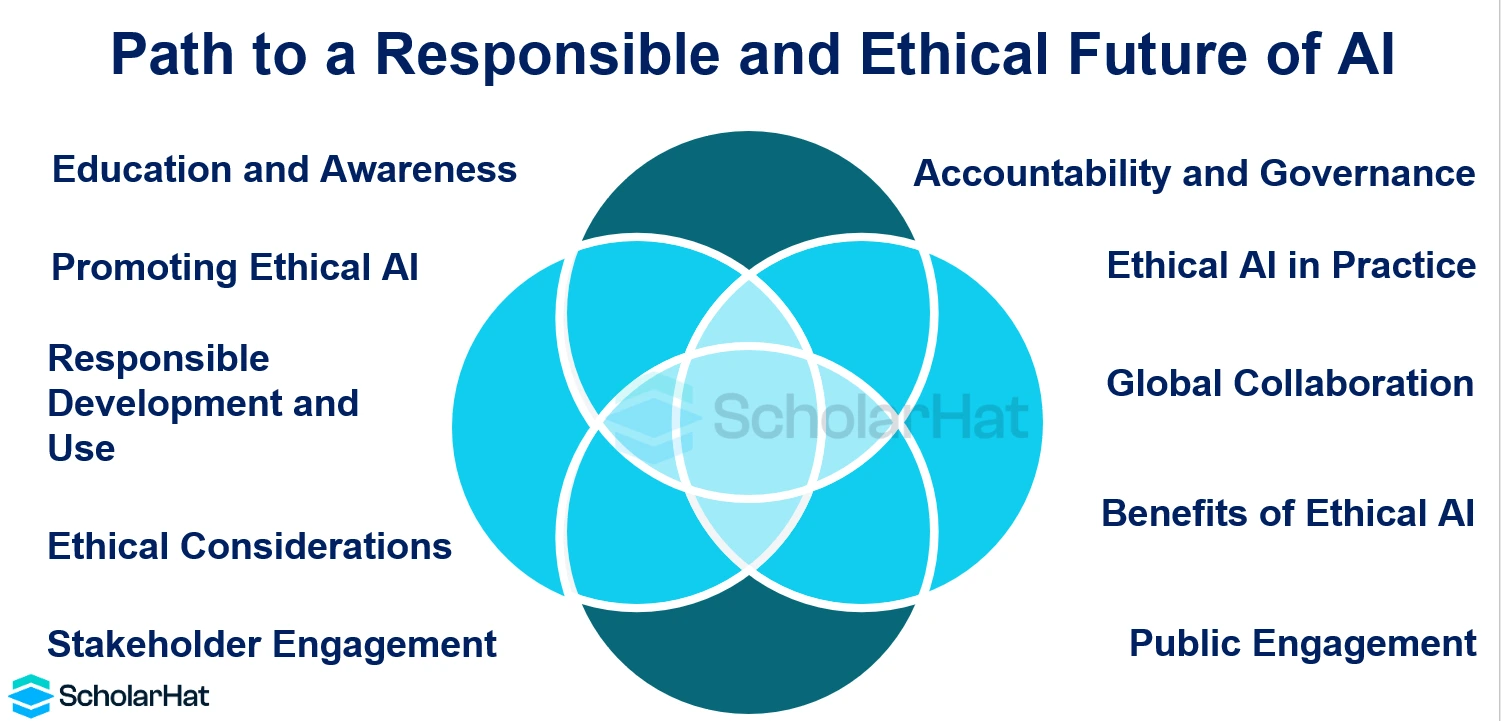
AI ethics operates through a combination of principles, frameworks, tools, and governance mechanisms designed to ensure responsible AI development. The process can be broken down into several key components:
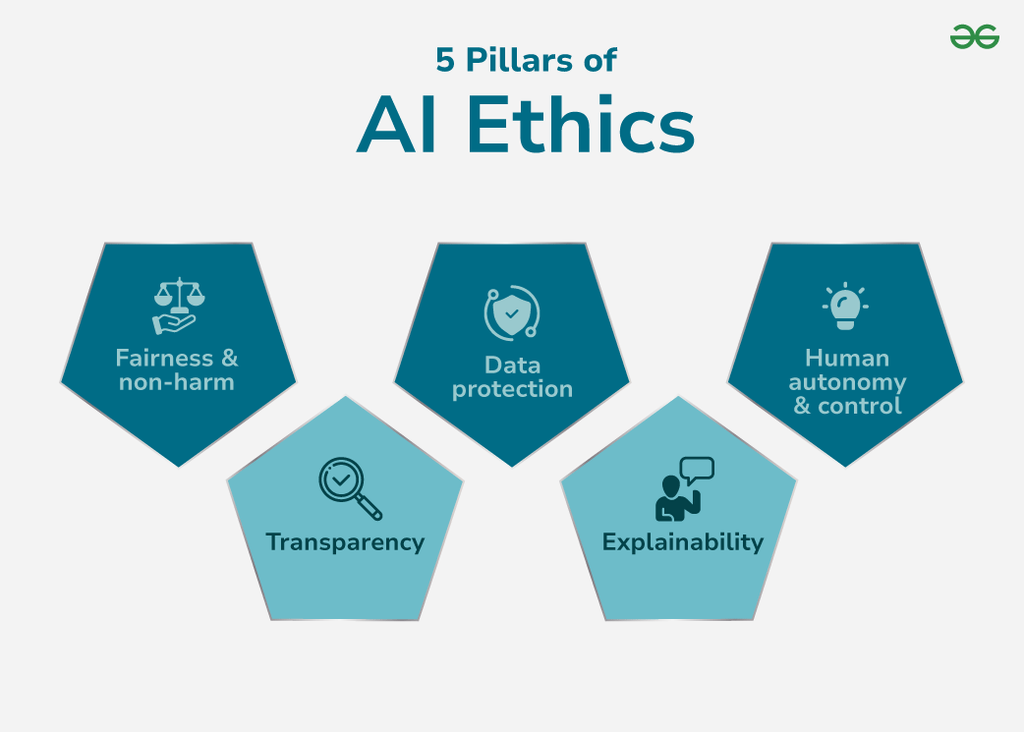
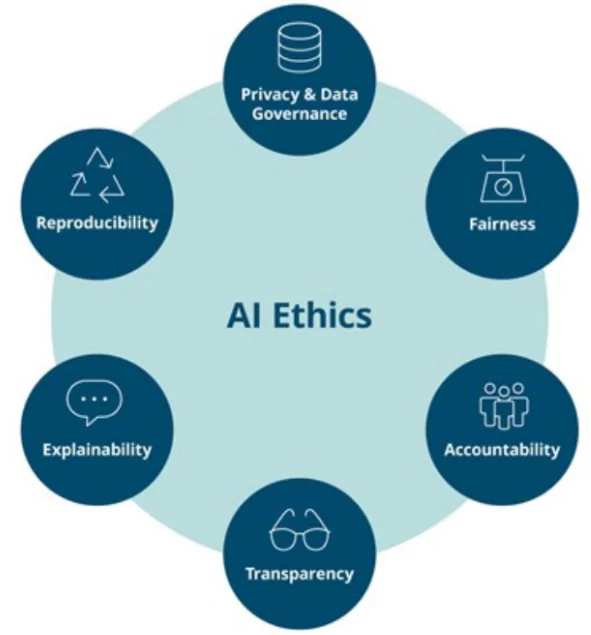
#1. Ethical Principles and Frameworks Ethical AI is guided by foundational principles, which vary across organizations but often include:
- Fairness: Ensuring AI systems do not discriminate based on race, gender, or other protected attributes.
- Transparency: Making AI decision-making processes understandable to users and stakeholders.
- Accountability: Assigning responsibility for AI outcomes, including mechanisms for redress.
- Privacy: Protecting user data and ensuring compliance with regulations like GDPR.
- Human Oversight: Keeping humans "in the loop" for critical decisions.
- Beneficence: Ensuring AI systems contribute to societal well-being. Frameworks like the Asilomar Principles and the IEEE Ethically Aligned Design provide structured approaches to embedding these principles into AI systems.
#2. Technical Tools and Methods Ethical AI relies on technical solutions to operationalize principles:
- Bias Detection and Mitigation:
- Fairness-Aware Algorithms: Techniques like reweighting, adversarial debiasing, and fairness constraints (e.g., demographic parity, equalized odds).
- Dataset Auditing: Tools like IBM’s AI Fairness 360 and Google’s What-If Tool help identify and correct biases in training data.
- Explainable AI (XAI):
- Interpretable Models: Techniques such as decision trees, LIME (Local Interpretable Model-agnostic Explanations), and SHAP (SHapley Additive exPlanations) make AI decisions more transparent.
- Post-Hoc Explanations: Methods like counterfactual explanations help users understand why an AI made a specific decision.
- Privacy-Preserving AI:
- Federated Learning: Trains models across decentralized devices without sharing raw data.
- Differential Privacy: Adds noise to datasets to prevent re-identification of individuals.
- Homomorphic Encryption: Allows computation on encrypted data without decryption.
#3. Governance and Regulation Ethical AI is enforced through:
- Regulatory Frameworks:
- Risk-Based Regulation: Classifies AI systems by risk level (e.g., EU AI Act’s "unacceptable," "high-risk," "limited-risk" categories).
- Mandatory Audits: Requires third-party assessments of high-risk AI systems (e.g., biometric identification tools).
- Corporate Policies:
- AI Ethics Boards: Internal committees that review AI projects for ethical compliance (e.g., Google’s AI Principles Review Board).
- Ethical AI Certifications: Programs like IEEE’s Ethics Certification Program for Autonomous and Intelligent Systems (ECPAIS).
- Public Engagement:
- Participatory AI: Involves stakeholders (e.g., affected communities) in AI design and deployment.
- Ethics Review Boards: Independent bodies that assess AI projects for societal impact.
#4. Challenges in Implementation Despite advances, several challenges persist:
- Trade-offs Between Principles: Balancing fairness and accuracy, or transparency and performance, often requires difficult compromises.
- Scalability: Ethical tools (e.g., bias detection) may not scale efficiently for large, complex models.
- Dynamic Ethics: Societal values evolve, requiring AI systems to adapt over time.
- Global Disparities: Ethical standards vary across regions, complicating international AI governance.
#Important Facts
- Algorithmic Bias is Pervasive: Studies show that facial recognition systems have higher error rates for darker-skinned individuals, particularly women of color (Buolamwini & Gebru, 2018).
- AI Can Amplify Inequality: Automated hiring tools have been found to favor male candidates over female ones, reflecting biases in historical hiring data.
- Explainable AI is Not a Panacea: While XAI methods improve transparency, they do not always provide actionable insights for non-experts.
- Ethical AI is a Competitive Advantage: Companies with strong ethical frameworks (e.g., Microsoft, Salesforce) report higher customer trust and brand loyalty.
- Regulation Lags Behind Innovation: Most AI ethics frameworks are voluntary, and enforcement remains inconsistent across industries.
- AI Ethics is Interdisciplinary: It requires collaboration between computer scientists, ethicists, lawyers, policymakers, and affected communities.
- The "Alignment Problem": Ensuring AI systems pursue goals that align with human values is one of the field’s most complex challenges (Bostrom, 2014).
- AI in Warfare Raises Ethical Dilemmas: Autonomous weapons systems (e.g., drones) pose risks of unintended escalation and loss of human control.
#Timeline
- Foundational ideas
Core concepts and early methods shape The Future of AI Ethics.
- Practical use
Tools, examples, and real-world deployments make the topic easier to evaluate.
- Responsible implementation
Current work focuses on reliability, governance, performance, and measurable impact.
#Related Terms
#FAQ
What does The Future of AI Ethics cover?
Explores the future of ai ethics, including emerging trends, practical impacts, risks, and important signals to watch.
Why is The Future of AI Ethics important?
It helps readers understand key concepts, compare practical use cases, and evaluate how AI Ethics decisions affect outcomes, risks, and implementation choices.
What should readers verify before applying this topic?
Readers should compare benefits, limitations, data requirements, and related themes such as Future, AI, Ethics before using the ideas in real projects.
#References
- The Future of AI Ethics terminology and background research
- The Future of AI Ethics use cases, implementation examples, and limitations
- AI Ethics best practices, standards, and risk guidance
- Future case studies, benchmarks, and current industry analysis


Comments
No comments yet. Start the discussion with a useful note.