


#Short Answer
Covers exploring the basics of ai ethics, including core concepts, practical examples, benefits, limitations, and risks in AI Ethics.
#Infobox
#Overview
Artificial Intelligence (AI) has transformed industries, economies, and daily life, but its rapid advancement has raised ethical dilemmas. AI Ethics is the interdisciplinary field that examines the moral implications of AI systems, ensuring they align with human values and societal norms. It encompasses issues like algorithmic bias, data privacy, job displacement, and the potential for autonomous systems to act unpredictably. The ethical concerns surrounding AI are not merely technical but also philosophical, legal, and social. As AI systems become more autonomous, the need for robust ethical frameworks grows. Governments, corporations, and researchers are increasingly prioritizing AI ethics to prevent misuse, ensure fairness, and maintain public trust.
#History / Background
#Early Foundations (1940s–1960s)
The concept of AI ethics traces back to the early days of artificial intelligence. In 1942, science fiction writer Isaac Asimov introduced the Three Laws of Robotics in his short story Runaround, which laid the groundwork for ethical guidelines in AI. These laws emphasized: 1. A robot must not harm humans or allow harm through inaction. 2. A robot must obey human orders unless they conflict with the first law. 3. A robot must protect its own existence unless it conflicts with the first two laws. In the 1950s and 1960s, pioneers like Alan Turing and Norbert Wiener explored the ethical implications of machine intelligence, with Wiener’s Cybernetics (1948) discussing the societal impact of automation.
#The AI Winter and Ethical Neglect (1970s–1990s)
During the AI winters—periods of reduced funding and interest in AI—the field stagnated, and ethical considerations were largely sidelined. However, debates on automation’s societal effects persisted, particularly in labor and military applications.
#Revival and Modern AI Ethics (2000s–Present)
The 21st century saw a resurgence of AI ethics due to:
- Big Data and Machine Learning: The rise of data-driven AI models highlighted biases in training data.
- Autonomous Systems: Self-driving cars and drones necessitated ethical decision-making frameworks.
- Regulatory Scrutiny: High-profile incidents (e.g., facial recognition biases, algorithmic hiring discrimination) prompted calls for regulation. Key milestones include:
- 2016: The Partnership on AI was formed by tech giants (Google, Amazon, Facebook, IBM, Microsoft) to promote ethical AI.
- 2018: The EU General Data Protection Regulation (GDPR) introduced principles like "right to explanation" for automated decisions.
- 2020: The IEEE Global Initiative on Ethics of Autonomous and Intelligent Systems published the Ethically Aligned Design framework.
- 2021: The EU AI Act proposed a risk-based regulatory approach for AI systems.
#How It Works
AI ethics operates through a combination of principles, frameworks, and practices designed to guide AI development and deployment. The process typically involves:
#
- Identifying Ethical Risks
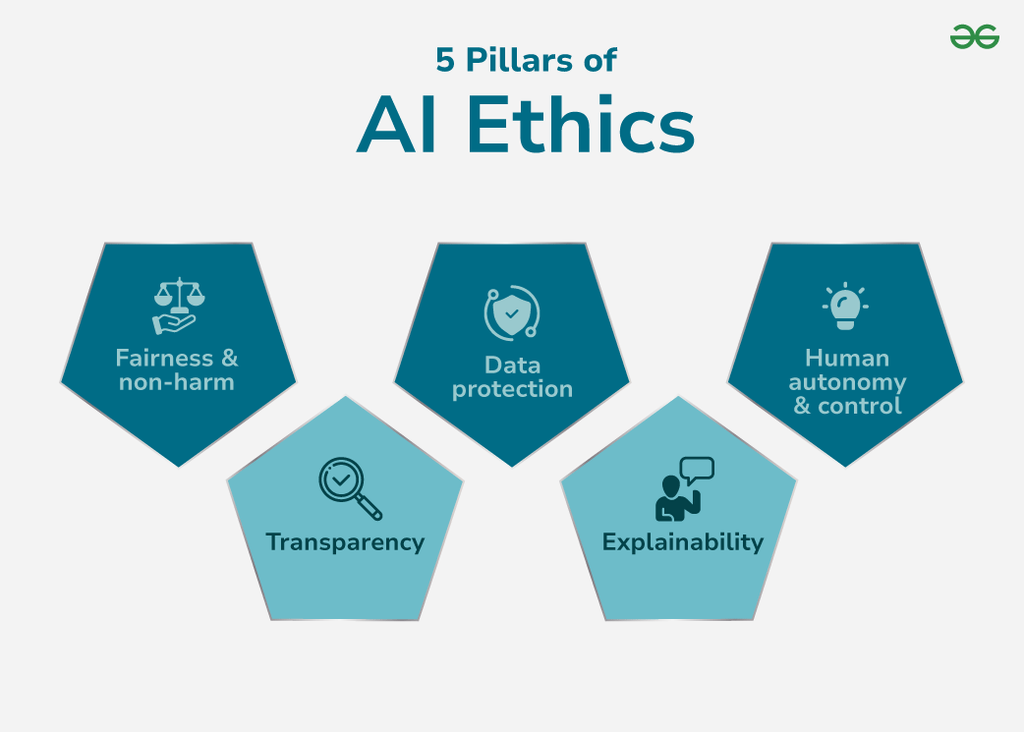
- Bias and Fairness: AI models trained on biased data can perpetuate discrimination (e.g., racial bias in facial recognition).
- Privacy Violations: AI systems often require vast datasets, raising concerns about data collection and surveillance.
- Accountability: Determining responsibility when an AI system causes harm (e.g., a self-driving car accident).
- Transparency: "Black box" AI models (e.g., deep neural networks) lack interpretability, making it hard to understand their decisions.
#
- Ethical Frameworks
- Principle-Based Approaches: Frameworks like the Asilomar AI Principles (2017) emphasize human values, transparency, and long-term safety.
- Stakeholder Engagement: Involving diverse groups (ethicists, policymakers, affected communities) in AI design.
- Algorithmic Auditing: Regularly testing AI systems for bias, fairness, and compliance with ethical standards.
#
- Regulatory and Governance Mechanisms
- Laws and Policies: Governments implement regulations like the EU AI Act, which classifies AI systems into risk categories (unacceptable, high, limited, minimal risk).
- Corporate Policies: Companies adopt AI ethics boards (e.g., Google’s AI Principles, Microsoft’s Responsible AI practices).
- Certifications: Standards like ISO/IEC 23894 (AI risk management) provide guidelines for ethical AI deployment.
#
- Technical Solutions
- Fairness-Aware Algorithms: Techniques like adversarial debiasing or fairness constraints to mitigate bias.
- Explainable AI (XAI): Tools like LIME (Local Interpretable Model-agnostic Explanations) and SHAP (SHapley Additive exPlanations) improve model interpretability.
- Differential Privacy: Protects user data by adding noise to datasets, ensuring individual privacy.
#Important Facts
- Algorithmic Bias: A 2018 study by MIT and Stanford found that facial recognition systems had higher error rates for darker-skinned individuals, highlighting racial bias in AI.
- Job Displacement: The World Economic Forum estimates that by 2025, AI will displace 85 million jobs but create 97 million new ones, requiring reskilling efforts.
- Autonomous Weapons: The Campaign to Stop Killer Robots advocates for bans on lethal autonomous weapons systems (LAWS), citing ethical and humanitarian concerns.
- AI in Healthcare: AI-driven diagnostics can improve accuracy but may also exacerbate healthcare disparities if trained on non-diverse datasets.
- Deepfakes and Misinformation: AI-generated deepfakes pose threats to democracy, leading to calls for content authentication and regulatory oversight.
- Energy Consumption: Training large AI models (e.g., GPT-3) consumes significant energy, raising environmental ethics concerns.
#Timeline
- Foundational ideas
Core concepts and early methods shape Exploring the Basics of AI Ethics.
- Practical use
Tools, examples, and real-world deployments make the topic easier to evaluate.
- Responsible implementation
Current work focuses on reliability, governance, performance, and measurable impact.
#Related Terms
#FAQ
What does Exploring the Basics of AI Ethics cover?
Covers exploring the basics of ai ethics, including core concepts, practical examples, benefits, limitations, and risks in AI Ethics.
Why is Exploring the Basics of AI Ethics important?
It helps readers understand key concepts, compare practical use cases, and evaluate how AI Ethics decisions affect outcomes, risks, and implementation choices.
What should readers verify before applying this topic?
Readers should compare benefits, limitations, data requirements, and related themes such as Exploring, Basics, AI before using the ideas in real projects.
#References
- Exploring the Basics of AI Ethics terminology and background research
- Exploring the Basics of AI Ethics use cases, implementation examples, and limitations
- AI Ethics best practices, standards, and risk guidance
- Exploring case studies, benchmarks, and current industry analysis


Comments
No comments yet. Start the discussion with a useful note.