


#Short Answer
Traces the rise of machine learning: a historical perspective, highlighting major milestones, context, examples, and future implications.
#Infobox
#Overview
Machine learning represents a paradigm shift in computing, where algorithms autonomously identify patterns in data to make predictions or decisions. Unlike traditional programming, which relies on rigid rules, ML systems adapt through exposure to data, enabling them to handle complex tasks such as image recognition, fraud detection, and predictive analytics. The rise of ML has been fueled by advancements in computational power, the availability of large datasets, and breakthroughs in algorithmic design. Today, it underpins many modern technologies, from voice assistants like Siri to personalized content recommendations on streaming platforms.
#History / Background
#Early Foundations (Pre-1950s)
The conceptual roots of machine learning trace back to the 18th and 19th centuries, with early work in probability theory and statistics. Key milestones include:
- 1805: Adrien-Marie Legendre introduces the method of least squares, a foundational technique in regression analysis.
- 1812: Pierre-Simon Laplace expands on probability theory, laying groundwork for Bayesian inference.
- 1906: Francis Galton studies regression toward the mean, influencing later ML models.
#The Birth of AI and Early ML (1950s–1970s)
The mid-20th century marked the formalization of AI and early ML:
- 1950: Alan Turing proposes the "Turing Test," a benchmark for machine intelligence.
- 1952: Arthur Samuel develops the first self-learning program, a checkers-playing algorithm that improves with experience.
- 1956: The term "artificial intelligence" is coined at the Dartmouth Conference, marking the field's official inception.
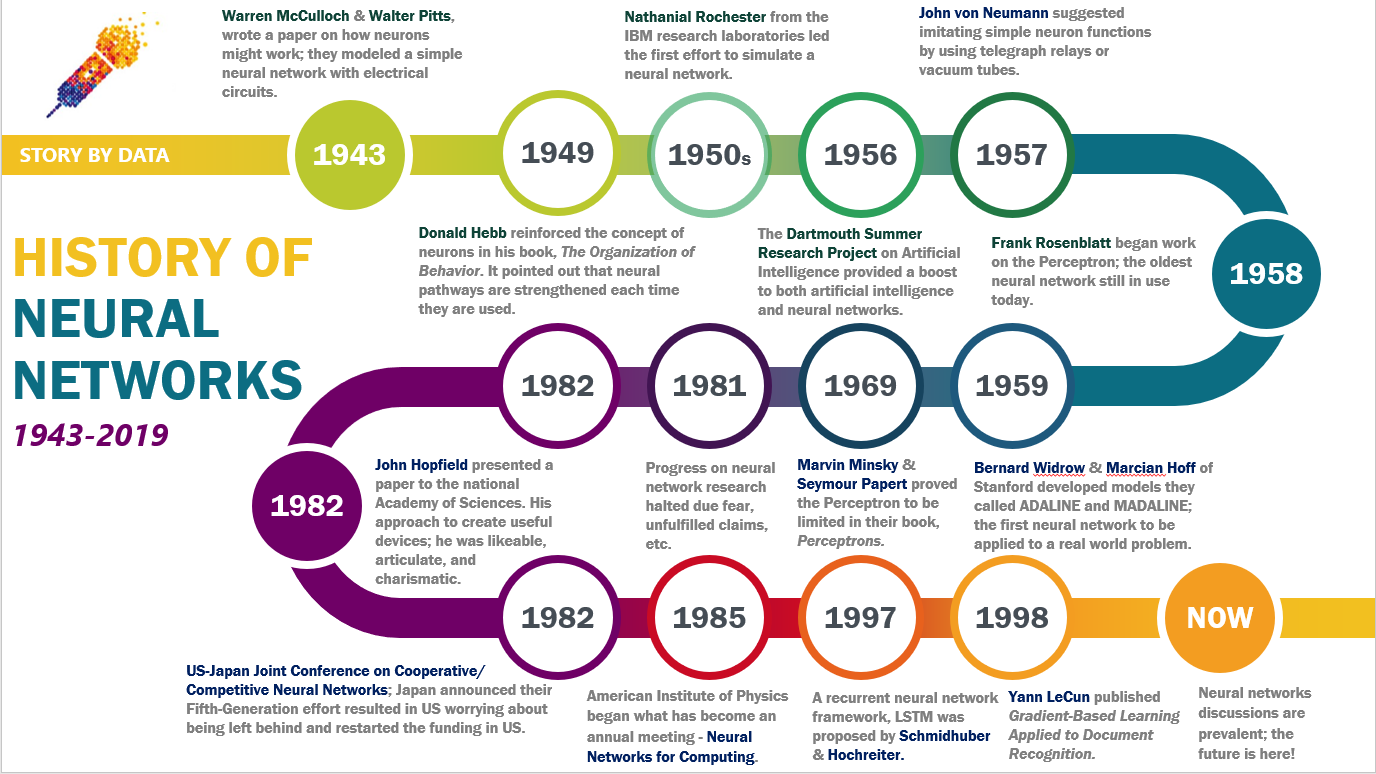
- 1958: Frank Rosenblatt invents the Perceptron, an early neural network model, though its limitations are later exposed by Marvin Minsky and Seymour Papert in 1969.
#The AI Winter and Revival (1980s–1990s)
After the initial hype, AI research faced funding cuts and skepticism ("AI Winter"). However, progress continued in niche areas:
- 1980s: Revival of neural networks with backpropagation algorithms, enabling more efficient training.
- 1986: David Rumelhart, Geoffrey Hinton, and Ronald Williams popularize backpropagation, a cornerstone of modern deep learning.
- 1997: IBM's Deep Blue defeats world chess champion Garry Kasparov, showcasing AI's potential in strategic decision-making.
#The Deep Learning Revolution (2000s–Present)
The 21st century has seen unprecedented growth in ML, driven by:
- 2006: Geoffrey Hinton introduces deep belief networks, reviving interest in neural networks.
- 2012: AlexNet, a deep convolutional neural network, achieves breakthrough performance in image recognition, winning the ImageNet competition.
- 2016: Google's AlphaGo defeats Lee Sedol in Go, a game previously considered beyond AI's reach due to its complexity.
- 2020s: Transformers and large language models (e.g., GPT-3, BERT) dominate natural language processing, enabling applications like chatbots and automated content generation.
#How It Works
#Core Principles Machine learning operates on three primary paradigms:
- Supervised Learning: Algorithms learn from labeled data (input-output pairs). Examples include classification (e.g., spam detection) and regression (e.g., house price prediction).
- Unsupervised Learning: Models identify patterns in unlabeled data, such as clustering (e.g., customer segmentation) or dimensionality reduction (e.g., principal component analysis).
- Reinforcement Learning: Systems learn by interacting with an environment, receiving rewards or penalties for actions (e.g., robotics, game-playing AI).
#Key Algorithms
- Linear Regression: Predicts continuous outcomes using a linear relationship between variables.
- Decision Trees: Splits data into branches based on feature values to make predictions.
- Support Vector Machines (SVM): Classifies data by finding optimal hyperplanes in high-dimensional space.
- Neural Networks: Mimic the human brain's structure, with layers of interconnected nodes (neurons) that process data hierarchically.
- Deep Learning: A subset of neural networks with multiple hidden layers, excelling in tasks like image and speech recognition.
#Training Process
- Data Collection: Gathering relevant datasets (e.g., images, text, sensor data).
- Preprocessing: Cleaning, normalizing, and transforming data to improve model performance.
- Model Selection: Choosing an appropriate algorithm based on the problem type.
- Training: Feeding data into the model to adjust parameters (e.g., weights in a neural network) via optimization techniques like gradient descent.
- Evaluation: Assessing model performance using metrics like accuracy, precision, recall, or mean squared error.
- Deployment: Integrating the trained model into real-world applications (e.g., mobile apps, cloud services).
#Important Facts
- Data Dependency: ML models require vast amounts of high-quality data; poor data quality can lead to biased or inaccurate results.
- Computational Requirements: Training deep learning models demands significant processing power, often requiring GPUs or TPUs.
- Ethical Concerns: Issues like algorithmic bias, privacy violations, and job displacement have sparked debates about responsible AI development.
- Interpretability: Many ML models (e.g., deep neural networks) are "black boxes," making it challenging to understand their decision-making processes.
- Transfer Learning: Pre-trained models can be fine-tuned for new tasks, reducing the need for extensive training data.
- Edge Computing: ML models are increasingly deployed on edge devices (e.g., smartphones, IoT sensors) to enable real-time processing without cloud dependency.
#Timeline
- Foundational ideas
Core concepts and early methods shape The Rise of Machine Learning: a Historical Perspective.
- Practical use
Tools, examples, and real-world deployments make the topic easier to evaluate.
- Responsible implementation
Current work focuses on reliability, governance, performance, and measurable impact.
#Related Terms
#FAQ
What does The Rise of Machine Learning: a Historical Perspective cover?
Traces the rise of machine learning: a historical perspective, highlighting major milestones, context, examples, and future implications.
Why is The Rise of Machine Learning: a Historical Perspective important?
It helps readers understand key concepts, compare practical use cases, and evaluate how Machine Learning decisions affect outcomes, risks, and implementation choices.
What should readers verify before applying this topic?
Readers should compare benefits, limitations, data requirements, and related themes such as Rise, Machine, Learning before using the ideas in real projects.
#References
- The Rise of Machine Learning: a Historical Perspective terminology and background research
- The Rise of Machine Learning: a Historical Perspective use cases, implementation examples, and limitations
- Machine Learning best practices, standards, and risk guidance
- Rise case studies, benchmarks, and current industry analysis


Comments
No comments yet. Start the discussion with a useful note.