


#Short Answer
Explains how machine learning is changing the world, including the main process, tools, examples, risks, and practical implementation steps.
#Infobox
#Overview
Machine learning is revolutionizing the modern world by enabling computers to process vast amounts of data, recognize patterns, and make intelligent decisions without explicit programming. Unlike traditional software, which follows rigid rules, ML systems improve their performance over time as they are exposed to more data. This adaptability has made ML a cornerstone of the Fourth Industrial Revolution, driving innovation across sectors. The technology powers applications ranging from virtual assistants like Siri and Alexa to advanced medical diagnostics and algorithmic trading in finance. By leveraging statistical models and computational algorithms, ML systems can uncover hidden insights in data, automate repetitive tasks, and even predict future trends with remarkable accuracy. Its influence extends beyond technology, impacting economics, education, and social structures.
#History / Background
#Early Foundations (1940s–1960s)
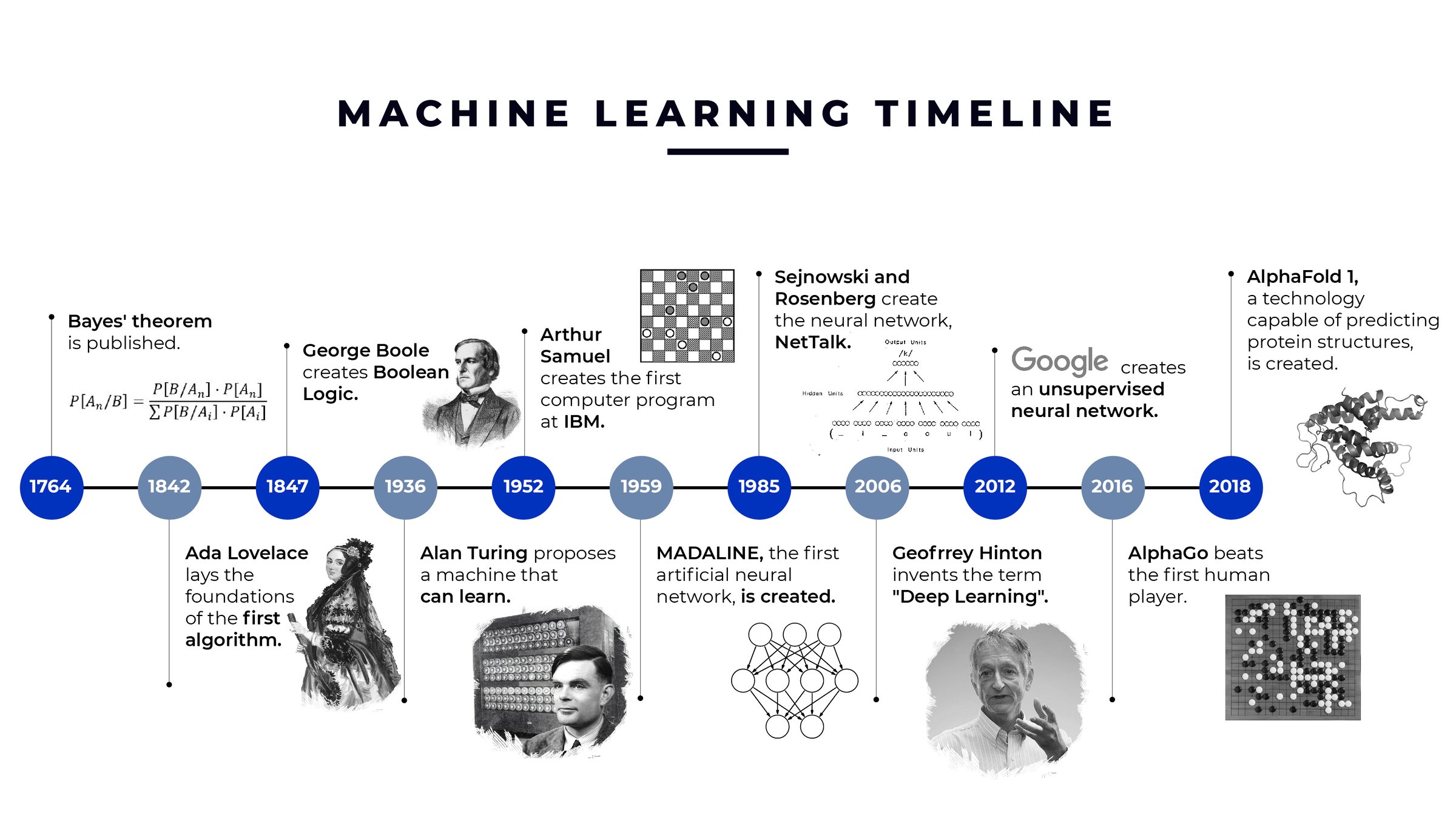
The conceptual roots of machine learning trace back to the 1940s and 1950s, when early computer scientists explored the idea of machines that could "learn." In 1950, Alan Turing proposed the "Turing Test," a benchmark for machine intelligence, while Arthur Samuel coined the term "machine learning" in 1959. The first AI programs, such as Arthur Samuel’s checkers-playing program (1952), demonstrated that computers could improve through experience.
#The Rise of Neural Networks (1960s–1980s)
The 1960s saw the development of perceptrons, the earliest form of artificial neural networks, by Frank Rosenblatt. However, limitations in computing power and data availability stifled progress. The field experienced a resurgence in the 1980s with the introduction of backpropagation, a method for training multi-layer neural networks, which laid the groundwork for modern deep learning.
#The Big Data Era (1990s–2010s)
The late 20th century brought significant advancements, including support vector machines (SVMs) and ensemble methods like random forests. The explosion of digital data in the 2000s, driven by the internet and mobile devices, provided the fuel for ML algorithms to thrive. Companies like Google and Amazon began leveraging ML for search algorithms, recommendation systems, and targeted advertising.
#The Deep Learning Revolution (2010s–Present)
The breakthrough of deep learning, powered by graphics processing units (GPUs) and large-scale datasets, marked a turning point. Convolutional neural networks (CNNs) achieved unprecedented success in image recognition, while recurrent neural networks (RNNs) excelled in natural language processing (NLP). Landmark achievements, such as AlphaGo’s victory over a human Go champion in 2016, showcased ML’s potential to tackle complex, real-world problems.
#How It Works
Machine learning operates through a series of interconnected processes that enable systems to learn from data and generalize to new, unseen inputs. The core methodology involves:
#
- Data Collection and Preprocessing ML systems require high-quality, labeled or unlabeled data to train models. Data preprocessing includes cleaning, normalization, and feature extraction to ensure consistency and relevance. Techniques like principal component analysis (PCA) may be used to reduce dimensionality.
#
- Model Selection Depending on the problem, different ML models are chosen:
- Supervised Learning: Uses labeled data to train models for classification (e.g., spam detection) or regression (e.g., price prediction).
- Unsupervised Learning: Identifies patterns in unlabeled data, such as clustering (e.g., customer segmentation) or anomaly detection.
- Reinforcement Learning: Trains agents to make sequences of decisions by rewarding desired outcomes (e.g., robotics, game-playing AI).
#
- Training and Optimization The model is trained using algorithms like gradient descent, which adjusts parameters to minimize error. Hyperparameter tuning (e.g., learning rate, batch size) is critical for performance. Techniques like cross-validation help prevent overfitting, where the model memorizes training data but fails to generalize.
#
- Evaluation and Deployment Models are evaluated using metrics such as accuracy, precision, recall, or mean squared error. Once validated, they are deployed in production environments, where they process real-time data to make predictions or automate decisions.
#
- Continuous Learning Many modern ML systems incorporate feedback loops, allowing them to adapt and improve over time. Online learning, where models update incrementally with new data, is particularly useful in dynamic environments like finance or social media.
#Important Facts
- Data Dependency: ML models are only as good as the data they are trained on. Biased or incomplete datasets can lead to flawed predictions.
- Computational Power: Training deep learning models requires significant computational resources, often necessitating cloud-based solutions or specialized hardware like TPUs (Tensor Processing Units).
- Explainability: Many ML models, particularly deep neural networks, operate as "black boxes," making it difficult to interpret their decisions. This has led to the development of explainable AI (XAI) techniques.
- Ethical Concerns: ML systems can perpetuate biases present in training data, raising ethical questions about fairness, accountability, and transparency.
- Energy Consumption: Large-scale ML models, such as those used in training language models, have a substantial carbon footprint, prompting research into more energy-efficient algorithms.
- Democratization: Open-source frameworks like TensorFlow, PyTorch, and scikit-learn have made ML accessible to non-experts, accelerating innovation.
#Timeline
- Foundational ideas
Core concepts and early methods shape How Machine Learning Is Changing the World.
- Practical use
Tools, examples, and real-world deployments make the topic easier to evaluate.
- Responsible implementation
Current work focuses on reliability, governance, performance, and measurable impact.
#Related Terms
#FAQ
What does How Machine Learning Is Changing the World cover?
Explains how machine learning is changing the world, including the main process, tools, examples, risks, and practical implementation steps.
Why is How Machine Learning Is Changing the World important?
It helps readers understand key concepts, compare practical use cases, and evaluate how Machine Learning decisions affect outcomes, risks, and implementation choices.
What should readers verify before applying this topic?
Readers should compare benefits, limitations, data requirements, and related themes such as Machine, Learning, Changing before using the ideas in real projects.
#References
- How Machine Learning Is Changing the World terminology and background research
- How Machine Learning Is Changing the World use cases, implementation examples, and limitations
- Machine Learning best practices, standards, and risk guidance
- Machine case studies, benchmarks, and current industry analysis


Comments
No comments yet. Start the discussion with a useful note.