


#Short Answer
Explains how does ai in marketing work?, including the main process, tools, examples, risks, and practical implementation steps.
#Infobox
#Overview
AI in marketing represents a paradigm shift from traditional, intuition-driven strategies to data-centric, automated, and predictive approaches. By leveraging AI, marketers can process and interpret vast amounts of structured and unstructured data—such as customer interactions, purchase histories, social media activity, and browsing behavior—to uncover actionable insights. These insights inform decisions across the entire marketing funnel, from lead generation and segmentation to campaign optimization and customer retention. The integration of AI into marketing is not merely a trend but a fundamental evolution in how businesses engage with consumers. It enables real-time personalization at scale, predictive lead scoring, dynamic content creation, and even autonomous campaign management. As consumer expectations for relevance and immediacy grow, AI-powered marketing tools have become essential for maintaining competitive advantage.
#History / Background
The roots of AI in marketing can be traced back to the 1950s with the advent of early computing and statistical models. However, the practical application of AI in marketing began to take shape in the 1990s with the rise of digital advertising and the internet.
- 1990s–2000s: Early AI applications included rule-based systems for email marketing and basic recommendation engines (e.g., Amazon’s early product suggestions).
- 2010s: The explosion of big data, cloud computing, and advancements in machine learning accelerated AI adoption. Google’s RankBrain (2015) and Facebook’s ad targeting algorithms revolutionized search and social advertising.
- 2016–Present: The introduction of generative AI models (e.g., GPT-3 in 2020) transformed content creation, while AI-driven chatbots (e.g., chatbots on e-commerce sites) became mainstream. Tools like Salesforce Einstein and Adobe Sensei integrated AI into CRM and content management systems. The COVID-19 pandemic further accelerated digital transformation, pushing businesses to adopt AI for remote customer engagement and automated workflows.
#How It Works
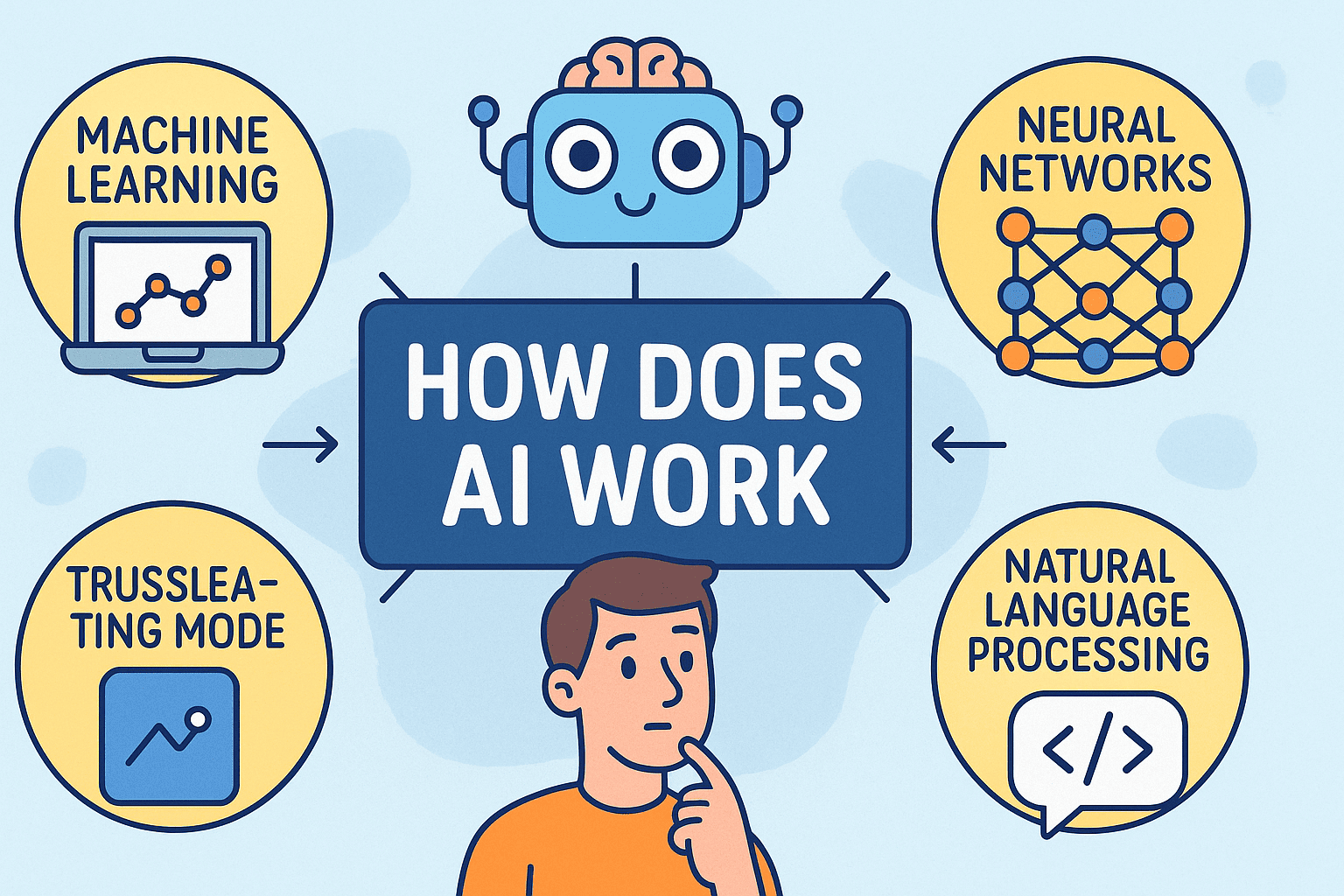
AI in marketing operates through several core mechanisms, each powered by advanced algorithms and data processing capabilities:
#
- Data Collection and Integration AI systems ingest data from multiple sources:
- Customer Data Platforms (CDPs): Unify first-party data (e.g., CRM, website analytics, email interactions).
- Third-Party Data: Enrich datasets with demographic, behavioral, and intent data.
- Real-Time Signals: Track user actions (e.g., clicks, dwell time, cart abandonment) via pixels and APIs.
#
- Data Processing and Analysis
- Natural Language Processing (NLP): Analyzes text data from reviews, social media, and customer support chats to gauge sentiment and intent.
- Computer Vision: Processes visual content (e.g., images, videos) for brand monitoring, logo detection, and user-generated content analysis.
- Predictive Analytics: Uses historical data to forecast trends, customer churn, or purchasing likelihood.
#
- Personalization and Segmentation
- Dynamic Content Generation: AI tailors website content, emails, and ads based on user behavior (e.g., Netflix recommendations, Spotify playlists).
- Hyper-Segmentation: Divides audiences into micro-segments using clustering algorithms (e.g., k-means) to deliver targeted messaging.
- Predictive Lead Scoring: Assigns scores to leads based on their likelihood to convert, using models trained on past conversion data.
#
- Automation and Optimization
- Chatbots and Virtual Assistants: Use NLP to handle customer queries, qualify leads, and provide 24/7 support (e.g., Sephora’s chatbot).
- Programmatic Advertising: AI automates ad buying, placement, and bidding in real time (e.g., Google Ads, Meta Ads Manager).
- A/B Testing and Multivariate Testing: AI tools like Optimizely or VWO optimize campaigns by testing variations and selecting the best-performing elements.
#
- Content Creation and Curation
- Generative AI: Tools like Jasper, Copy.ai, and Midjourney create blog posts, social media captions, and even video scripts.
- Content Curation: AI curates relevant articles, videos, or products for users (e.g., Flipboard, Pinterest recommendations).
#
- Sentiment Analysis and Social Listening
- Brand Monitoring: AI tracks mentions across social media, forums, and review sites to assess brand sentiment and detect crises.
- Influencer Identification: Algorithms identify influencers whose audiences align with a brand’s target market.
#
- Voice and Visual Search Optimization
- Voice Search: AI-powered assistants (e.g., Siri, Alexa) interpret voice queries and optimize content for conversational search.
- Image and Video Search: Tools like Google Lens or Pinterest Visual Search use AI to match user-uploaded images with products or content.
#Important Facts
- ROI Impact: Companies using AI in marketing report a 20–30% increase in revenue and a 40% reduction in costs (McKinsey, 2023).
- Personalization Effect: 80% of consumers are more likely to purchase when brands offer personalized experiences (Epsilon, 2022).
- Chatbot Efficiency: AI chatbots can handle 80% of routine customer queries, reducing support costs by up to 30% (Juniper Research, 2023).
- Ad Spend Optimization: Programmatic advertising accounts for over 80% of digital ad spend in the U.S. (eMarketer, 2023).
- Content Volume: AI-generated content can produce 10x more marketing collateral in the same timeframe as human teams (Gartner, 2023).
- Data Privacy: 68% of consumers are concerned about how their data is used in AI-driven marketing (PwC, 2023).
- Bias in AI: Algorithms can perpetuate biases if trained on unrepresentative data, leading to discriminatory ad targeting (e.g., gender or racial bias in job ads).
#Timeline
- Foundational ideas
Core concepts and early methods shape How Does AI in Marketing Work?.
- Practical use
Tools, examples, and real-world deployments make the topic easier to evaluate.
- Responsible implementation
Current work focuses on reliability, governance, performance, and measurable impact.
#Related Terms
#FAQ
What does How Does AI in Marketing Work? cover?
Explains how does ai in marketing work?, including the main process, tools, examples, risks, and practical implementation steps.
Why is How Does AI in Marketing Work? important?
It helps readers understand key concepts, compare practical use cases, and evaluate how Business & Marketing decisions affect outcomes, risks, and implementation choices.
What should readers verify before applying this topic?
Readers should compare benefits, limitations, data requirements, and related themes such as Does, AI, Marketing before using the ideas in real projects.
#References
- How Does AI in Marketing Work? terminology and background research
- How Does AI in Marketing Work? use cases, implementation examples, and limitations
- Business & Marketing best practices, standards, and risk guidance
- Does case studies, benchmarks, and current industry analysis

Comments
No comments yet. Start the discussion with a useful note.