

#Short Answer
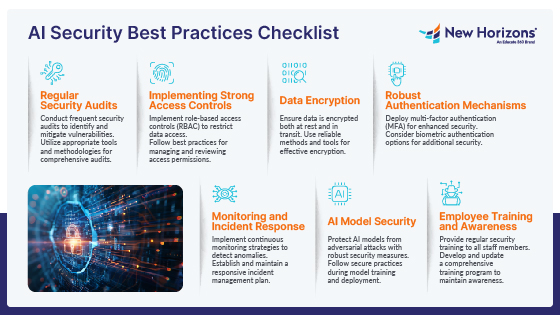
AI systems, particularly those based on machine learning and deep learning, are vulnerable to a range of security threats that can compromise their functionality, integrity, or confidentiality. Unlike traditional software, AI models are trained on large datasets and operate in dynamic environments, making them susceptible to novel attack vectors. AI security best practices aim to address these vulnerabilities through a combination of technical safeguards, operational controls, and governance frameworks.
#Infobox
#Overview
AI systems, particularly those based on machine learning and deep learning, are vulnerable to a range of security threats that can compromise their functionality, integrity, or confidentiality. Unlike traditional software, AI models are trained on large datasets and operate in dynamic environments, making them susceptible to novel attack vectors. AI security best practices aim to address these vulnerabilities through a combination of technical safeguards, operational controls, and governance frameworks.
Key objectives of AI security include:
- Preventing unauthorized access to AI models and training data
- Ensuring the integrity of AI outputs and decision-making processes
- Protecting against adversarial manipulation of inputs
- Maintaining transparency and accountability in AI operations
- Complying with regulatory and ethical standards
#History / Background
The concept of AI security emerged alongside the rapid advancement of AI technologies in the 2010s. Early concerns focused on the robustness of machine learning models against adversarial examples—subtly altered inputs designed to deceive AI systems. Research in this area gained momentum after high-profile demonstrations, such as the adversarial attacks on image recognition systems by Ian Goodfellow and colleagues in 2014.
As AI applications expanded into critical domains like healthcare diagnostics, autonomous vehicles, and financial fraud detection, the need for formalized security practices became evident. Governments and industry bodies began developing guidelines and frameworks to address AI-specific risks. Notable milestones include:
- 2016: The National Institute of Standards and Technology (NIST) initiated research into AI security risks.
- 2018: The European Union introduced the General Data Protection Regulation (GDPR), which includes provisions relevant to AI transparency and accountability.
- 2019: The Partnership on AI published a white paper on AI security and robustness.
- 2020: The U.S. Department of Defense released its AI Principles, emphasizing security and ethical considerations.
- 2023: The White House issued an Executive Order on AI mandating security assessments for high-risk AI systems.
#How It Works
AI security best practices are implemented through a multi-layered approach that addresses vulnerabilities at different stages of the AI lifecycle: data collection, model development, deployment, and monitoring. The following are core components:
#Data Security
- Data Integrity: Ensuring training data is accurate, representative, and free from tampering. Techniques include data validation, anomaly detection, and cryptographic hashing.
- Data Privacy: Protecting sensitive data through anonymization, encryption, and access controls. Compliance with regulations like GDPR and CCPA is critical.
- Data Poisoning Prevention: Detecting and mitigating malicious data injection that could bias or degrade model performance. Methods include robust data filtering and adversarial training.
#Model Security
- Model Hardening: Techniques such as differential privacy, federated learning, and homomorphic encryption protect models from reverse engineering and theft.
- Adversarial Robustness: Training models to resist adversarial examples through methods like adversarial training, gradient masking, and input sanitization.
- Model Explainability: Using techniques such as SHAP values and LIME to ensure transparency and detect biases or vulnerabilities.
#System Integration
- Secure Deployment: Implementing zero-trust architectures, secure APIs, and sandboxed environments to limit exposure.
- Continuous Monitoring: Deploying real-time anomaly detection systems to identify unusual behavior or attacks, such as model drift or input manipulation.
- Incident Response: Establishing protocols for responding to security breaches, including model rollback, forensic analysis, and stakeholder notification.
#Governance and Compliance
- Ethical Guidelines: Adhering to frameworks such as the Asilomar AI Principles or the EU AI Act to ensure responsible AI development.
- Risk Assessment: Conducting regular audits and risk assessments to identify and mitigate vulnerabilities in AI systems.
- Employee Training: Educating developers, data scientists, and stakeholders on AI security risks and best practices.
#Important Facts
- AI systems can be compromised even when operating correctly due to inherent vulnerabilities in their design or training data.
- Adversarial attacks can cause AI models to misclassify inputs with high confidence, posing risks in applications like autonomous driving or medical diagnosis.
- Data poisoning attacks can subtly alter training data to manipulate model behavior over time, making detection difficult.
- Model theft, where attackers reverse-engineer proprietary AI models, can result in intellectual property loss and competitive disadvantages.
- AI security is not a one-time effort but requires continuous updates and monitoring as new threats emerge.
- Regulatory bodies are increasingly mandating AI security assessments, particularly for high-risk applications such as facial recognition or predictive policing.
#Timeline
- Publication of seminal paper
Publication of seminal paper on adversarial examples by Ian Goodfellow et al.
- NIST begins research into
NIST begins research into AI security risks.
- GDPR comes into effect
GDPR comes into effect, introducing requirements for AI transparency.
- Partnership on AI releases
Partnership on AI releases guidelines on AI security and robustness.
- U.S. Department of Defense
U.S. Department of Defense releases AI Principles emphasizing security.
- Launch of the AI
Launch of the [AI Incident Database](# 'AI Incident Database') to track AI-related security failures.
- White House issues Executive
White House issues Executive Order on AI, mandating security assessments for high-risk systems.
- Publication of comprehensive A
Publication of comprehensive AI security checklists and frameworks by industry and government bodies.
#Related Terms
#FAQ
What does AI Security: Best Practices cover?
AI security: best practices covers practical examples, benefits, limitations, and important considerations for readers.
Why is AI Security: Best Practices important?
It helps readers understand key concepts, compare practical use cases, and evaluate how Security & Privacy decisions affect outcomes, risks, and implementation choices.
What should readers verify before applying this topic?
Readers should compare the benefits, limitations, data requirements, and related themes such as Comparison, Selection Criteria, Security before using the ideas in real projects.
#References
- AI Security: Best Practices terminology and background research
- AI Security: Best Practices use cases, implementation examples, and limitations
- Security & Privacy best practices, standards, and risk guidance
- Comparison case studies, benchmarks, and current industry analysis



Comments
No comments yet. Start the discussion with a useful note.