

#Short Answer
Explores how artificial intelligence shapes security and protecting systems, covering practical use cases, benefits, limitations, and risks.
#Infobox
Artificial intelligence in security systems for threat detection and protection. Artificial Intelligence in Security Field Computer science Subfield Artificial intelligence, Cybersecurity Applications Threat detection, access control, video surveillance, anomaly detection Key Technologies Machine learning, deep learning, computer vision, natural language processing Notable Researchers Andrew Ng, Fei-Fei Li, Yann LeCun First Introduced 1950s Major Developments 2010s: Deep learning breakthroughs, real-time processing
#Overview
Artificial intelligence (AI) in security refers to the application of AI technologies to enhance the protection of digital and physical systems against threats. AI-driven security systems leverage machine learning, deep learning, and computer vision to detect, analyze, and respond to potential risks in real time. These systems are widely used in cybersecurity, perimeter security, video surveillance, and access control, providing advanced threat detection capabilities that surpass traditional rule-based methods.
AI security solutions are designed to adapt to evolving threats by continuously learning from data patterns, reducing false positives, and improving response times. The integration of AI in security frameworks has become essential in sectors such as finance, healthcare, government, and critical infrastructure, where the cost of breaches can be catastrophic.
#History / Background
#Early Developments
The concept of AI in security traces back to the 1950s, when early researchers explored the potential of artificial intelligence in problem-solving and pattern recognition. The Dartmouth Conference in 1956 marked a pivotal moment, where the term "artificial intelligence" was coined, and foundational work in neural networks began. However, limited computational power and data availability constrained early AI applications in security.
#Rise of Machine Learning
In the 1980s and 1990s, advancements in machine learning algorithms, such as support vector machines and decision trees, enabled more sophisticated threat detection. These methods allowed security systems to identify anomalies based on historical data, improving intrusion detection systems (IDS) and fraud detection in financial transactions.
#Modern AI in Security
The 2010s witnessed a revolution in AI security with the advent of deep learning and big data. Convolutional neural networks (CNNs) and recurrent neural networks (RNNs) enabled breakthroughs in computer vision and natural language processing, respectively. Companies like Palantir and CrowdStrike pioneered AI-driven cybersecurity platforms that could analyze vast datasets in real time. The proliferation of IoT devices further expanded the attack surface, necessitating AI-powered security solutions to monitor and protect interconnected systems.
#How It Works
#Core Technologies
AI security systems rely on several key technologies:
- Machine Learning (ML): Algorithms that learn from data to identify patterns and anomalies. Supervised learning uses labeled datasets to train models, while unsupervised learning detects outliers without prior knowledge.
- Deep Learning: A subset of ML that uses neural networks with multiple layers to process complex data, such as images, audio, and text. Convolutional neural networks (CNNs) are particularly effective in video surveillance and facial recognition.
- Computer Vision: Enables systems to interpret and analyze visual data from cameras and sensors. Applications include object detection, license plate recognition, and behavior analysis in crowds.
- Natural Language Processing (NLP): Used to analyze text data, such as emails, chat logs, and social media, to detect phishing attempts, hate speech, or other malicious content.
- Predictive Analytics: Leverages historical data to forecast potential security threats, allowing organizations to proactively mitigate risks.
#Implementation in Security Systems
AI security systems are deployed across various domains:
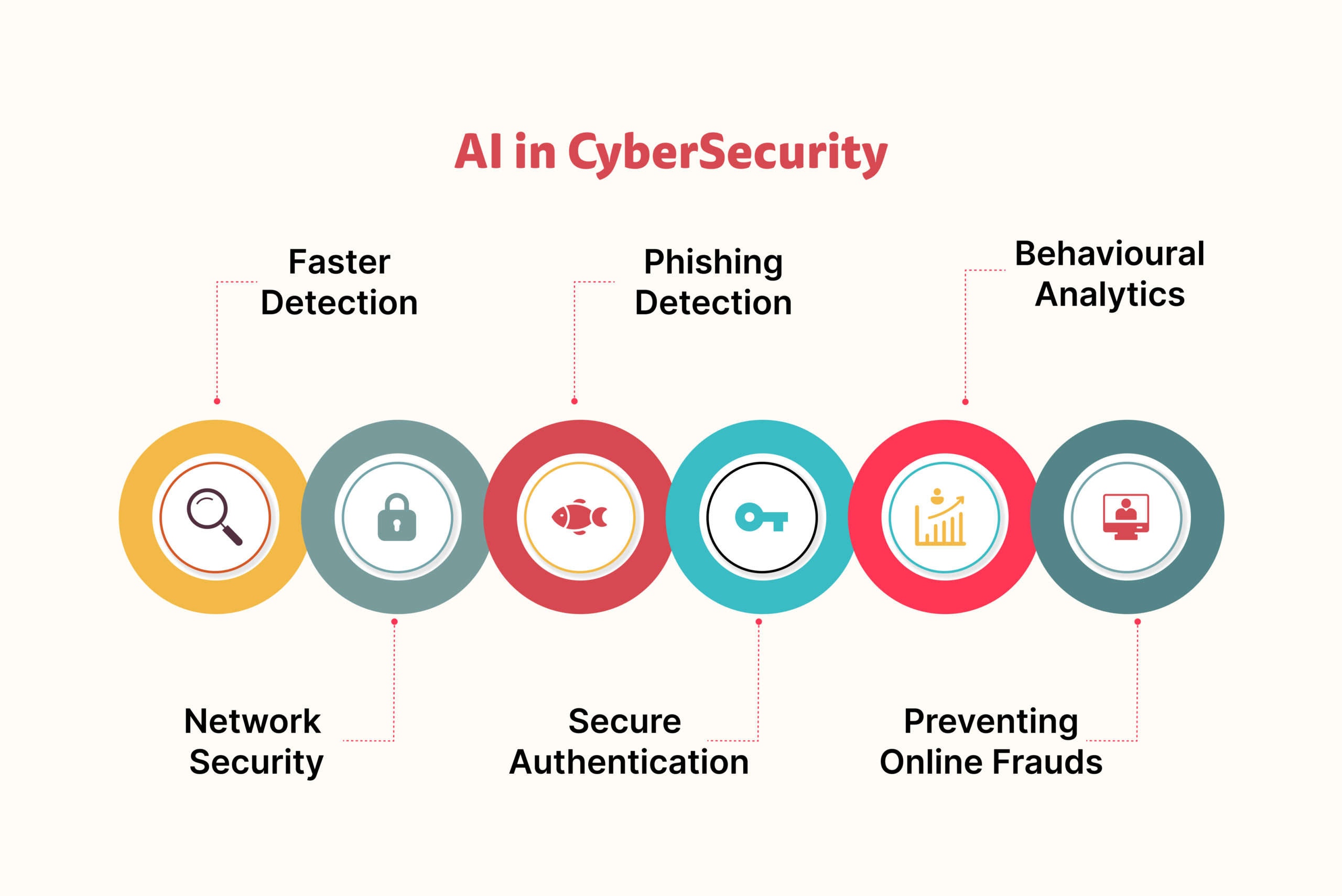
- Cybersecurity: AI monitors network traffic to detect intrusions, malware, and ransomware. Tools like Darktrace use unsupervised learning to identify deviations from normal behavior.
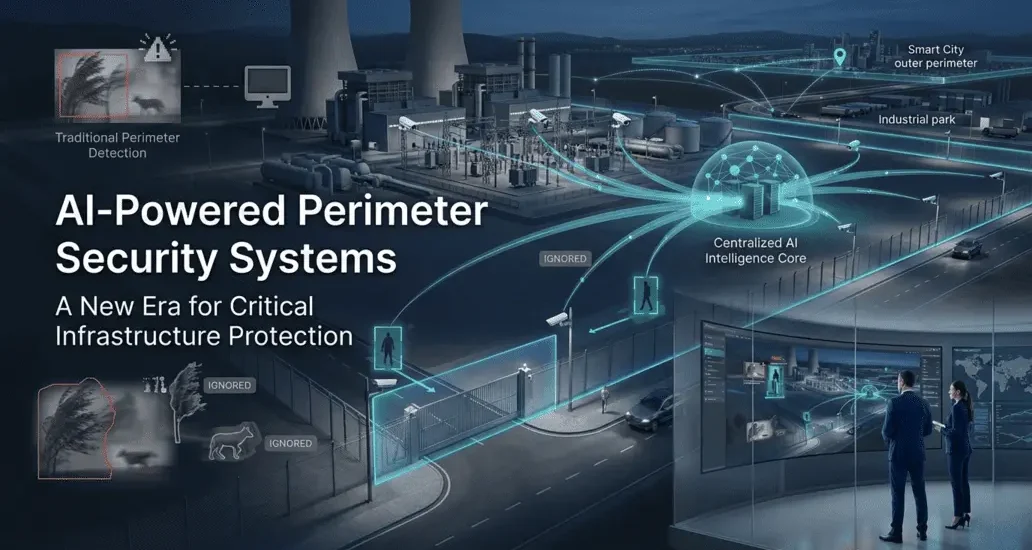
- Physical Security: AI-powered video analytics enhance perimeter security by detecting unauthorized access, suspicious behavior, or unattended objects. Facial recognition systems are used in airports and high-security facilities.
- Access Control: Biometric authentication, such as fingerprint or iris scanning, combined with AI, ensures secure and efficient access management.
- Fraud Detection: Financial institutions use AI to analyze transaction patterns and flag fraudulent activities in real time.
- Autonomous Response: AI-driven systems can automatically respond to threats, such as isolating infected devices or blocking suspicious IP addresses.
#Important Facts
- Accuracy: AI security systems can achieve over 90% accuracy in threat detection, compared to 60-70% for traditional rule-based systems.
- Real-Time Processing: Modern AI systems process and analyze data in milliseconds, enabling immediate threat response.
- Scalability: AI solutions can scale to handle vast amounts of data, making them suitable for large enterprises and government agencies.
- Adaptability: AI models continuously learn and adapt to new threats, reducing the need for manual updates.
- Cost-Effectiveness: While initial implementation costs are high, AI security systems reduce long-term expenses by minimizing false positives and improving response efficiency.
- Ethical Concerns: The use of AI in security raises privacy issues, particularly with facial recognition and mass surveillance.
- Regulatory Compliance: Organizations must adhere to regulations like GDPR and CCPA when deploying AI security systems.
#Timeline
Year Event 1950 Alan Turing publishes "Computing Machinery and Intelligence," introducing the Turing Test. 1956 Dartmouth Conference coins the term "artificial intelligence." 1980s Machine learning algorithms like support vector machines are developed for threat detection. 1997 IBM's Deep Blue defeats world chess champion Garry Kasparov, demonstrating AI's potential in complex decision-making. 2012 AlexNet, a deep learning model, wins the ImageNet competition, revolutionizing computer vision. 2014 Google acquires DeepMind, advancing AI research in security and robotics. 2016 AI-powered facial recognition systems are widely adopted in law enforcement and border control. 2018 European Union introduces GDPR, regulating AI and data privacy in security applications. 2020 AI-driven cybersecurity platforms like Darktrace gain prominence during the rise of remote work and cyber threats. 2023 Generative AI models, such as ChatGPT, are explored for automating security incident response and threat intelligence.
#Related Terms
#FAQ
What does AI And Security: Protecting Systems cover?
Explores how artificial intelligence shapes security and protecting systems, covering practical use cases, benefits, limitations, and risks.
Why is AI And Security: Protecting Systems important?
It helps readers understand key concepts, compare practical use cases, and evaluate how Security & Privacy decisions affect outcomes, risks, and implementation choices.
What should readers verify before applying this topic?
Readers should compare the benefits, limitations, data requirements, and related themes such as Security, Protecting, System before using the ideas in real projects.
#References
- AI And Security: Protecting Systems terminology and background research
- AI And Security: Protecting Systems use cases, implementation examples, and limitations
- Security & Privacy best practices, standards, and risk guidance
- Security case studies, benchmarks, and current industry analysis


Comments
No comments yet. Start the discussion with a useful note.