


#Short Answer
Explores how artificial intelligence shapes security and preventing harm, covering practical use cases, benefits, limitations, and risks.
#Infobox
Artificial Intelligence in Cybersecurity Field Cybersecurity Focus Threat detection, prevention, and response Key Technologies Machine learning, deep learning, natural language processing Applications Intrusion detection, malware analysis, fraud prevention Notable Developments AI-driven SOCs, autonomous response systems
#Overview
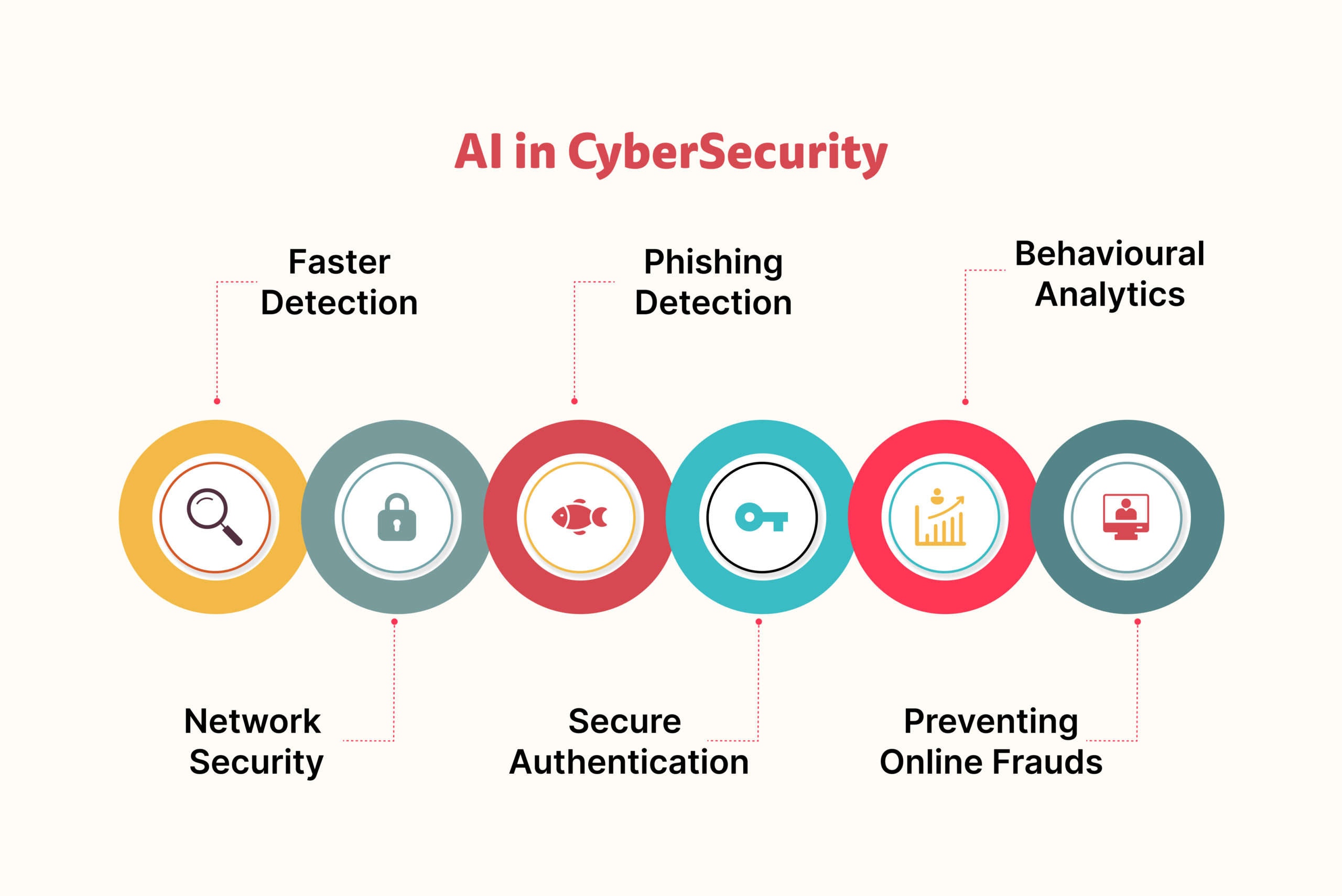
Artificial intelligence (AI) has become a cornerstone of modern cybersecurity, transforming how organizations defend against increasingly sophisticated cyber threats. Traditional security measures, such as firewalls and signature-based antivirus systems, struggle to keep pace with the rapid evolution of cyberattacks, including zero-day exploits, polymorphic malware, and advanced persistent threats (APTs). AI addresses these challenges by enabling proactive threat detection, adaptive defense mechanisms, and automated incident response.
AI-driven cybersecurity solutions analyze network traffic, user behavior, and system logs in real time, identifying patterns indicative of malicious activity. Unlike rule-based systems, AI models continuously learn from new data, improving their detection capabilities over time. This adaptability is crucial in an era where cybercriminals employ evasion techniques such as obfuscation, encryption, and AI-powered attacks to bypass conventional defenses.
#History and background
#Early developments
The integration of AI into cybersecurity began in the late 20th century, with early applications focusing on rule-based expert systems and heuristic analysis. In the 1980s and 1990s, researchers explored the use of artificial neural networks (ANNs) for intrusion detection, though computational limitations constrained their effectiveness. The term "cybersecurity AI" gained traction in the early 2000s as machine learning algorithms became more accessible and powerful.
#Modern era
The proliferation of big data and cloud computing in the 2010s accelerated AI adoption in cybersecurity. Breakthroughs in deep learning, particularly convolutional neural networks (CNNs) and recurrent neural networks (RNNs), enabled more accurate anomaly detection and malware classification. Companies like Darktrace, Cylance, and Palo Alto Networks pioneered AI-first security platforms, integrating unsupervised learning to detect unknown threats without relying on predefined signatures.
The rise of generative AI and large language models (LLMs) in the 2020s further expanded AI's role in cybersecurity. These models are used for threat intelligence analysis, phishing detection, and even simulating cyberattacks to test defenses. However, the dual-use nature of AI also introduced new risks, as adversaries began leveraging AI to craft more convincing phishing emails, deepfake scams, and automated hacking tools.
#How it works
#Threat detection
AI-powered threat detection relies on several core techniques:
- Supervised learning: Models are trained on labeled datasets containing known threats and benign activity. Algorithms such as support vector machines (SVMs) and random forests classify new data points based on learned patterns.
- Unsupervised learning: Used for detecting unknown threats, this approach identifies anomalies by clustering data points that deviate from established norms. Techniques like k-means clustering and autoencoders are commonly employed.
- Reinforcement learning: AI agents learn optimal defense strategies by interacting with their environment, receiving rewards for correct actions (e.g., blocking an attack) and penalties for errors.
- Natural language processing (NLP): Analyzes text-based threats such as phishing emails, social engineering attacks, and dark web chatter to identify malicious intent.
#Automated response
AI enhances incident response by automating repetitive tasks and accelerating decision-making. Security orchestration, automation, and response (SOAR) platforms use AI to:
- Prioritize alerts based on severity and context.
- Automatically quarantine infected systems or block malicious IP addresses.
- Generate incident reports and recommend remediation steps.
For example, an AI system might detect a ransomware attack in progress, isolate the affected devices, and deploy countermeasures before the malware can encrypt critical files.
#Predictive analytics
AI-driven predictive analytics forecast potential vulnerabilities and attack vectors by analyzing historical data, threat intelligence feeds, and emerging trends. This proactive approach allows organizations to patch weaknesses before they are exploited. For instance, AI models can predict which systems are most likely to be targeted based on their configuration, patch history, and exposure to the internet.
#Important facts
- Efficiency: AI reduces the time to detect and respond to threats from days or weeks to minutes or seconds.
- Scalability: AI systems can process and analyze vast datasets that would overwhelm human analysts.
- Adaptability: Unlike static rule-based systems, AI models evolve alongside new threats, reducing the need for constant manual updates.
- False positives: A significant challenge in AI-driven security is the rate of false positives, which can lead to alert fatigue and operational inefficiencies.
- Bias and fairness: AI models trained on biased datasets may produce skewed results, potentially overlooking certain types of attacks or misclassifying benign activity as malicious.
- Regulatory compliance: Organizations using AI in cybersecurity must ensure their systems comply with data protection regulations such as GDPR and CCPA.
#Timeline
Year Event 1986 First use of neural networks for intrusion detection (Denning's model). 1990s Development of heuristic-based antivirus systems. 2007 Introduction of unsupervised learning for anomaly detection in network traffic. 2012 Breakthrough in deep learning for image-based malware detection. 2016 Launch of Darktrace's Enterprise Immune System, an AI-driven cybersecurity platform. 2018 Adoption of AI in security operations centers (SOCs) for automated threat hunting. 2020 Use of NLP for detecting phishing emails and social engineering attacks. 2023 Emergence of generative AI for simulating cyberattacks and testing defenses. 2024 AI-powered autonomous response systems capable of mitigating attacks without human intervention.
#Related Terms
#FAQ
What does AI And Security: Preventing Harm cover?
Explores how artificial intelligence shapes security and preventing harm, covering practical use cases, benefits, limitations, and risks.
Why is AI And Security: Preventing Harm important?
It helps readers understand key concepts, compare practical use cases, and evaluate how Security & Privacy decisions affect outcomes, risks, and implementation choices.
What should readers verify before applying this topic?
Readers should compare the benefits, limitations, data requirements, and related themes such as Security, Preventing, Harm before using the ideas in real projects.
#References
- AI And Security: Preventing Harm terminology and background research
- AI And Security: Preventing Harm use cases, implementation examples, and limitations
- Security & Privacy best practices, standards, and risk guidance
- Security case studies, benchmarks, and current industry analysis



Comments
No comments yet. Start the discussion with a useful note.