

#Short Answer
Explores how artificial intelligence shapes security and threats and solutions, covering practical use cases, benefits, limitations, and risks.
#Infobox
Artificial Intelligence in Cybersecurity Field Cybersecurity Subfields Threat detection, Malware analysis, Behavioral analytics, Automated response Key Technologies Machine learning, Deep learning, Natural language processing, Predictive analytics Applications Intrusion detection, Fraud prevention, Vulnerability assessment, Incident response Challenges Adversarial attacks, Data privacy, Explainability, Bias in algorithms Notable Researchers Andrew Ng, Fei-Fei Li, Yoshua Bengio
#Overview
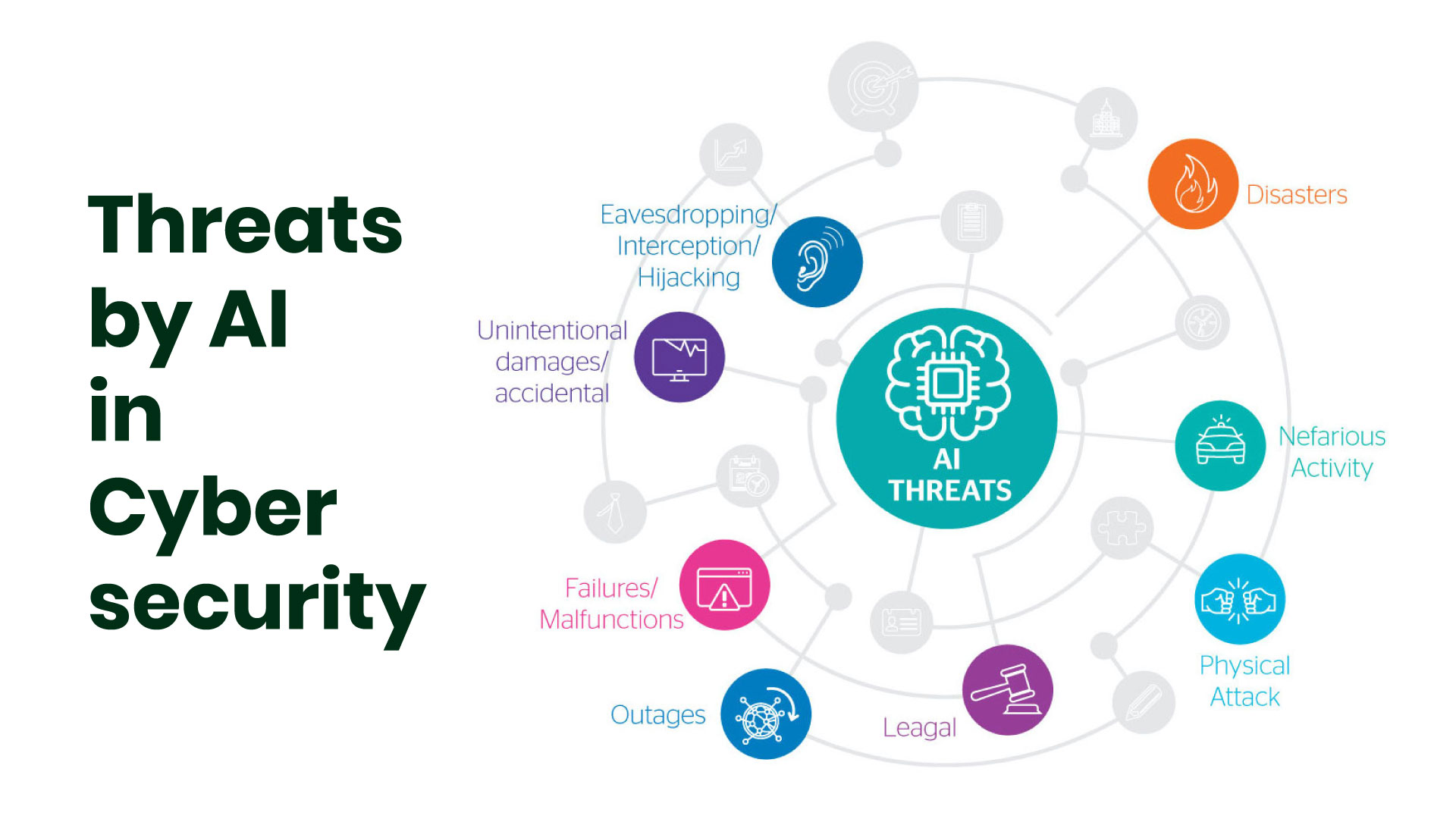
AI has become a cornerstone of modern cybersecurity, enabling organizations to combat increasingly sophisticated cyber threats. Traditional security measures, such as signature-based detection and rule-based systems, struggle to keep pace with the volume and complexity of modern attacks. AI-driven solutions leverage advanced algorithms to analyze network traffic, user behavior, and system logs in real time, identifying anomalies and potential threats before they cause significant damage.
AI in cybersecurity encompasses a wide range of applications, including threat detection, malware analysis, fraud prevention, and automated incident response. By automating routine tasks and augmenting human analysts, AI reduces response times and improves the accuracy of threat identification. However, the adoption of AI also raises concerns about data privacy, algorithmic bias, and the potential for adversarial manipulation of AI systems.
#History and background
The integration of AI into cybersecurity began in the late 20th century, with early applications focusing on rule-based expert systems and simple machine learning models. One of the first notable uses of AI in cybersecurity was in intrusion detection systems (IDS), which used statistical methods to identify anomalous behavior in network traffic.
In the 2000s, the rise of big data and advancements in computing power enabled the development of more sophisticated AI models, such as support vector machines (SVMs) and random forests. These models improved the accuracy of threat detection by analyzing large datasets and identifying complex patterns.
The 2010s saw a surge in the use of deep learning techniques, including convolutional neural networks (CNNs) and recurrent neural networks (RNNs), for tasks such as malware classification and behavioral analytics. The proliferation of cloud computing and the Internet of Things (IoT) further accelerated the adoption of AI in cybersecurity, as organizations sought to protect increasingly distributed and interconnected systems.
#How it works
#Threat detection
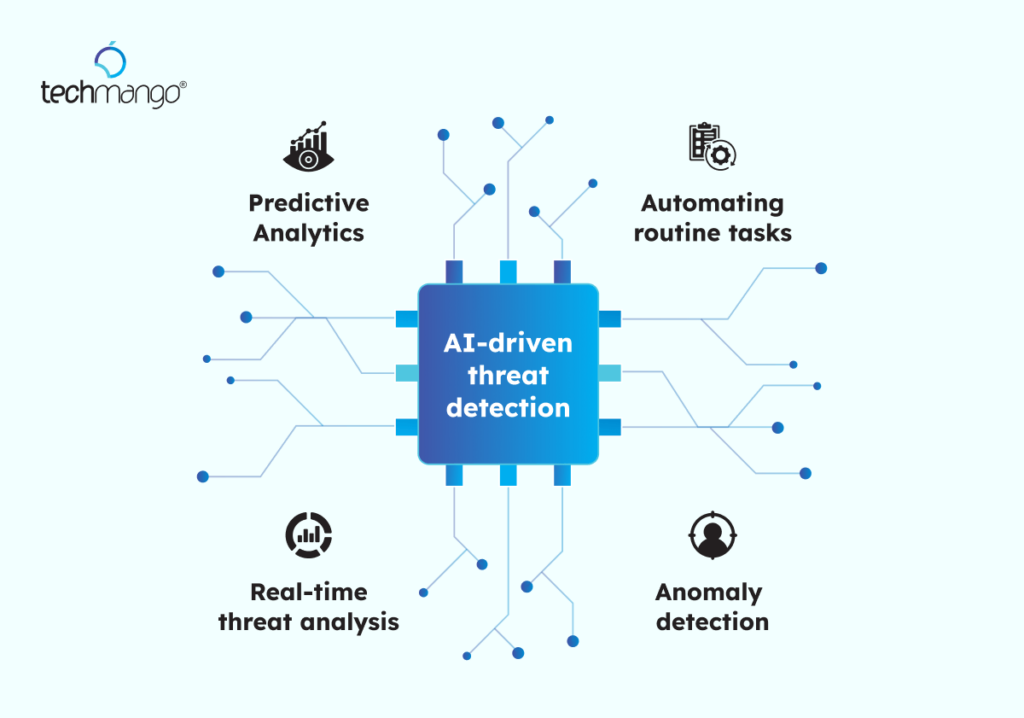
AI-powered threat detection systems analyze network traffic, user behavior, and system logs to identify potential threats. Machine learning models, such as supervised learning algorithms, are trained on labeled datasets to recognize known attack patterns. Unsupervised learning techniques, such as clustering and anomaly detection, are used to identify novel or previously unseen threats.
Behavioral analytics is another key application of AI in threat detection. By establishing baseline patterns of normal user and system behavior, AI models can detect deviations that may indicate a security breach. For example, an AI system might flag a user who suddenly accesses sensitive data outside of normal working hours.
#Malware analysis
AI is increasingly used to analyze and classify malware, including viruses, worms, and ransomware. Traditional malware analysis relies on static and dynamic analysis techniques, which can be time-consuming and resource-intensive. AI models, particularly deep learning models, can automate this process by analyzing file attributes, code structure, and behavior patterns to identify malicious software.
For example, convolutional neural networks (CNNs) can analyze the binary structure of executable files to detect similarities with known malware samples. Recurrent neural networks (RNNs) can analyze the sequential behavior of malware to identify patterns indicative of malicious activity.
#Automated response
AI-driven automated response systems enable organizations to respond to security incidents in real time. These systems use predefined playbooks and machine learning models to take immediate action, such as isolating affected systems, blocking malicious IP addresses, or deploying patches. Automated response reduces the time between detection and mitigation, minimizing the impact of security breaches.
However, automated response systems must be carefully designed to avoid false positives, which can disrupt legitimate operations. Human oversight and continuous monitoring are essential to ensure that automated actions are appropriate and effective.
#Important facts
- AI can analyze millions of events per second, far exceeding the capabilities of human analysts.
- Machine learning models require large datasets for training, which can raise concerns about data privacy and security.
- Adversarial attacks, where attackers manipulate AI systems to evade detection, are a growing concern in cybersecurity.
- AI-driven cybersecurity solutions are used in industries such as finance, healthcare, and critical infrastructure to protect sensitive data and systems.
- The global AI in cybersecurity market is projected to reach USD 46.3 billion by 2027, growing at a compound annual growth rate (CAGR) of 23.6%.
#Timeline
Year Event 1980s Early rule-based expert systems used for intrusion detection. 1990s Development of statistical methods for anomaly detection in network traffic. 2000s Rise of machine learning techniques, such as SVMs and random forests, for threat detection. 2010 Introduction of deep learning for malware classification and behavioral analytics. 2015 Widespread adoption of AI-driven security solutions in enterprise environments. 2018 Growing concern about adversarial attacks on AI systems. 2020 Increased use of AI in cloud security and IoT protection. 2023 Development of explainable AI (XAI) techniques to improve transparency in AI-driven security decisions.
#Related Terms
#FAQ
What does AI And Security: Threats And Solutions cover?
Explores how artificial intelligence shapes security and threats and solutions, covering practical use cases, benefits, limitations, and risks.
Why is AI And Security: Threats And Solutions important?
It helps readers understand key concepts, compare practical use cases, and evaluate how Business & Marketing decisions affect outcomes, risks, and implementation choices.
What should readers verify before applying this topic?
Readers should compare the benefits, limitations, data requirements, and related themes such as Security, Threat, Solution before using the ideas in real projects.
#References
- AI And Security: Threats And Solutions terminology and background research
- AI And Security: Threats And Solutions use cases, implementation examples, and limitations
- Business & Marketing best practices, standards, and risk guidance
- Security case studies, benchmarks, and current industry analysis

Comments
No comments yet. Start the discussion with a useful note.