

#Short Answer
Explores how artificial intelligence shapes space and satellite operations, covering practical use cases, benefits, limitations, and risks.
#Infobox
Artificial Intelligence in Space Exploration Field Space exploration, Satellite operations Key Technologies Machine learning, Computer vision, Autonomous systems, Neural networks Notable Applications Satellite autonomy, Deep space navigation, Exoplanet discovery, Space debris tracking First Major AI Integration 2001 (Deep Space 1) Major AI Systems AEGIS, Deep Space 1, Mars rovers, James Webb Space Telescope
#Overview
Artificial intelligence has become a cornerstone of modern space exploration, particularly in satellite operations and deep space missions. AI systems process vast amounts of data from sensors, cameras, and telescopes to make autonomous decisions, optimize trajectories, and identify celestial objects. In satellite operations, AI enhances autonomy, reduces ground control dependency, and improves fault detection. For deep space missions, AI enables spacecraft to navigate complex environments, avoid hazards, and conduct scientific experiments with minimal human input.
The integration of AI in space technology has led to breakthroughs in mission planning, real-time anomaly detection, and adaptive control systems. Machine learning algorithms analyze patterns in cosmic data, while computer vision systems interpret images from planetary surfaces and distant galaxies. As AI continues to evolve, its role in space exploration is expected to expand, enabling more ambitious missions to the Moon, Mars, and beyond.
#AI in Satellite Operations
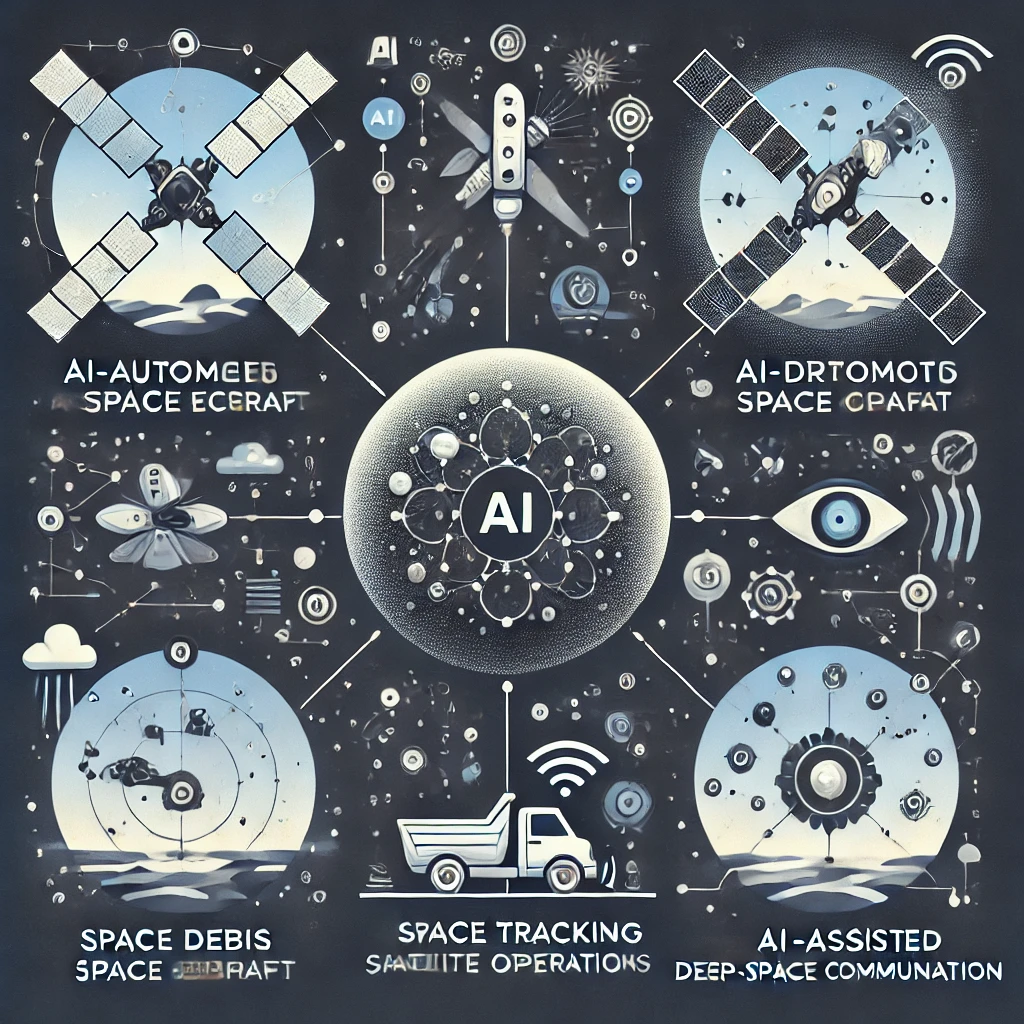
AI plays a critical role in satellite operations by automating routine tasks, optimizing fuel consumption, and enhancing communication protocols. Autonomous satellite systems use AI to:
- Detect and correct orbital anomalies without ground intervention.
- Prioritize data transmission based on scientific importance.
- Predict and avoid collisions with space debris or other satellites.
- Adjust solar panel orientations for maximum energy efficiency.
AI-driven satellite constellations, such as those used in Earth observation, can process terabytes of data daily to identify changes in climate, urban development, or natural disasters. Companies like Planet Labs and Spire Global leverage AI to analyze satellite imagery for agriculture, logistics, and disaster response.
#History / Background
The concept of AI in space exploration dates back to the early days of computer science. In the 1960s, NASA began experimenting with rule-based systems to assist in mission control. However, the first significant AI integration occurred in 2001 with Deep Space 1, which used an autonomous navigation system called Remote Agent to plan and execute maneuvers without ground commands.
The 2010s saw rapid advancements with the deployment of AI in Mars rovers like Curiosity and Perseverance, which use machine learning to navigate rocky terrain and select scientific targets. The James Webb Space Telescope (launched in 2021) employs AI to process and analyze infrared data from distant galaxies, identifying exoplanets and studying cosmic phenomena.
Government agencies and private companies have since adopted AI for various space applications. NASA’s Autonomous Exploration Research System (AEGIS) is used on the Mars Exploration Rovers to autonomously select rock targets for analysis. Similarly, the European Space Agency (ESA) has integrated AI into its Gaia mission to classify stars and detect asteroids.
#How It Works
#Machine Learning in Space
Machine learning (ML) algorithms are trained on vast datasets to recognize patterns in space data. For example:
- Supervised Learning: Used to classify celestial objects (e.g., distinguishing stars from galaxies in telescope images).
- Unsupervised Learning: Helps identify anomalies in satellite telemetry, such as unexpected temperature fluctuations.
- Reinforcement Learning: Enables spacecraft to learn optimal trajectories by simulating different flight paths and selecting the most efficient one.
#Computer Vision for Planetary Exploration
Computer vision systems process images from rovers and orbiters to map terrain, identify hazards, and select safe landing sites. For instance:
- Terrain Relative Navigation (TRN): Used by NASA’s Mars 2020 mission to guide the Perseverance rover during its landing.
- Obstacle Avoidance: AI-powered cameras on rovers detect rocks and slopes, allowing autonomous navigation.
- Exoplanet Detection: AI analyzes light curves from telescopes like TESS to identify potential exoplanets by detecting dips in starlight.
#Autonomous Systems and Control
Autonomous AI systems in spacecraft operate with minimal human input, using:
- Onboard Decision-Making: AI evaluates sensor data to adjust course, manage power, or reroute communications.
- Fault Detection and Recovery: Systems like NASA’s Livingstone monitor spacecraft health and initiate repairs autonomously.
- Swarm Intelligence: AI coordinates multiple satellites or rovers to work collaboratively, such as in NASA’s Mars Helicopter missions.
#Important Facts
- First AI Spacecraft: Deep Space 1 (2001) was the first mission to use an autonomous AI system for navigation and operations.
- AI in Mars Missions: The Perseverance rover uses AI to select rock samples for analysis, reducing the need for direct human commands.
- Space Debris Tracking: AI algorithms process radar and optical data to predict collisions between satellites and debris, enabling avoidance maneuvers.
- Exoplanet Discovery: Over 70% of known exoplanets have been identified using AI-powered analysis of telescope data.
- Energy Efficiency: AI optimizes power usage in satellites by predicting solar panel efficiency and battery degradation.
- Real-Time Anomaly Detection: AI systems can detect and respond to anomalies in spacecraft systems within milliseconds, far faster than human operators.
#Timeline
Year Milestone 1960s NASA begins using rule-based AI for mission control and early satellite operations. 1999 NASA’s Deep Space 1 mission launches with the first autonomous AI navigation system (Remote Agent). 2004 Mars Exploration Rovers (Spirit and Opportunity) use basic AI for autonomous navigation. 2012 NASA deploys AEGIS on the Mars Reconnaissance Orbiter for autonomous target selection. 2018 ESA’s Gaia mission uses AI to classify over a billion stars. 2020 Perseverance rover lands on Mars with advanced AI for sample selection and terrain mapping. 2021 James Webb Space Telescope launches, using AI to process infrared data from distant galaxies. 2023 NASA’s Lunar Flashlight mission uses AI for autonomous lunar surface mapping. 2024 Private companies like SpaceX and Blue Origin begin integrating AI into satellite constellations for real-time Earth observation.
#Related Terms
#FAQ
What does AI And Space: Satellite Operations cover?
Explores how artificial intelligence shapes space and satellite operations, covering practical use cases, benefits, limitations, and risks.
Why is AI And Space: Satellite Operations important?
It helps readers understand key concepts, compare practical use cases, and evaluate how Business & Marketing decisions affect outcomes, risks, and implementation choices.
What should readers verify before applying this topic?
Readers should compare the benefits, limitations, data requirements, and related themes such as Space, Satellite, Operation before using the ideas in real projects.
#References
- AI And Space: Satellite Operations terminology and background research
- AI And Space: Satellite Operations use cases, implementation examples, and limitations
- Business & Marketing best practices, standards, and risk guidance
- Space case studies, benchmarks, and current industry analysis

Comments
No comments yet. Start the discussion with a useful note.