


#Short Answer
Artificial intelligence (AI) and fifth-generation wireless technology (5G) represent a transformative convergence in telecommunications. AI-driven enhancements to 5G networks enable unprecedented speed, ultra-low latency, and intelligent automation, forming the backbone of next-generation digital infrastructure. By leveraging machine learning (ML), deep learning, and edge computing, AI optimizes network resources, predicts traffic patterns, and automates troubleshooting, ensuring seamless connectivity for billions of devices.
#Infobox
#Overview
Artificial intelligence (AI) and fifth-generation wireless technology (5G) represent a transformative convergence in telecommunications. AI-driven enhancements to 5G networks enable unprecedented speed, ultra-low latency, and intelligent automation, forming the backbone of next-generation digital infrastructure. By leveraging machine learning (ML), deep learning, and edge computing, AI optimizes network resources, predicts traffic patterns, and automates troubleshooting, ensuring seamless connectivity for billions of devices.
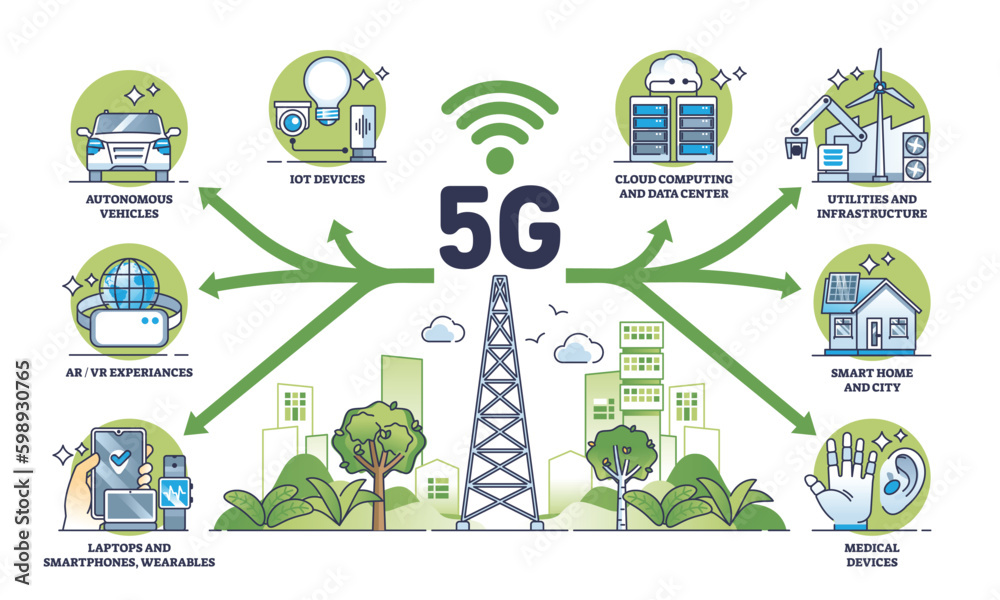
This synergy is pivotal for industries such as healthcare, manufacturing, and transportation, where real-time data processing and high-speed communication are critical. AI-powered 5G networks also support the growth of the Internet of Things (IoT), enabling smart cities, autonomous systems, and immersive digital experiences. As 5G deployment expands globally, AI continues to play a central role in refining network efficiency and unlocking new capabilities.
#History / Background
The evolution of AI in telecommunications traces back to early experiments with rule-based systems in the 1980s and 1990s. However, the integration of AI with mobile networks gained momentum with the advent of 4G LTE, where basic predictive analytics were used to manage network congestion. The transition to 5G in the late 2010s accelerated this trend, as the increased complexity of 5G networks demanded more sophisticated solutions.
Key milestones include the introduction of network slicing in 5G, which allows operators to create virtualized, isolated networks tailored to specific use cases. AI algorithms were deployed to dynamically allocate resources across these slices, optimizing performance for applications ranging from industrial automation to augmented reality. Major telecommunications companies, including Ericsson, Nokia, and Huawei, began integrating AI into their 5G infrastructure, developing proprietary platforms like Ericsson’s AI-powered Network Management and Nokia’s Nokia AVA.
Regulatory bodies such as the 3GPP also recognized the importance of AI in 5G standards, incorporating AI-driven features into the 5G New Radio specifications. This standardization ensured interoperability and scalability across global 5G deployments.
#How It Works
AI enhances 5G networks through several core mechanisms:
Predictive Analytics and Traffic Management
AI models analyze historical and real-time network data to predict traffic patterns, congestion points, and demand fluctuations. This enables proactive resource allocation, reducing latency and improving user experience. Techniques such as time series analysis and reinforcement learning are commonly used to optimize bandwidth distribution.
Network Slicing and Automation
5G’s network slicing allows operators to create multiple virtual networks on a single physical infrastructure. AI automates the creation, monitoring, and adjustment of these slices based on dynamic requirements. For example, a slice dedicated to autonomous vehicles may prioritize ultra-low latency, while an IoT slice may focus on energy efficiency.
Edge Computing Integration
AI-powered edge computing processes data closer to the source (e.g., user devices or IoT sensors) rather than relying solely on centralized cloud servers. This reduces transmission delays and enhances real-time decision-making. Edge AI is particularly critical for applications like remote surgery, where milliseconds count.
Self-Healing Networks
AI-driven systems continuously monitor network health and detect anomalies. When issues arise—such as hardware failures or cyberattacks—AI can autonomously reroute traffic, adjust configurations, or trigger maintenance protocols without human intervention.
Security Enhancements
AI strengthens 5G security by identifying and mitigating threats in real time. Machine learning models detect unusual patterns indicative of cyberattacks, such as distributed denial-of-service (DDoS) attempts or unauthorized access. AI also enhances encryption protocols and authentication mechanisms.
#Important Facts
- AI can reduce 5G network latency by up to 90% by optimizing data routing and processing.
- The global AI in telecom market is projected to reach $11.2 billion by 2026, growing at a CAGR of 42%.
- 5G networks with AI support can handle 100 times more connected devices per square kilometer compared to 4G.
- AI-driven network slicing enables customized performance for industries like healthcare (telemedicine), manufacturing (industrial IoT), and entertainment (8K streaming).
- Leading AI frameworks used in 5G include TensorFlow, PyTorch, and Apache Spark.
- AI can predict network failures with 95% accuracy, reducing downtime by up to 50%.
- The integration of AI with 5G is a key enabler for 6G networks, which are expected to rely even more heavily on AI for autonomous operation.
#Timeline
- Early AI applications in
Early AI applications in 4G networks for traffic prediction.
- 3GPP begins incorporating AI
3GPP begins incorporating AI into 5G standards.
- First commercial deployments o
First commercial deployments of AI in 5G networks by Ericsson and Nokia.
- Huawei launches AI-powered 5G
Huawei launches AI-powered 5G base stations.
- AI-driven network slicing beco
AI-driven network slicing becomes a standard feature in 5G deployments.
- Google and AWS introduce
Google and AWS introduce AI cloud services optimized for 5G edge computing.
- AI-based self-healing networks
AI-based self-healing networks reduce 5G outages by 40% in major cities.
- 3GPP releases Release 18
3GPP releases Release 18, further integrating AI into 5G-Advanced specifications.
#Related Terms
#FAQ
What does AI And 5G: Faster Smarter Networks cover?
Explores how artificial intelligence shapes 5G and faster smarter networks, covering practical use cases, benefits, limitations, and risks.
Why is AI And 5G: Faster Smarter Networks important?
It helps readers understand key concepts, compare practical use cases, and evaluate how Business & Marketing decisions affect outcomes, risks, and implementation choices.
What should readers verify before applying this topic?
Readers should compare the benefits, limitations, data requirements, and related themes such as 5G, Faster, Smarter before using the ideas in real projects.
#References
- AI And 5G: Faster Smarter Networks terminology and background research
- AI And 5G: Faster Smarter Networks use cases, implementation examples, and limitations
- Business & Marketing best practices, standards, and risk guidance
- 5G case studies, benchmarks, and current industry analysis
.jpg)

Comments
No comments yet. Start the discussion with a useful note.