

#Short Answer
Artificial intelligence (AI) in cybersecurity refers to the application of machine learning (ML), deep learning, and other AI techniques to identif...
#Infobox
Artificial intelligence in cybersecurity for automated threat detection and response.
#Overview
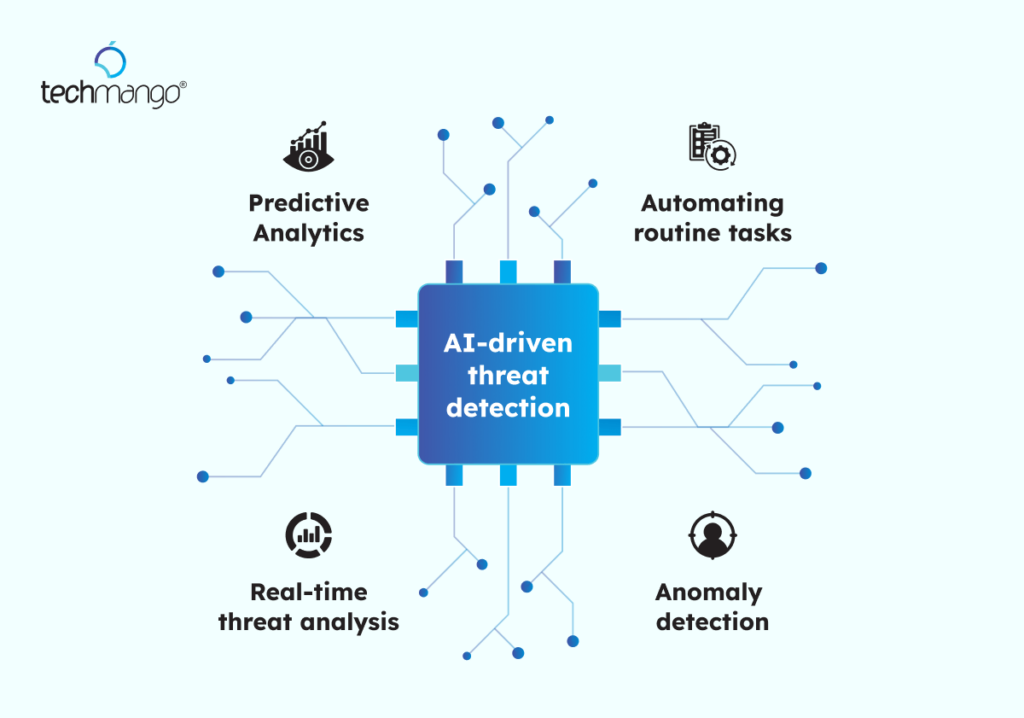
Artificial intelligence (AI) in cybersecurity refers to the application of machine learning (ML), deep learning, and other AI techniques to identify, analyze, and mitigate cyber threats. Unlike traditional rule-based systems, AI-driven threat detection systems continuously learn from data, adapt to new attack vectors, and improve detection accuracy over time. These systems are deployed across various domains, including network security, endpoint protection, fraud detection, and malware analysis, providing organizations with proactive and automated defense mechanisms against evolving cyber threats.
The integration of AI in cybersecurity enhances the ability to process vast amounts of data in real time, detect anomalies that deviate from normal behavior, and respond to incidents with minimal human intervention. This approach is particularly crucial in addressing the growing complexity and sophistication of cyberattacks, such as zero-day exploits, ransomware, and advanced persistent threats (APTs). By leveraging AI, organizations can reduce response times, minimize false positives, and allocate cybersecurity resources more efficiently.
#History / Background
The concept of using AI for cybersecurity emerged in the late 20th century, with early applications focusing on rule-based expert systems and simple anomaly detection. One of the pioneering efforts was the development of intrusion detection systems (IDS) in the 1980s and 1990s, which used statistical methods to identify suspicious activities. However, these systems were limited by their reliance on predefined rules and struggled to adapt to novel threats.
The breakthrough came with the advent of machine learning in the 2000s. Researchers began exploring supervised and unsupervised learning techniques to detect patterns in network traffic and system logs. The introduction of deep learning in the 2010s further revolutionized the field, enabling the analysis of large-scale datasets and the detection of complex, multi-stage attacks. Notable milestones include the development of Darktrace in 2013, which pioneered the use of AI for autonomous threat detection, and the launch of IBM Watson for Cyber Security in 2016, which combined AI with human expertise to enhance threat intelligence.
Today, AI-driven cybersecurity is a rapidly evolving discipline, driven by advancements in computing power, big data analytics, and the increasing sophistication of cyber adversaries. Governments, enterprises, and cybersecurity firms are investing heavily in AI research to stay ahead of emerging threats and develop next-generation defense mechanisms.
#How It Works
#Core Technologies
AI-driven threat detection relies on several core technologies, each contributing to its effectiveness:
- Machine Learning (ML): ML algorithms, such as support vector machines (SVM), random forests, and neural networks, are trained on historical data to recognize patterns associated with malicious activities. These models can classify threats, predict attack vectors, and adapt to new data over time.
- Deep Learning: Deep learning models, including convolutional neural networks (CNNs) and recurrent neural networks (RNNs), excel at processing unstructured data, such as images, logs, and network traffic. They are particularly effective in detecting anomalies in visual data (e.g., phishing emails with embedded images) and analyzing sequential data (e.g., time-series logs).
- Natural Language Processing (NLP): NLP is used to analyze text-based data, such as emails, social media posts, and security reports, to identify phishing attempts, social engineering attacks, and other forms of cyber threats. Techniques like sentiment analysis and named entity recognition help extract meaningful insights from unstructured text.
- Anomaly Detection: Anomaly detection algorithms identify deviations from normal behavior, flagging unusual activities that may indicate a cyberattack. These algorithms can be rule-based, statistical, or based on ML models, such as Isolation Forest or autoencoders.
- Behavioral Analytics: Behavioral analytics focuses on understanding user and entity behavior to detect insider threats, compromised accounts, and other anomalous activities. By establishing baselines of normal behavior, these systems can identify deviations that may signal a security breach.
#Implementation Approaches
AI-driven threat detection can be implemented using various approaches, depending on the specific use case and organizational requirements:
- Supervised Learning: In supervised learning, models are trained on labeled datasets containing examples of both malicious and benign activities. The model learns to classify new data points based on the patterns it has identified. This approach is commonly used for malware detection, spam filtering, and intrusion detection.
- Unsupervised Learning: Unsupervised learning does not rely on labeled data. Instead, it identifies patterns and clusters in the data to detect anomalies. Techniques like k-means clustering and DBSCAN are used to group similar data points and flag outliers that may indicate a threat.
- Reinforcement Learning: Reinforcement learning involves training models to make decisions based on rewards and penalties. In cybersecurity, this approach can be used to optimize response strategies, such as dynamically adjusting firewall rules or prioritizing alerts based on their severity.
- Hybrid Models: Hybrid models combine multiple AI techniques to enhance detection accuracy. For example, a system might use supervised learning for initial threat classification and unsupervised learning for anomaly detection, followed by reinforcement learning to refine response actions.
#Deployment Scenarios
AI-driven threat detection systems are deployed across various environments to provide comprehensive security coverage:
- Network Security: AI systems monitor network traffic in real time, analyzing packets, protocols, and behavioral patterns to detect intrusions, data exfiltration, and other malicious activities. Tools like Zeek (formerly Bro) and Snort incorporate AI to enhance their detection capabilities.
- Endpoint Protection: Endpoint detection and response (EDR) solutions use AI to monitor devices such as laptops, servers, and IoT devices for signs of compromise. These systems analyze system logs, file integrity, and user behavior to detect malware, ransomware, and other threats.
- Cloud Security: AI-powered cloud security platforms analyze cloud workloads, configurations, and access patterns to identify misconfigurations, unauthorized access, and other risks. Services like AWS GuardDuty and Microsoft Defender for Cloud leverage AI to provide real-time threat detection in cloud environments.
- Fraud Detection: In the financial sector, AI systems analyze transaction data, user behavior, and device fingerprints to detect fraudulent activities, such as credit card fraud, account takeover, and money laundering. Techniques like graph analytics and behavioral biometrics are commonly used.
- Threat Intelligence: AI enhances threat intelligence by automating the collection, analysis, and dissemination of information about emerging threats. Platforms like Recorded Future and Mandiant use AI to correlate data from multiple sources and provide actionable insights to security teams.
#Important Facts
- Accuracy and Efficiency: AI-driven threat detection systems can process millions of events per second, significantly reducing the time required to identify and respond to threats compared to traditional methods.
- Adaptability: Unlike static rule-based systems, AI models continuously learn from new data, allowing them to adapt to evolving attack techniques and zero-day vulnerabilities.
- Reduction in False Positives: By leveraging ML and behavioral analytics, AI systems can distinguish between legitimate activities and actual threats, reducing the number of false alarms that security teams must investigate.
- Scalability: AI-driven solutions can scale to handle the growing volume of data generated by modern IT environments, including cloud services, IoT devices, and remote workforces.
- Integration with Other Technologies: AI is often combined with other technologies, such as blockchain for secure data sharing, quantum computing for cryptanalysis, and Zero Trust architectures for access control.
- Regulatory Compliance: AI-driven cybersecurity solutions help organizations comply with regulations such as the GDPR, HIPAA, and PCI DSS by automating threat detection and response processes.
#Related Terms
#FAQ
What does AI And Cybersecurity: Threat Detection cover?
Explores how artificial intelligence shapes cybersecurity and threat detection, covering practical use cases, benefits, limitations, and risks.
Why is AI And Cybersecurity: Threat Detection important?
It helps readers understand key concepts, compare practical use cases, and evaluate how Business & Marketing decisions affect outcomes, risks, and implementation choices.
What should readers verify before applying this topic?
Readers should compare the benefits, limitations, data requirements, and related themes such as Cybersecurity, Threat, Detection before using the ideas in real projects.
#References
- AI And Cybersecurity: Threat Detection terminology and background research
- AI And Cybersecurity: Threat Detection use cases, implementation examples, and limitations
- Business & Marketing best practices, standards, and risk guidance
- Cybersecurity case studies, benchmarks, and current industry analysis

Comments
No comments yet. Start the discussion with a useful note.