

#Short Answer
AI feedback is a critical component in the development and refinement of artificial intelligence systems, particularly in machine learning and natu...
#Infobox
AI feedback systems rely on user input to refine models, improve accuracy, and enhance performance through iterative learning processes.
#Overview
AI feedback is a critical component in the development and refinement of artificial intelligence systems, particularly in machine learning and natural language processing (NLP). It refers to the process where AI models receive input from users or external systems to improve their performance, accuracy, and relevance. This feedback loop is essential for training models, correcting errors, and adapting to new data or user preferences. In modern AI applications, feedback mechanisms are often automated or semi-automated, allowing systems to learn continuously from interactions.
Feedback in AI can take various forms, including explicit user ratings, implicit behavior tracking (e.g., clicks, dwell time), or structured annotations. For instance, in chatbot systems, user corrections or follow-up questions serve as feedback to refine responses. Similarly, recommendation engines use implicit feedback like purchase history or watch time to personalize suggestions. The integration of feedback into AI systems has led to significant advancements in areas such as conversational AI, autonomous systems, and decision-making tools.
#History / Background
The concept of feedback in AI traces back to early cybernetics and control theory in the mid-20th century, where feedback loops were used to regulate systems. However, the application of feedback in machine learning gained prominence with the rise of supervised learning in the 1980s and 1990s. Early AI systems relied on labeled datasets for training, but the limitations of static datasets led to the exploration of dynamic feedback mechanisms.
In the 2000s, reinforcement learning (RL) emerged as a key framework for incorporating feedback, where an agent learns to make decisions by receiving rewards or penalties based on its actions. The advent of deep learning in the 2010s further accelerated the use of feedback, particularly in NLP and computer vision. Companies like Google, Microsoft, and OpenAI began integrating user feedback into their AI models to improve performance in products like search engines, virtual assistants, and content moderation tools.
A notable milestone was the introduction of human-in-the-loop (HITL) systems, where human annotators provide feedback to train or fine-tune AI models. Platforms like Amazon Mechanical Turk and specialized annotation services enabled the scaling of feedback-driven AI development. Today, feedback is a cornerstone of AI ethics and responsible AI, ensuring models align with user expectations and societal norms.
#How It Works
#Feedback Collection
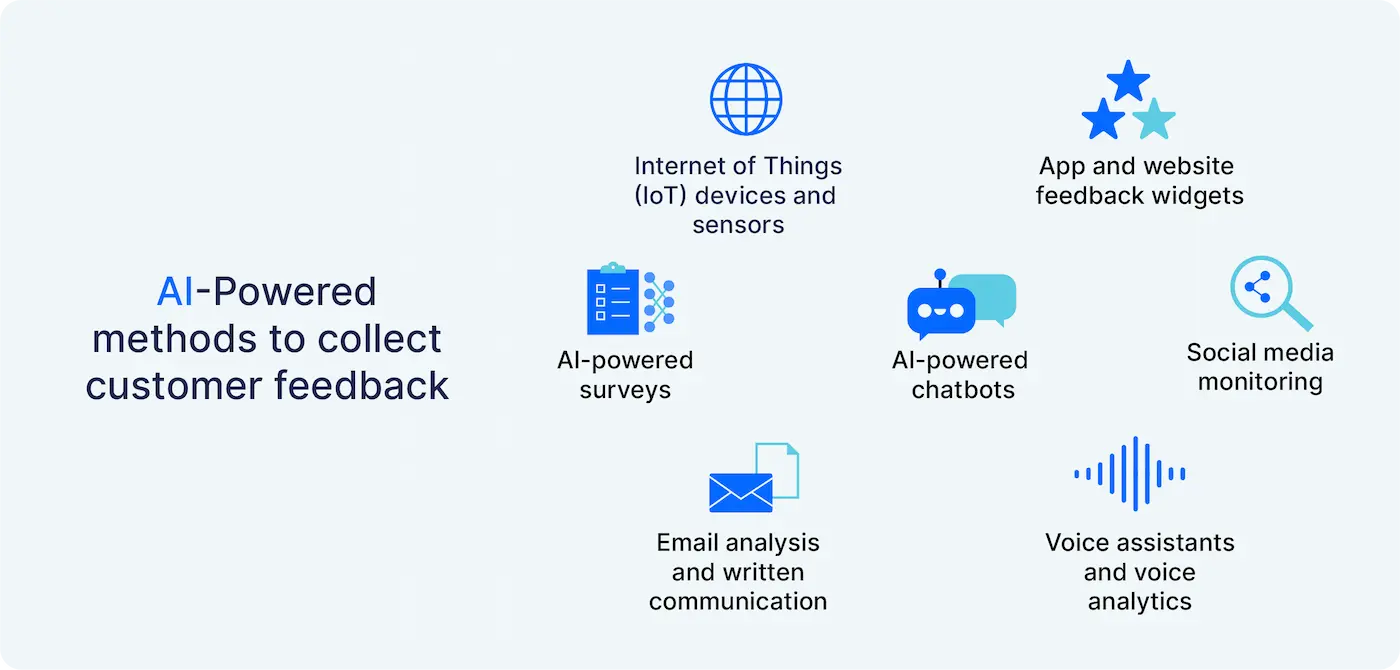
Feedback collection is the first step in the AI feedback loop. It can be categorized into two main types:
- Explicit Feedback: Direct input from users, such as ratings, reviews, or corrections. For example, a user may rate a chatbot's response as "helpful" or "not helpful."
- Implicit Feedback: Indirect signals derived from user behavior, such as click-through rates, time spent on a page, or repeated interactions. Implicit feedback is often used in recommendation systems to infer user preferences.
#Feedback Processing
Once collected, feedback is processed to extract meaningful insights. This involves:
- Data Cleaning: Removing noise, duplicates, or irrelevant feedback to ensure quality.
- Annotation: Labeling feedback with metadata (e.g., sentiment, relevance) to facilitate training.
- Aggregation: Summarizing feedback to identify trends or patterns, such as common user complaints or areas for improvement.
#Model Training and Adaptation
Feedback is then integrated into the AI model through various techniques:
- Supervised Learning: Feedback is used to create labeled datasets, which train the model to recognize patterns or make predictions.
- Reinforcement Learning: Feedback is treated as a reward or penalty, guiding the model to optimize its actions over time.
- Active Learning: The model selectively requests feedback on uncertain predictions to improve efficiency.
#Deployment and Iteration
After training, the model is deployed, and the feedback loop continues. Users interact with the AI system, providing new feedback that is fed back into the model for further refinement. This iterative process ensures continuous improvement and adaptation to changing user needs or environmental conditions.
#Important Facts
- Feedback Quality Matters: High-quality feedback leads to better model performance, while noisy or biased feedback can degrade accuracy.
- Bias Mitigation: Feedback can inadvertently introduce biases (e.g., racial, gender) if not carefully curated. Techniques like adversarial debiasing are used to address this.
- Scalability Challenges: Collecting and processing feedback at scale requires robust infrastructure, often leveraging cloud computing and distributed systems.
- Ethical Considerations: Feedback systems must balance user privacy with the need for data collection. Regulations like GDPR impose constraints on how feedback data is stored and used.
- Real-Time Feedback: Modern AI systems, such as autonomous vehicles or chatbots, rely on real-time feedback to make split-second decisions.
#Timeline
- A paradigm where humans provide feedback to guide AI model training or decision
making.
- A technique where human feedback is used to train reinforcement learning models.
- A machine learning approach where the model selectively queries users for feedback on uncertain predictions.
- The cyclical process where AI systems receive input, process it, and adapt based on the output.
- Systematic errors in AI models due to biased feedback or training data.
- Techniques to make AI decisions interpretable, often using feedback from users or domain experts.
#Related Terms
#FAQ
What does AI And Feedback: User Input cover?
Explores how artificial intelligence shapes feedback and user input, covering practical use cases, benefits, limitations, and risks.
Why is AI And Feedback: User Input important?
It helps readers understand key concepts, compare practical use cases, and evaluate how Biography decisions affect outcomes, risks, and implementation choices.
What should readers verify before applying this topic?
Readers should compare the benefits, limitations, data requirements, and related themes such as Feedback, User, Input before using the ideas in real projects.
#References
- AI And Feedback: User Input terminology and background research
- AI And Feedback: User Input use cases, implementation examples, and limitations
- Biography best practices, standards, and risk guidance
- Feedback case studies, benchmarks, and current industry analysis



Comments
No comments yet. Start the discussion with a useful note.