

#Short Answer
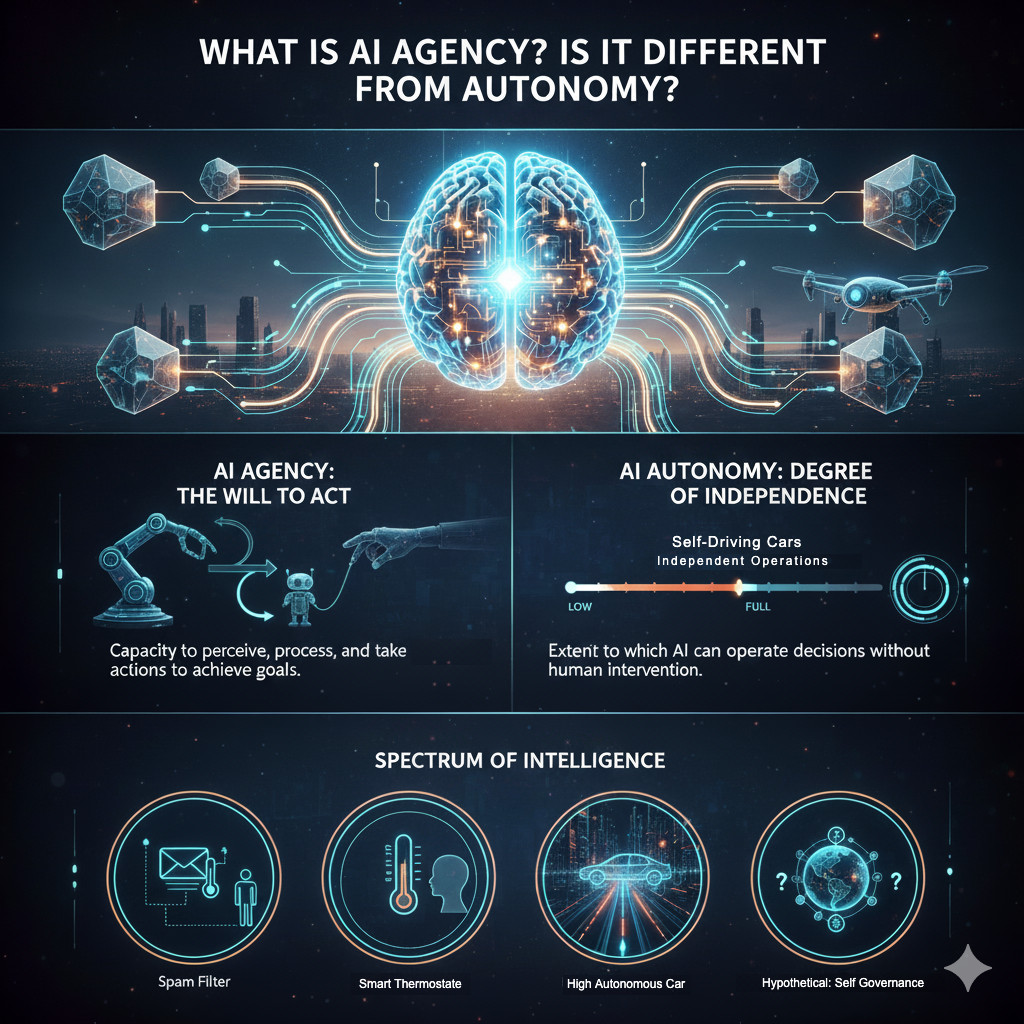
Artificial Intelligence and autonomy are closely related concepts in computer science and robotics. AI involves the simulation of human intelligence in machines, enabling them to learn, reason, and make decisions. Autonomy, on the other hand, refers to a system's ability to operate independently, making choices based on predefined goals or learned behaviors.
#Infobox
#Overview
Artificial Intelligence and autonomy are closely related concepts in computer science and robotics. AI involves the simulation of human intelligence in machines, enabling them to learn, reason, and make decisions. Autonomy, on the other hand, refers to a system's ability to operate independently, making choices based on predefined goals or learned behaviors.
In modern applications, AI systems often incorporate autonomy to enhance their functionality. For example, autonomous vehicles use AI to navigate roads, interpret traffic signals, and make real-time decisions. Similarly, smart home devices rely on autonomous AI to adjust settings based on user preferences and environmental conditions. The integration of AI and autonomy aims to create systems that are both intelligent and respectful of user control.
#History / Background
#Early Development of AI
The origins of AI trace back to the mid-20th century, with key contributions from researchers such as Alan Turing, who proposed the concept of a "universal machine" capable of performing any task a human could. The term "artificial intelligence" was coined in 1956 during the Dartmouth Conference, marking the formal beginning of AI as a field of study.
Early AI systems were rule-based and lacked the ability to learn from data. However, advancements in computing power and algorithmic techniques, such as machine learning and neural networks, revolutionized the field. By the 1980s, AI researchers began exploring autonomy as a critical component of intelligent systems, leading to the development of autonomous agents capable of making decisions without direct human input.
#Evolution of Autonomy in AI
Autonomy in AI gained prominence with the rise of robotics and autonomous systems in the late 20th and early 21st centuries. Projects like NASA's Mars rovers demonstrated the potential of autonomous machines to operate in unpredictable environments. Meanwhile, advancements in sensor technology, computer vision, and reinforcement learning further enhanced the autonomy of AI systems.
Today, autonomy is a cornerstone of modern AI applications, from self-driving cars to industrial robots. The focus has shifted from merely automating tasks to ensuring that AI systems can adapt, learn, and make decisions in ways that align with human values and preferences.
#How It Works
#AI Systems
AI systems operate by processing large amounts of data through algorithms designed to identify patterns, make predictions, or perform specific tasks. Machine learning, a subset of AI, enables systems to improve their performance over time by learning from data. Deep learning, a more advanced form of machine learning, uses neural networks to model complex relationships in data.
AI systems can be categorized into narrow AI, which is designed for specific tasks, and general AI, which aims to perform any intellectual task a human can. Most current AI applications fall under narrow AI, such as natural language processing, image recognition, and autonomous decision-making.
#Autonomy in AI
Autonomy in AI refers to a system's ability to operate independently, making decisions based on its environment and goals. This involves several key components:
- Perception: Gathering data from sensors or other inputs to understand the surrounding environment.
- Reasoning: Processing the data to make informed decisions or predictions.
- Action: Executing tasks based on the reasoning process, often in real-time.
- Learning: Adapting and improving over time through feedback and new data.
For example, an autonomous drone uses cameras and sensors to perceive its surroundings, processes the data to determine its path, and takes action to navigate obstacles while avoiding collisions. The system may also learn from its experiences to improve future performance.
#Balancing AI and User Autonomy
Respecting user choice is a critical aspect of AI autonomy. Systems must be designed to allow users to override or modify decisions, ensuring that AI serves as a tool rather than a replacement for human judgment. This balance is achieved through:
- User Interfaces: Providing clear controls and feedback mechanisms for users to interact with AI systems.
- Explainability: Ensuring that AI decisions are transparent and understandable to users.
- Customization: Allowing users to set preferences and constraints for AI behavior.
- Safety Mechanisms: Implementing safeguards to prevent unintended or harmful actions by autonomous systems.
#Important Facts
- AI autonomy is not synonymous with complete independence; it often involves collaboration between machines and humans.
- The level of autonomy in AI systems varies widely, from semi-autonomous tools to fully autonomous agents.
- Ethical considerations, such as bias in AI algorithms and the impact on employment, are major concerns in the development of autonomous AI.
- Regulatory frameworks, such as the EU's AI Act, aim to govern the deployment of autonomous AI systems to ensure safety and fairness.
- Autonomous AI systems are increasingly used in healthcare, finance, transportation, and manufacturing, transforming industries.
#Timeline
- Alan Turing proposes the
Alan Turing proposes the 'Turing Test' as a criterion for machine intelligence.
- The term 'artificial intellig
The term 'artificial intelligence' is coined at the Dartmouth Conference.
- ELIZA, an early natural
ELIZA, an early natural language processing program, is developed.
- Expert systems and rule-based
Expert systems and rule-based AI gain popularity.
- IBM's Deep Blue defeats
IBM's Deep Blue defeats world chess champion Garry Kasparov.
- DARPA's Grand Challenge sparks
DARPA's Grand Challenge sparks interest in autonomous vehicles.
- IBM Watson wins *Jeopardy!*
IBM Watson wins *Jeopardy!*, showcasing advanced natural language processing.
- Deep learning breakthroughs le
Deep learning breakthroughs lead to significant improvements in AI performance.
- AlphaGo defeats a world
AlphaGo defeats a world champion Go player, demonstrating advanced autonomous decision-making.
- Autonomous AI systems become
Autonomous AI systems become widespread in industries such as healthcare, finance, and transportation.
#Related Terms
#FAQ
What does AI And Autonomy: Respecting User Choice cover?
Explores how artificial intelligence shapes autonomy and respecting user choice, covering practical use cases, benefits, limitations, and risks.
Why is AI And Autonomy: Respecting User Choice important?
It helps readers understand key concepts, compare practical use cases, and evaluate how Biography decisions affect outcomes, risks, and implementation choices.
What should readers verify before applying this topic?
Readers should compare the benefits, limitations, data requirements, and related themes such as Autonomy, Respecting, User before using the ideas in real projects.
#References
- AI And Autonomy: Respecting User Choice terminology and background research
- AI And Autonomy: Respecting User Choice use cases, implementation examples, and limitations
- Biography best practices, standards, and risk guidance
- Autonomy case studies, benchmarks, and current industry analysis



Comments
No comments yet. Start the discussion with a useful note.