

#Short Answer
Exploration of artificial intelligence applications in user feedback analysis, methodologies, and real-world impacts.
#Infobox
#Overview
Artificial intelligence (AI) has transformed the way organizations collect, process, and interpret user feedback. By leveraging advanced algorithms and natural language processing (NLP), AI enables businesses to automatically analyze vast volumes of qualitative and quantitative feedback from sources such as surveys, social media, reviews, and support tickets. This capability allows for real-time insights, sentiment detection, and trend identification, empowering companies to respond swiftly to customer needs and enhance product development cycles.
AI-driven feedback analysis goes beyond traditional keyword matching. Modern systems utilize deep learning models—particularly transformer-based architectures like BERT and its variants—to understand context, detect nuance, and classify emotions with high accuracy. These systems can distinguish between sarcasm, mixed sentiments, and subtle linguistic cues, providing a more nuanced understanding of user experiences than rule-based or lexicon-based approaches.
#History / Background
#Early Developments
The roots of AI in feedback analysis trace back to the 1990s and early 2000s, when basic sentiment analysis tools emerged using rule-based systems and simple machine learning classifiers. Early applications focused on binary sentiment classification (positive/negative) and relied on manually crafted lexicons such as SentiWordNet. These systems were limited in scope and struggled with ambiguity, context, and domain-specific language.
#Rise of Machine Learning
The mid-2000s saw a shift toward machine learning models, including support vector machines (SVMs) and Naive Bayes classifiers, trained on labeled datasets. This period improved accuracy but still required significant feature engineering and domain adaptation. The introduction of word embeddings—such as Word2Vec and GloVe—enabled models to capture semantic relationships between words, enhancing the contextual understanding of feedback.
#Deep Learning and Transformers
A major breakthrough occurred in 2017 with the publication of the Attention Is All You Need paper, introducing the Transformer architecture. Models like BERT (Bidirectional Encoder Representations from Transformers), released by Google in 2018, revolutionized NLP by pre-training on massive corpora and fine-tuning for specific tasks. These models achieved state-of-the-art performance in sentiment analysis, intent detection, and emotion classification, enabling AI systems to process feedback with unprecedented accuracy and contextual awareness.
#Modern Integration
Today, AI feedback analysis is integrated into customer experience platforms, CRM systems, and business intelligence tools. Companies across industries—from e-commerce and SaaS to healthcare and finance—use AI to automate feedback processing, generate actionable insights, and personalize customer interactions. The rise of generative AI has further expanded capabilities, enabling systems to not only analyze feedback but also generate responses, summarize trends, and predict future user behavior.
#How It Works
#Data Collection
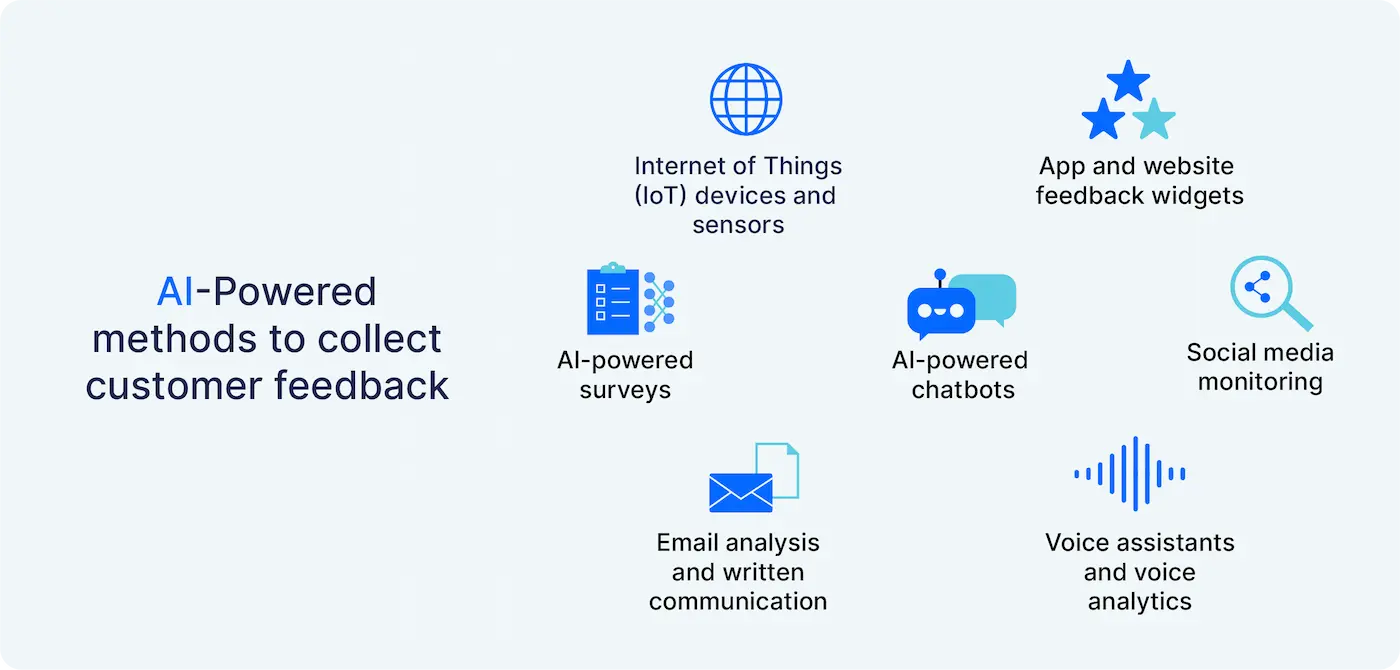
AI feedback analysis begins with data ingestion from multiple sources: customer surveys, online reviews (e.g., Google, Yelp), social media posts, support tickets, and in-app feedback forms. Structured data (e.g., rating scores) and unstructured data (e.g., open-ended comments) are both captured. APIs, web scraping, and data pipelines ensure continuous data flow into centralized repositories.
#Preprocessing
Raw text undergoes preprocessing to improve model performance. This includes tokenization, lowercasing, removal of stop words, stemming/lemmatization, and handling of special characters, emojis, and slang. Emojis are often converted to sentiment-bearing tokens (e.g., 😊 → "positive_emoji"). Noise such as typos and abbreviations is corrected using spell-checking algorithms or contextual models.
#Model Inference
Preprocessed text is fed into AI models for analysis. Common approaches include:
- Sentiment Analysis: Classifies text as positive, negative, or neutral, often with fine-grained scales (e.g., 1–5 stars).
- Aspect-Based Sentiment Analysis (ABSA): Identifies sentiments toward specific product features or attributes (e.g., "The battery life is great, but the screen is too dim").
- Intent Detection: Classifies user intent (e.g., complaint, praise, question, request for help).
- Emotion Recognition: Detects emotions such as joy, frustration, anger, or confusion using models trained on emotional lexicons.
- Topic Modeling: Extracts key themes or topics from feedback using algorithms like LDA (Latent Dirichlet Allocation).
#Post-Processing and Insights
Model outputs are aggregated and visualized in dashboards. Key metrics include sentiment distribution, topic frequency, and trending issues. Alerts are triggered for negative spikes or urgent feedback. Some systems integrate with workflow tools to automatically route high-priority feedback to relevant teams. Natural language generation (NLG) models may produce executive summaries or actionable recommendations based on analysis.
#Important Facts
- Accuracy: Modern transformer models achieve over 90% accuracy on standard sentiment analysis benchmarks like SST-2 and IMDB reviews.
- Scalability: AI systems can process millions of feedback entries per day, far exceeding human capacity.
- Multilingual Support: Advanced models support over 100 languages, enabling global feedback analysis without language barriers.
- Bias Mitigation: Techniques such as adversarial training and bias audits are used to reduce demographic or cultural biases in model predictions.
- Real-Time Processing: Cloud-based AI pipelines enable real-time analysis, with latency often under 500 milliseconds per document.
- Cost Efficiency: Automating feedback analysis reduces operational costs by up to 70% compared to manual review processes.
- Integration with CRM: Over 60% of CRM platforms now include built-in AI feedback analysis tools.
#Timeline
- Introduction of early sentimen
Introduction of early sentiment analysis using lexicon-based methods.
- First use of machine
First use of machine learning (SVM) for sentiment classification.
- Adoption of word embeddings
Adoption of word embeddings (Word2Vec) improves semantic understanding.
- Deep learning models (RNNs
Deep learning models (RNNs, LSTMs) begin outperforming traditional ML in sentiment tasks.
- Transformer architecture intro
Transformer architecture introduced, paving the way for BERT.
- BERT released, revolutionizing
BERT released, revolutionizing NLP and feedback analysis.
- Fine-tuned BERT models become
Fine-tuned BERT models become standard in commercial feedback analysis platforms.
- Generative AI models (e.g.
Generative AI models (e.g., LLMs) enable automated response generation and trend forecasting.
- Multimodal feedback analysis (
Multimodal feedback analysis (text + audio + video) emerges in customer experience platforms.
#Related Terms
#FAQ
What does AI Users: Their Experiences And Feedback cover?
AI users: their experiences and feedback covers practical examples, benefits, limitations, and important considerations for readers.
Why is AI Users: Their Experiences And Feedback important?
It helps readers understand key concepts, compare practical use cases, and evaluate how Biography decisions affect outcomes, risks, and implementation choices.
What should readers verify before applying this topic?
Readers should compare the benefits, limitations, data requirements, and related themes such as User, Experience, Feedback before using the ideas in real projects.
#References
- AI Users: Their Experiences And Feedback terminology and background research
- AI Users: Their Experiences And Feedback use cases, implementation examples, and limitations
- Biography best practices, standards, and risk guidance
- User case studies, benchmarks, and current industry analysis


Comments
No comments yet. Start the discussion with a useful note.