

#Short Answer
Traces timeline of ai tools, highlighting major milestones, context, examples, and future implications.
#Infobox
#Overview
The Timeline of AI Tools provides a structured overview of the development of artificial intelligence technologies, from early theoretical concepts to contemporary applications. AI tools have evolved through distinct phases, each marked by technological breakthroughs, shifts in methodology, and expanding capabilities. This timeline traces the progression from rule-based systems to machine learning, deep learning, and generative AI, illustrating how these tools have transitioned from academic research to real-world deployment. AI tools today encompass a wide range of applications, including natural language processing (NLP), computer vision, robotics, and autonomous systems. The timeline highlights how these tools have become integral to industries such as healthcare, finance, education, and entertainment, reshaping how humans interact with technology.
#History / Background
#Early Foundations (Pre-1950s)
The origins of AI can be traced to the early 20th century, with foundational work in logic, mathematics, and computation. Key contributions include:
- Alan Turing’s 1936 paper on computable numbers, which introduced the concept of a universal machine (later known as the Turing machine).
- Claude Shannon’s 1948 paper on information theory, which laid the groundwork for digital circuit design and symbolic logic.
- Norbert Wiener’s cybernetics (1948), which explored the parallels between human cognition and machine control systems.
#The Birth of AI (1950s–1960s)
The formal field of AI was established in the 1950s, marked by:
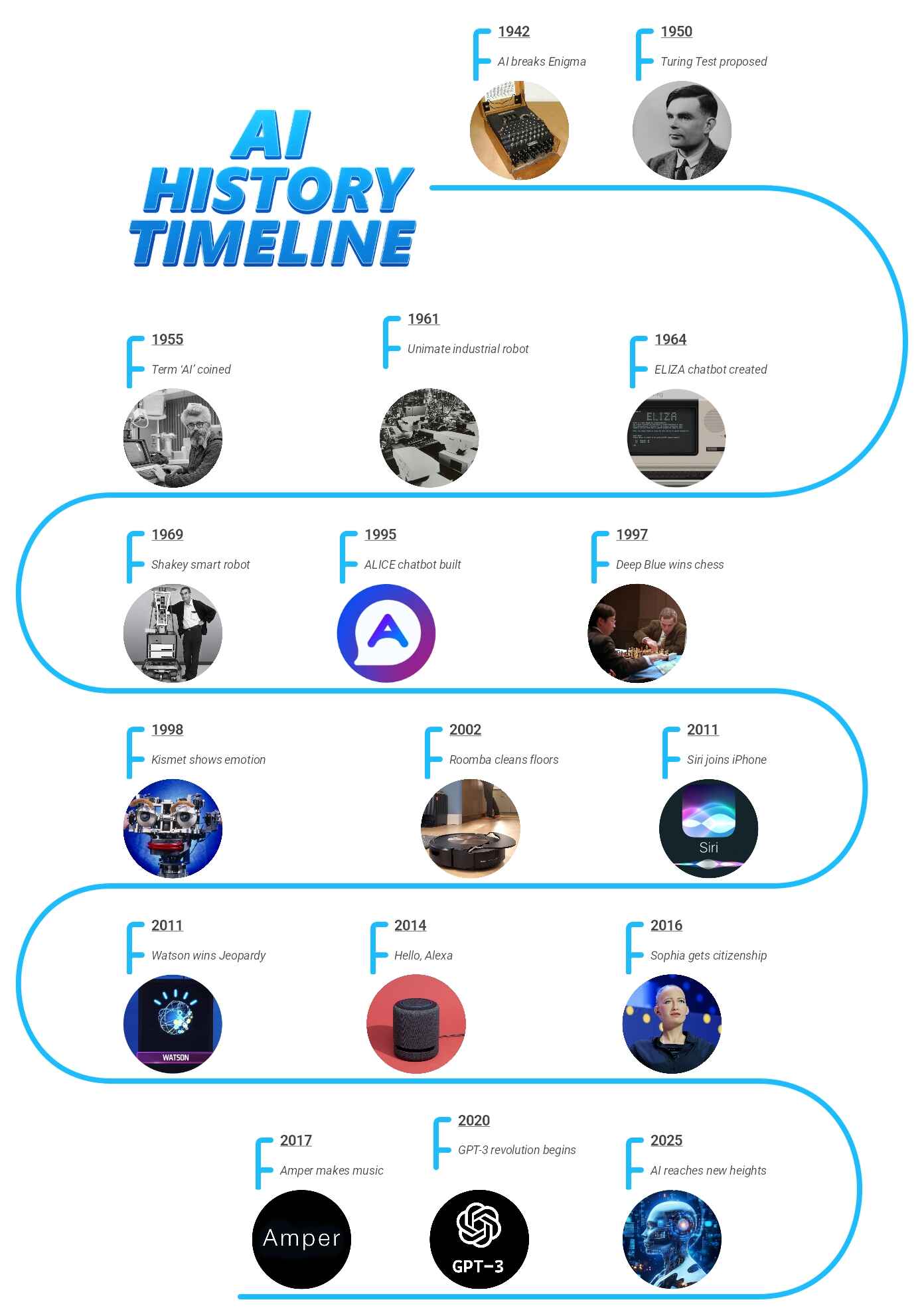
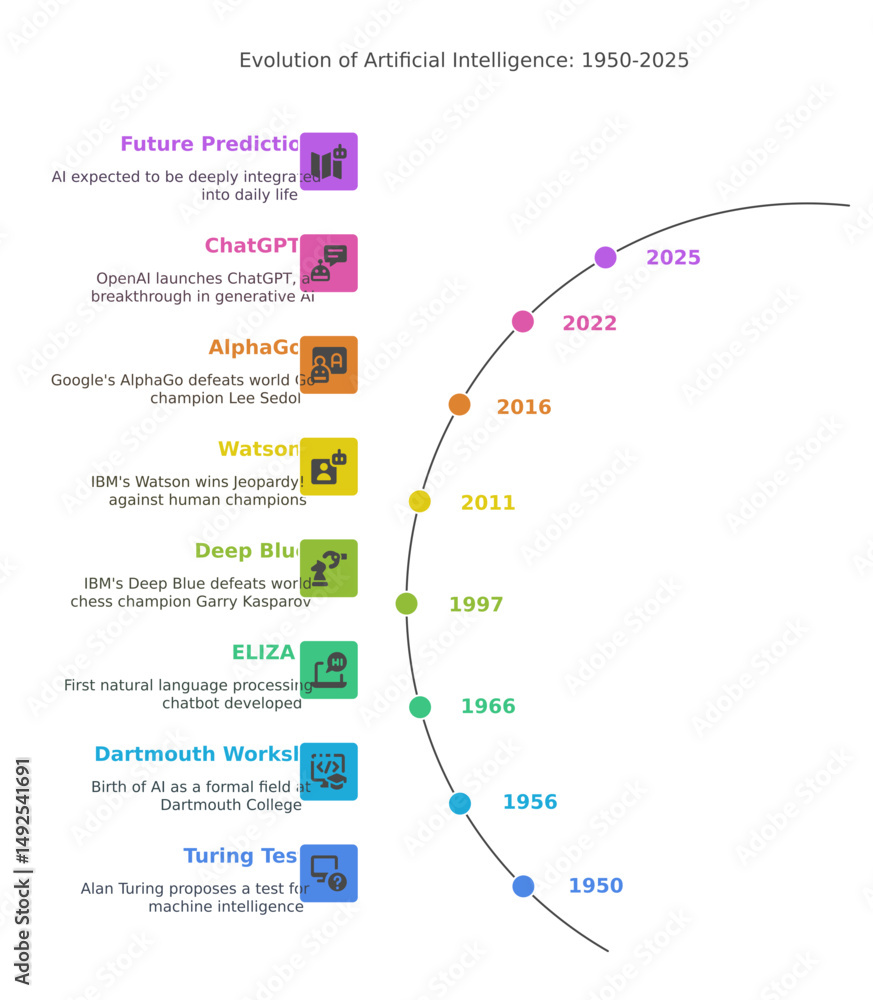
- 1950: Alan Turing’s "Computing Machinery and Intelligence" proposed the Turing Test as a criterion for machine intelligence.
- 1951: The first AI program, a checkers-playing algorithm written by Christopher Strachey for the Ferranti Mark 1 computer.
- 1956: The Dartmouth Conference, organized by John McCarthy, Marvin Minsky, Nathaniel Rochester, and Claude Shannon, coined the term "artificial intelligence" and set the agenda for AI research.
- 1958: John McCarthy developed LISP, a programming language that became a standard for AI research.
- 1966: ELIZA, an early NLP program created by Joseph Weizenbaum, demonstrated the potential of conversational AI by simulating a Rogerian psychotherapist.
#The AI Winter and Expert Systems (1970s–1980s)
Despite early optimism, AI faced challenges due to limited computational power and unrealistic expectations. This period, known as the AI Winter, saw reduced funding and slowed progress. However, significant advancements occurred:
- 1970: SHRDLU, an early natural language understanding program by Terry Winograd, showcased how AI could interpret and execute commands in a constrained environment.
- 1970s: Development of expert systems, such as MYCIN (1970s), which used rule-based logic to diagnose medical conditions.
- 1980s: Revival of AI interest with the rise of neural networks and backpropagation, though computational limitations persisted.
#The Machine Learning Revolution (1990s–2010s)
The late 20th century saw a shift toward data-driven approaches, leveraging increased computational power and the availability of large datasets:
- 1997: IBM’s Deep Blue defeated world chess champion Garry Kasparov, marking a milestone in AI’s ability to handle complex strategic tasks.
- 2006: Geoffrey Hinton’s work on deep learning revitalized neural networks, enabling breakthroughs in image and speech recognition.
- 2011: IBM Watson won Jeopardy!, demonstrating AI’s capability in natural language processing and knowledge retrieval.
- 2012: AlexNet, a deep convolutional neural network, achieved state-of-the-art results in the ImageNet competition, sparking widespread adoption of deep learning.
#The Generative AI Era (2020s–Present)
The 2020s have been defined by the rise of generative AI, capable of creating text, images, audio, and video:
- 2020: OpenAI’s GPT-3 demonstrated the potential of large language models (LLMs) for generating human-like text.
- 2021: DALL·E and Stable Diffusion introduced AI-generated art, enabling users to create images from text prompts.
- 2022: ChatGPT, built on GPT-3.5, gained global attention for its conversational abilities, leading to widespread adoption and integration into various industries.
- 2023–2024: Advancements in multimodal AI, such as Google’s Gemini and Anthropic’s Claude, expanded AI’s capabilities to handle multiple data types simultaneously.
#How It Works
AI tools operate through a combination of algorithms, data, and computational power. The underlying mechanisms vary depending on the type of AI tool:
#Rule-Based Systems Early AI tools relied on rule-based systems, where explicit instructions (rules) were programmed to perform specific tasks. For example:
- Expert systems like MYCIN used a knowledge base of rules to diagnose medical conditions.
- ELIZA employed pattern-matching rules to simulate conversation.
#Machine Learning (ML)
Modern AI tools often leverage machine learning, where models learn patterns from data rather than relying on explicit rules:
- Supervised learning: Models are trained on labeled datasets (e.g., image classification, spam detection).
- Unsupervised learning: Models identify patterns in unlabeled data (e.g., clustering, anomaly detection).
- Reinforcement learning: Models learn by interacting with an environment and receiving feedback (e.g., game-playing AI like AlphaGo).
#Deep Learning A subset of machine learning, deep learning uses neural networks with multiple layers (hence "deep") to model complex patterns:
- Convolutional Neural Networks (CNNs): Optimized for image and video processing (e.g., facial recognition, medical imaging).
- Recurrent Neural Networks (RNNs) and Transformers: Designed for sequential data, such as text and speech (e.g., language models like BERT, GPT).
- Generative Adversarial Networks (GANs): Used for generating realistic data, such as images or audio (e.g., DALL·E, StyleGAN).
#Generative AI Generative AI tools create new content by learning from vast datasets:
- Large Language Models (LLMs): Trained on text corpora to generate coherent and contextually relevant responses (e.g., ChatGPT, Llama).
- Diffusion Models: Generate high-quality images by progressively refining noise into structured outputs (e.g., Stable Diffusion, Midjourney).
- Multimodal Models: Combine text, image, and audio inputs to produce outputs across modalities (e.g., Google’s Gemini, Microsoft’s Kosmos).
#Important Facts
- AI’s Dual-Edged Nature: While AI tools have revolutionized industries, they also raise ethical concerns, including bias, misinformation, and job displacement.
- Computational Demands: Training advanced AI models requires significant computational resources, often necessitating specialized hardware like GPUs and TPUs.
- Data Dependency: AI tools rely heavily on high-quality, diverse datasets. Poor data quality can lead to biased or inaccurate outputs.
- Regulatory Challenges: Governments worldwide are grappling with how to regulate AI, balancing innovation with ethical and safety concerns.
- Accessibility: Open-source AI tools (e.g., Hugging Face, Stable Diffusion) have democratized access to AI, enabling smaller organizations and individuals to leverage advanced technologies.
#Timeline
- Foundational ideas
Core concepts and early methods shape Timeline of AI Tools.
- Practical use
Tools, examples, and real-world deployments make the topic easier to evaluate.
- Responsible implementation
Current work focuses on reliability, governance, performance, and measurable impact.
#Related Terms
#FAQ
What does Timeline of AI Tools cover?
Traces timeline of ai tools, highlighting major milestones, context, examples, and future implications.
Why is Timeline of AI Tools important?
It helps readers understand key concepts, compare practical use cases, and evaluate how AI Tools decisions affect outcomes, risks, and implementation choices.
What should readers verify before applying this topic?
Readers should compare benefits, limitations, data requirements, and related themes such as Timeline, AI, Tools before using the ideas in real projects.
#References
- Timeline of AI Tools terminology and background research
- Timeline of AI Tools use cases, implementation examples, and limitations
- AI Tools best practices, standards, and risk guidance
- Timeline case studies, benchmarks, and current industry analysis

Comments
No comments yet. Start the discussion with a useful note.