

#Short Answer
Traces timeline of ai frameworks, highlighting major milestones, context, examples, and future implications.
#Infobox
#Overview
Artificial intelligence (AI) frameworks are software libraries or platforms designed to simplify the development, training, and deployment of AI models. These frameworks provide pre-built functions, optimized algorithms, and tools for handling large datasets, enabling researchers and developers to focus on innovation rather than low-level implementation. The evolution of AI frameworks can be segmented into distinct phases:
- Symbolic AI (1950s–1980s): Rule-based systems using logic and symbolic reasoning.
- Machine Learning (1980s–2010s): Statistical models and algorithms for pattern recognition.
- Deep Learning (2010s–Present): Neural networks with multiple layers, enabled by advances in hardware and big data.
- Generative AI (2020s–Present): Frameworks supporting large language models (LLMs) and generative adversarial networks (GANs). Modern frameworks like TensorFlow and PyTorch have democratized AI development, allowing even non-experts to build sophisticated models. The shift toward open-source tools has accelerated collaboration and innovation in the field.
#History / Background
#Early Foundations (Pre-1950s)
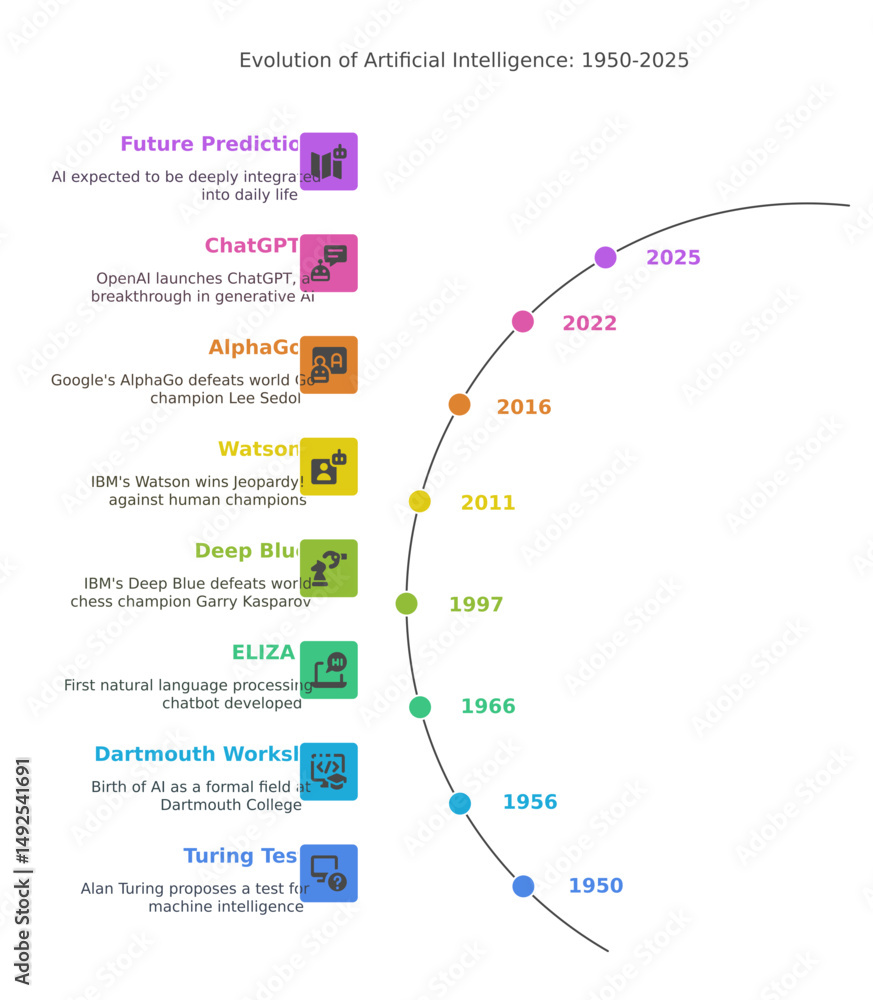
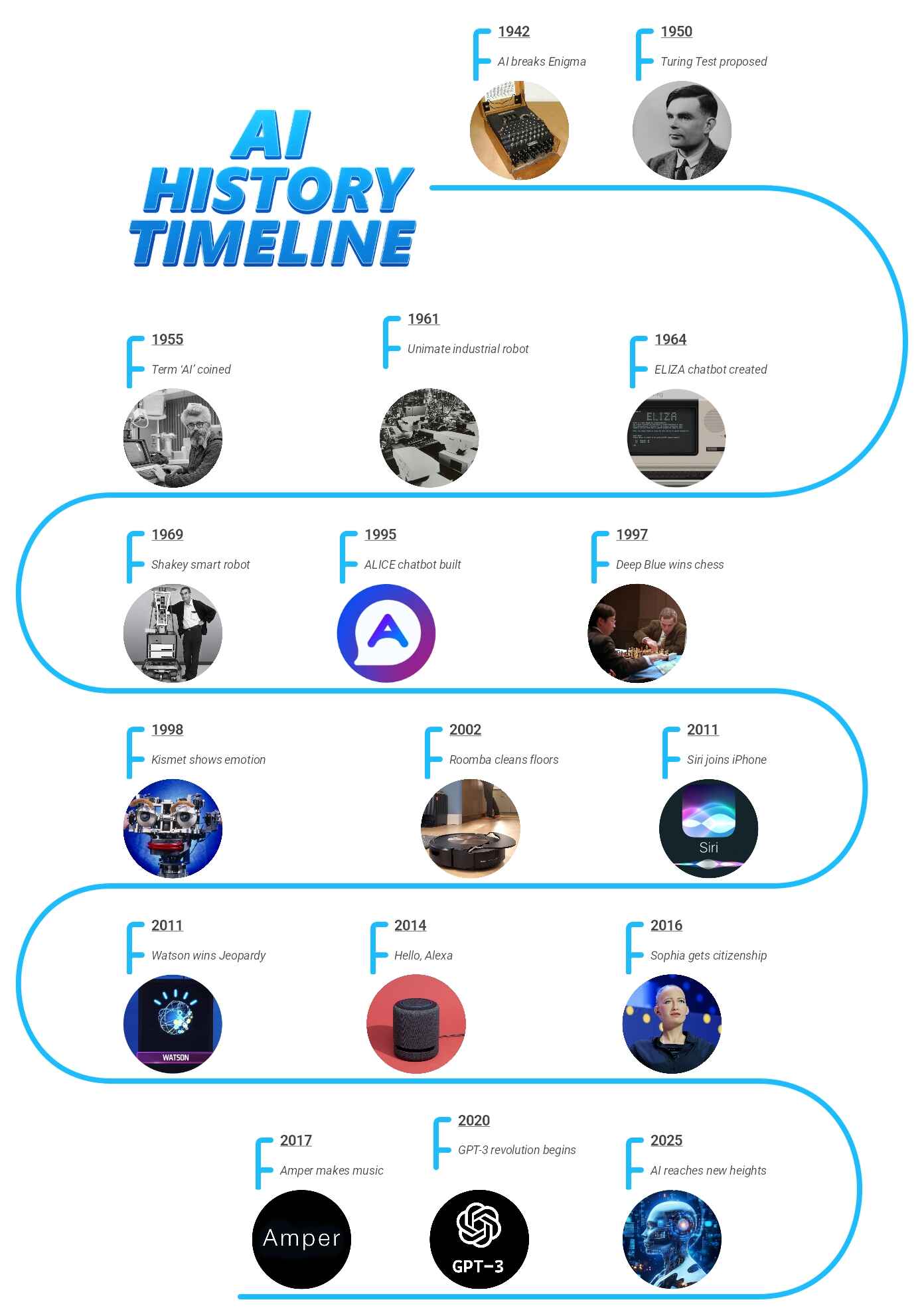
The conceptual roots of AI frameworks trace back to early computing and mathematical theories. In 1943, Warren McCulloch and Walter Pitts proposed the first mathematical model of a neural network, laying the groundwork for future AI systems. Alan Turing’s 1950 paper "Computing Machinery and Intelligence" introduced the Turing Test, a benchmark for AI capabilities.
#Symbolic AI Era (1950s–1980s)
The 1950s marked the birth of AI as a formal discipline. Key developments included:
- 1956: The Dartmouth Conference, where the term "artificial intelligence" was coined, and John McCarthy developed LISP, the first AI programming language.
- 1958: McCarthy’s LISP became the dominant language for AI research due to its support for symbolic computation.
- 1960s–1970s: Expert systems like DENDRAL (1965) and MYCIN (1970s) emerged, using rule-based logic to solve domain-specific problems.
- 1980s: The rise of Prolog, a logic programming language, and the decline of symbolic AI due to its limitations in handling real-world complexity.
#Machine Learning Revolution (1980s–2010s)
The 1980s saw a paradigm shift toward statistical learning and data-driven approaches:
- 1986: The backpropagation algorithm was popularized, enabling neural networks to learn from data.
- 1997: IBM’s Deep Blue defeated world chess champion Garry Kasparov, showcasing the power of AI in complex decision-making.
- 2006: Geoffrey Hinton’s work on deep belief networks reignited interest in neural networks, leading to breakthroughs in image and speech recognition.
- 2012: AlexNet, a deep convolutional neural network, won the ImageNet competition, proving the superiority of deep learning over traditional methods.
#Deep Learning Dominance (2010s–Present)
The 2010s witnessed an explosion in deep learning frameworks, driven by advances in hardware (GPUs, TPUs) and the availability of large datasets:
- 2015: Google open-sourced TensorFlow, a framework designed for scalable machine learning.
- 2016: PyTorch, developed by Facebook’s AI Research lab, gained popularity for its dynamic computation graph and ease of use.
- 2018: TensorFlow 2.0 introduced eager execution, simplifying model development.
- 2020s: Frameworks like JAX (Google) and MXNet (Apache) emerged, focusing on performance and flexibility. The rise of generative AI, exemplified by models like DALL·E and Stable Diffusion, further expanded the capabilities of AI frameworks.
#How It Works
AI frameworks provide a structured environment for developing and deploying machine learning models. Their core functionalities include:
#Key Components
- Data Handling: - Frameworks offer tools for data loading, preprocessing, and augmentation (e.g., TensorFlow’s
tf.datapipeline). - Support for various data formats (CSV, images, text) and distributed storage (HDFS, cloud storage). - Model Building:
- High-Level APIs: Simplify model creation with pre-defined layers (e.g., Keras’
SequentialandFunctionalAPIs). - Low-Level APIs: Provide fine-grained control over model architecture (e.g., PyTorch’s autograd system).
- Pre-trained Models: Libraries like Hugging Face’s Transformers offer models for tasks such as text classification and image generation.
- Training:
- Optimization Algorithms: Frameworks include optimizers like Adam, SGD, and RMSprop to minimize loss functions.
- Distributed Training: Support for multi-GPU and multi-node training (e.g., TensorFlow’s
MirroredStrategy). - Hyperparameter Tuning: Tools like Keras Tuner and Optuna automate the search for optimal model parameters.
- Evaluation and Deployment:
- Metrics: Built-in functions for accuracy, precision, recall, and other evaluation metrics.
- Deployment: Frameworks provide APIs for exporting models to production environments (e.g., TensorFlow Serving, ONNX runtime).
- Edge Deployment: Tools like TensorFlow Lite and PyTorch Mobile enable AI model deployment on mobile and IoT devices.
#Workflow Example
- Data Ingestion: Load a dataset (e.g., CIFAR-10 for image classification).
- Preprocessing: Normalize images, split into training/validation sets.
- Model Definition: Use a high-level API to define a convolutional neural network (CNN).
- Training: Compile the model with an optimizer and loss function, then fit it to the training data.
- Evaluation: Assess model performance on a held-out test set.
- Deployment: Export the trained model to a serving environment for real-world use.
#Important Facts
- LISP (1958): The first AI programming language, designed for symbolic computation and still used in some niche applications.
- Expert Systems (1970s–1980s): Rule-based systems like MYCIN demonstrated AI’s potential in specialized domains but struggled with scalability.
- Backpropagation (1986): A cornerstone of modern neural networks, enabling efficient training of multi-layer models.
- ImageNet (2012): The AlexNet breakthrough reduced the error rate in image classification from 26% to 15%, sparking the deep learning revolution.
- TensorFlow (2015): Google’s open-source framework became the most widely used AI tool, powering applications from Google Photos to self-driving cars.
- PyTorch (2016): Preferred by researchers for its dynamic computation graph and Pythonic design, it underpins models like BERT and GPT.
- Generative AI (2020s): Frameworks like Stable Diffusion and DALL·E enable the creation of high-quality images and text from prompts, revolutionizing creative industries.
- AutoML: Tools like Google’s AutoML and H2O.ai automate the model development process, making AI accessible to non-experts.
- Federated Learning: Frameworks like TensorFlow Federated allow models to be trained across decentralized devices without sharing raw data, enhancing privacy.
#Timeline
- Foundational ideas
Core concepts and early methods shape Timeline of AI Frameworks.
- Practical use
Tools, examples, and real-world deployments make the topic easier to evaluate.
- Responsible implementation
Current work focuses on reliability, governance, performance, and measurable impact.
#Related Terms
#FAQ
What does Timeline of AI Frameworks cover?
Traces timeline of ai frameworks, highlighting major milestones, context, examples, and future implications.
Why is Timeline of AI Frameworks important?
It helps readers understand key concepts, compare practical use cases, and evaluate how AI Tools decisions affect outcomes, risks, and implementation choices.
What should readers verify before applying this topic?
Readers should compare benefits, limitations, data requirements, and related themes such as Timeline, AI, Frameworks before using the ideas in real projects.
#References
- Timeline of AI Frameworks terminology and background research
- Timeline of AI Frameworks use cases, implementation examples, and limitations
- AI Tools best practices, standards, and risk guidance
- Timeline case studies, benchmarks, and current industry analysis


Comments
No comments yet. Start the discussion with a useful note.