


#Short Answer
Traces the rise of chatbots: a historical perspective, highlighting major milestones, context, examples, and future implications.
#Infobox
#Overview
Chatbots represent a transformative shift in human-computer interaction, enabling machines to understand, process, and respond to human language with increasing sophistication. Initially conceived as simple text-based programs, they have evolved into multimodal interfaces capable of handling voice, images, and contextual reasoning. The integration of artificial intelligence (AI) has propelled chatbots from rigid, scripted dialogues to dynamic, adaptive conversations that improve with user interaction. The rise of chatbots is closely tied to advancements in natural language processing (NLP), machine learning (ML), and deep learning (DL). These technologies enable chatbots to parse language, recognize intent, and generate contextually appropriate responses. Today, chatbots are ubiquitous, powering virtual assistants like Siri and Alexa, customer service bots on e-commerce platforms, and AI-driven tutors in educational settings. Their impact extends beyond convenience, driving efficiency in industries such as healthcare (e.g., symptom checkers), finance (e.g., fraud detection assistants), and education (e.g., personalized learning companions). As AI continues to advance, chatbots are poised to become even more integrated into daily life, blurring the lines between human and machine interaction.
#History / Background
#Early Foundations (1950s–1960s)
The conceptual groundwork for chatbots was laid in the 1950s with the Turing Test, proposed by Alan Turing, which challenged the notion of machine intelligence by evaluating a machine's ability to exhibit human-like behavior. This test became a cornerstone for AI development, inspiring researchers to create programs capable of mimicking human conversation. In 1966, ELIZA, developed by Joseph Weizenbaum at MIT, became the first notable chatbot. ELIZA used pattern matching and substitution methodologies to simulate a Rogerian psychotherapist, responding to user inputs with pre-defined scripts. While rudimentary by today's standards, ELIZA demonstrated the potential for machines to engage in dialogue, albeit in a constrained manner.
#Rule-Based Systems (1970s–1990s)
The 1970s and 1980s saw the emergence of rule-based chatbots, which relied on predefined rules and keyword matching to generate responses. Notable examples included:
- PARRY (1972): Created by Kenneth Colby, PARRY simulated a person with paranoid schizophrenia, advancing the complexity of chatbot interactions.
- Racter (1980s): An early AI program capable of generating creative, albeit often nonsensical, text. In 1995, ALICE (Artificial Linguistic Internet Computer Entity), developed by Richard Wallace, introduced the AIML (Artificial Intelligence Markup Language) framework. ALICE used a vast repository of predefined responses and pattern matching to engage in more dynamic conversations, winning the Loebner Prize (a Turing Test competition) multiple times.
#Statistical and Machine Learning Approaches (2000s–2010s)
The early 2000s marked a shift toward statistical models and machine learning in chatbot development. Researchers began using corpus-based methods to train chatbots on large datasets of human conversations, enabling more natural responses. Key milestones during this period included:
- Smarty (2001): One of the first chatbots to use statistical language models.
- IBM Watson (2011): A question-answering system that combined NLP, information retrieval, and machine learning to compete on the quiz show Jeopardy!, defeating human champions.
- Microsoft Xiaoice (2014): A social chatbot designed for emotional engagement, capable of maintaining long-term relationships with users.
#The Deep Learning Revolution (2010s–Present)
The advent of deep learning and neural networks revolutionized chatbot development, enabling models to understand context, handle ambiguity, and generate human-like text. Transformers, introduced in the 2017 paper "Attention Is All You Need" by Vaswani et al., became the backbone of modern chatbots. Notable advancements include:
- Google Assistant (2016): Leveraged deep learning for voice-based interactions.
- ChatGPT (2022): Developed by OpenAI, ChatGPT popularized large language models (LLMs) for general-purpose conversational AI, demonstrating unprecedented fluency and adaptability.
- Bard (2023): Google's response to ChatGPT, integrating LaMDA (Language Model for Dialogue Applications) for real-time information retrieval. Today, chatbots are increasingly multimodal, incorporating computer vision and speech recognition to handle images, videos, and voice inputs. The integration of Retrieval-Augmented Generation (RAG) further enhances their ability to provide accurate, up-to-date information by fetching data from external sources.
#How It Works
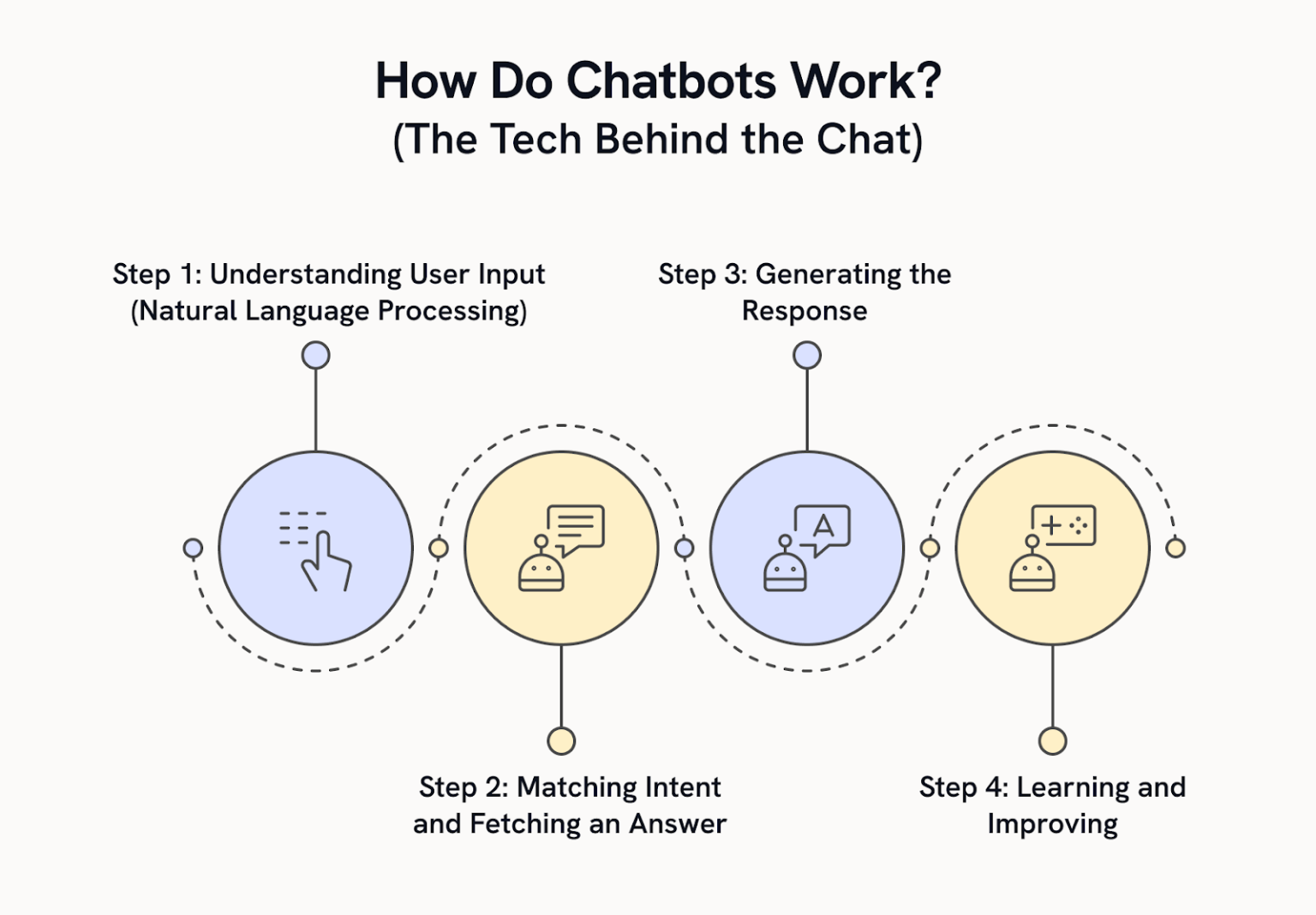
#Core Components Modern chatbots rely on a combination of technologies to function effectively:
- Natural Language Processing (NLP)
- Tokenization: Breaking down input text into smaller units (tokens) for analysis.
- Part-of-Speech (POS) Tagging: Identifying grammatical structures (e.g., nouns, verbs).
- Named Entity Recognition (NER): Extracting entities like names, dates, and locations.
- Sentiment Analysis: Determining the emotional tone of user inputs.
- Natural Language Understanding (NLU)
- Intent Recognition: Identifying the user's goal (e.g., "book a flight" vs. "check weather").
- Entity Extraction: Pulling relevant details (e.g., "New York" as a destination).
- Natural Language Generation (NLG)
- Response Formulation: Crafting coherent, contextually appropriate replies.
- Template-Based vs. Generative Models: Early chatbots used predefined templates, while modern systems (e.g., LLMs) generate responses dynamically.
- Dialogue Management
- State Tracking: Maintaining context across multiple turns in a conversation.
- Fallback Mechanisms: Handling out-of-scope queries gracefully (e.g., "I don’t understand. Can you rephrase?").
- Integration with External Systems
- APIs: Connecting to databases, CRM systems, or third-party services (e.g., fetching weather data).
- Knowledge Bases: Using structured or unstructured data to provide accurate responses.
#Architectural Models
- Rule-Based Chatbots - Use predefined rules and keyword matching (e.g., ELIZA, ALICE). - Limited flexibility but highly predictable.
- Retrieval-Based Chatbots - Select responses from a predefined set based on input similarity (e.g., using cosine similarity in embeddings). - Common in customer service applications.
- Generative Chatbots - Use deep learning models (e.g., Transformers) to generate responses from scratch. - Capable of handling open-ended conversations but may produce hallucinations (incorrect or nonsensical outputs).
- Hybrid Chatbots - Combine rule-based, retrieval-based, and generative approaches for robustness. - Example: A customer service bot that uses rules for FAQs and generative models for complex queries.
#Training and Optimization
- Supervised Learning: Training on labeled datasets where inputs are paired with correct responses.
- Reinforcement Learning: Optimizing responses based on user feedback (e.g., reward signals for helpful answers).
- Fine-Tuning: Adapting pre-trained models (e.g., BERT, GPT) to specific domains (e.g., healthcare, finance).
- Evaluation Metrics: Measuring performance using metrics like BLEU (Bilingual Evaluation Understudy), ROUGE (Recall-Oriented Understudy for Gisting Evaluation), and human evaluation (e.g., user satisfaction scores).
#Important Facts
- First Chatbot: ELIZA (1966) is widely regarded as the first chatbot, created by Joseph Weizenbaum at MIT.
- Loebner Prize: A competition based on the Turing Test, where chatbots attempt to convince judges they are human. ALICE won multiple times in the 1990s and 2000s.
- IBM Watson’s Jeopardy! Victory: In 2011, IBM Watson defeated human champions on the quiz show Jeopardy!, showcasing the power of NLP and machine learning.
- ChatGPT’s Viral Popularity: Launched in November 2022, ChatGPT reached 100 million users in just two months, becoming the fastest-growing consumer application in history.
- Multimodal Capabilities: Modern chatbots like Google’s Bard can process and generate text, images, and voice inputs.
- Ethical Concerns: Chatbots raise issues such as data privacy, bias in training data, and misinformation spread (e.g., hallucinations in LLMs).
- Industry Adoption: Over 80% of businesses are expected to implement some form of chatbot by 2025, according to Gartner.
- Healthcare Applications: Chatbots like Woebot use cognitive behavioral therapy (CBT) techniques to provide mental health support.
- Educational Tools: Platforms like Duolingo’s chatbots help users practice languages through conversational exercises.
- Future Trends: The integration of emotion recognition, personalization, and real-time learning will further enhance chatbot capabilities.
#Timeline
- Foundational ideas
Core concepts and early methods shape The Rise of Chatbots: a Historical Perspective.
- Practical use
Tools, examples, and real-world deployments make the topic easier to evaluate.
- Responsible implementation
Current work focuses on reliability, governance, performance, and measurable impact.
#Related Terms
#FAQ
What does The Rise of Chatbots: a Historical Perspective cover?
Traces the rise of chatbots: a historical perspective, highlighting major milestones, context, examples, and future implications.
Why is The Rise of Chatbots: a Historical Perspective important?
It helps readers understand key concepts, compare practical use cases, and evaluate how Language AI decisions affect outcomes, risks, and implementation choices.
What should readers verify before applying this topic?
Readers should compare benefits, limitations, data requirements, and related themes such as Rise, Chatbots, Historical before using the ideas in real projects.
#References
- The Rise of Chatbots: a Historical Perspective terminology and background research
- The Rise of Chatbots: a Historical Perspective use cases, implementation examples, and limitations
- Language AI best practices, standards, and risk guidance
- Rise case studies, benchmarks, and current industry analysis

Comments
No comments yet. Start the discussion with a useful note.