

#Short Answer
Covers exploring the basics of chatbots, including core concepts, practical examples, benefits, limitations, and risks in Language AI.
#Infobox
#Overview
Chatbots are AI-powered tools that enable human-like interactions through text or voice. They operate by processing user input, analyzing intent, and generating appropriate responses using predefined rules or adaptive learning algorithms. Modern chatbots leverage natural language processing (NLP) to interpret slang, typos, and contextual nuances, making them increasingly indistinguishable from human agents in many scenarios. The primary function of a chatbot is to automate repetitive tasks, such as answering FAQs, scheduling appointments, or processing orders. Businesses deploy chatbots to enhance customer engagement, reduce operational costs, and provide instant support. In personal use, chatbots assist with productivity, learning, and entertainment, such as virtual assistants like Siri or Alexa. Chatbots can be categorized into two main types:
- Rule-based chatbots – Follow predefined scripts and respond to specific keywords.
- AI-based chatbots – Use machine learning to improve responses over time, adapting to user behavior.
#History / Background
#Early Developments
(1960s–1990s)
The concept of chatbots dates back to the 1960s with ELIZA, developed by Joseph Weizenbaum at MIT. ELIZA simulated a psychotherapist by using pattern matching to respond to user inputs, though it lacked true understanding. In 1972, PARRY, created by Kenneth Colby, mimicked a paranoid schizophrenic, marking one of the first attempts at emotional simulation. The 1990s saw the introduction of SmarterChild, an early AI assistant integrated into AOL Instant Messenger. It could answer questions, perform calculations, and provide trivia, laying the groundwork for modern conversational AI.
#2000s–2010s: Rise of AI and Commercialization The 2000s introduced chatterbots like ALICE (Artificial Linguistic Internet Computer Entity), which used NLP to engage in more dynamic conversations. However, these systems were still limited by computational constraints. The launch of Apple’s Siri (2011) and Google Now (2012) marked a turning point, bringing AI assistants into mainstream use. These voice-activated chatbots integrated with smartphones, offering hands-free interaction. Meanwhile, IBM Watson (2011) demonstrated advanced NLP capabilities by winning Jeopardy! against human champions.
#2020s: Mainstream Adoption and Advancements The proliferation of messaging apps (e.g., WhatsApp, Facebook Messenger) accelerated chatbot adoption for businesses. Companies like Microsoft (Cortana) and Amazon (Alexa) expanded voice-based chatbots, while OpenAI’s ChatGPT (2022) revolutionized the field with generative AI, enabling human-like, context-aware responses. Today, chatbots are integral to industries such as:
- E-commerce (e.g., Shopify’s customer support bots)
- Healthcare (e.g., symptom-checking assistants)
- Banking (e.g., fraud detection and transaction alerts)
- Education (e.g., language learning tools like Duolingo)
#How It Works
#Core Technologies
- Natural Language Processing (NLP) - Breaks down user input into tokens (words, phrases) for analysis. - Uses tokenization, part-of-speech tagging, and sentiment analysis to interpret meaning. - Example: Understanding "I’m frustrated with my order" vs. "I’m happy with my order."
- Machine Learning (ML) and Deep Learning
- Supervised learning trains chatbots on labeled datasets (e.g., customer service logs).
- Reinforcement learning improves responses based on user feedback (e.g., correcting errors).
- Transformers (e.g., Google’s BERT, OpenAI’s GPT) enable contextual understanding in large language models (LLMs).
- Dialogue Management - Tracks conversation history to maintain context (e.g., remembering a user’s previous query). - Uses state machines or neural networks to decide the next response.
- Integration with APIs and Databases - Connects to external systems (e.g., CRM software, payment gateways) for real-time data retrieval. - Example: A banking chatbot fetching account balances via an API.
#Workflow Example
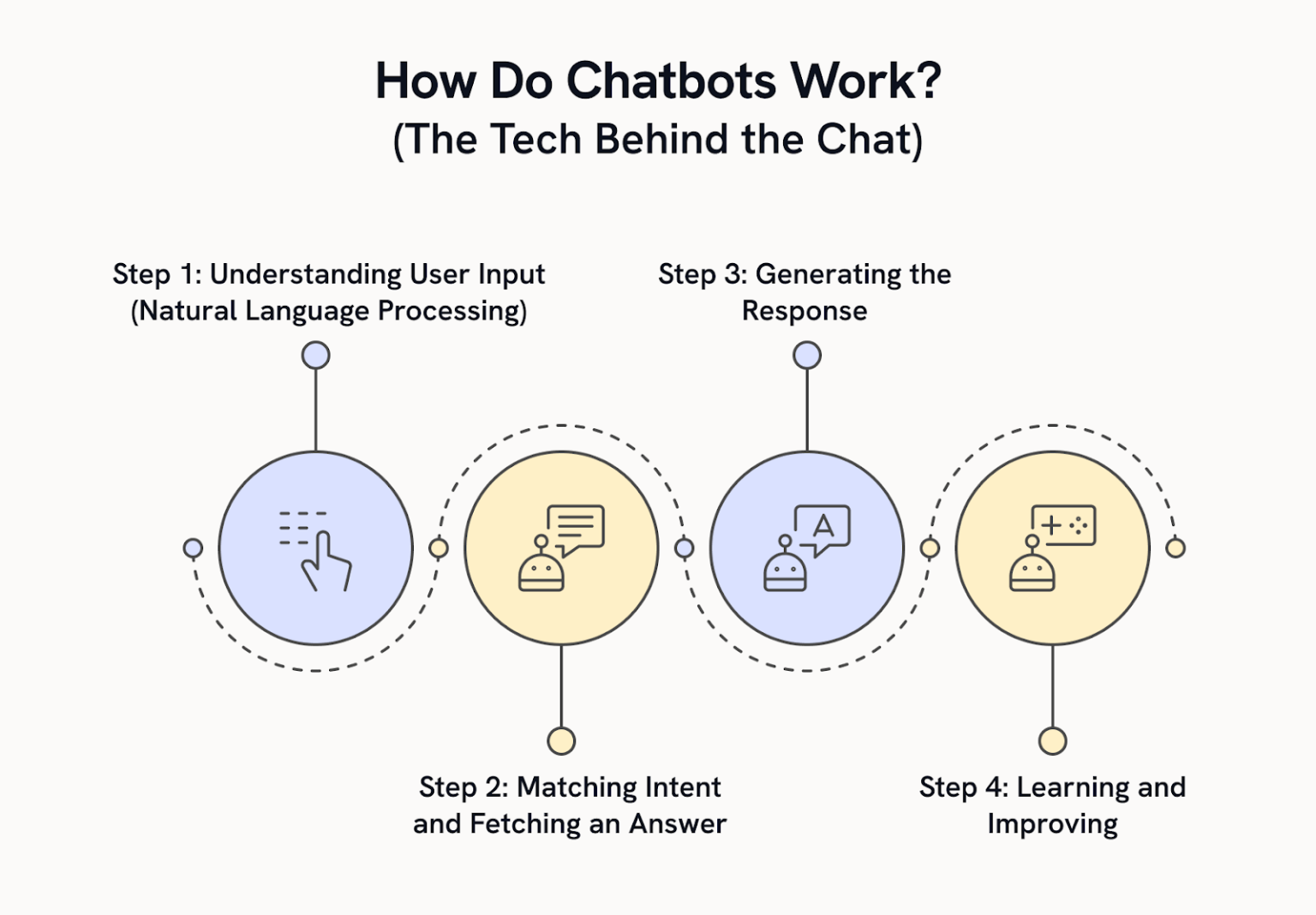
- User Input: "What’s the status of my order #12345?"
- NLP Processing: Extracts intent ("order status") and entities ("order #12345").
- Dialogue Management: Checks if the user is authenticated and retrieves order data.
- Response Generation: "Your order #12345 is out for delivery and will arrive by December 20."
- Feedback Loop: Logs the interaction to improve future responses.
#Important Facts
- Efficiency: Chatbots can handle 80% of routine queries, reducing human agent workload by up to 30% (Gartner).
- Cost Savings: Businesses save $0.70 per interaction compared to human agents (Juniper Research).
- User Preference: 64% of users prefer chatbots for quick answers over waiting for human support (Drift).
- Multilingual Support: Advanced chatbots support over 100 languages, breaking language barriers.
- Ethical Concerns: Risks include data privacy violations, bias in responses, and misinformation spread.
- Future Trends: Integration with augmented reality (AR) and voice commerce is expected to grow.
#Timeline
- Foundational ideas
Core concepts and early methods shape Exploring the Basics of Chatbots.
- Practical use
Tools, examples, and real-world deployments make the topic easier to evaluate.
- Responsible implementation
Current work focuses on reliability, governance, performance, and measurable impact.
#Related Terms
#FAQ
What does Exploring the Basics of Chatbots cover?
Covers exploring the basics of chatbots, including core concepts, practical examples, benefits, limitations, and risks in Language AI.
Why is Exploring the Basics of Chatbots important?
It helps readers understand key concepts, compare practical use cases, and evaluate how Language AI decisions affect outcomes, risks, and implementation choices.
What should readers verify before applying this topic?
Readers should compare benefits, limitations, data requirements, and related themes such as Exploring, Basics, Chatbots before using the ideas in real projects.
#References
- Exploring the Basics of Chatbots terminology and background research
- Exploring the Basics of Chatbots use cases, implementation examples, and limitations
- Language AI best practices, standards, and risk guidance
- Exploring case studies, benchmarks, and current industry analysis


Comments
No comments yet. Start the discussion with a useful note.