

#Short Answer
Covers facts about chatbots, including core concepts, practical examples, benefits, limitations, and risks in Language AI.
#Infobox
#Overview
Chatbots are software programs that engage in human-like conversations, either through text or voice, using artificial intelligence (AI). They are designed to interpret user inputs, process requests, and generate appropriate responses without human intervention. The primary goal of a chatbot is to automate repetitive tasks, enhance user experience, and provide instant support. Chatbots operate on predefined rules or advanced AI models, including machine learning and deep learning. Rule-based chatbots follow strict scripts, while AI-powered chatbots use NLP to understand context, intent, and nuances in language. The latter can improve over time by learning from interactions, making them more adaptive and efficient. The integration of chatbots into digital platforms has revolutionized customer engagement. Businesses deploy them to handle inquiries 24/7, reducing operational costs and improving response times. In personal applications, chatbots assist with scheduling, reminders, and information retrieval, acting as virtual assistants.
#History / Background
#Early Developments
(1960s–1990s)
The concept of chatbots dates back to the 1960s with ELIZA, created by Joseph Weizenbaum at MIT. ELIZA was a simple program that mimicked a Rogerian psychotherapist by using pattern matching and substitution to simulate conversation. Though primitive, it demonstrated the potential of machines to engage in dialogue. In 1972, PARRY was developed by Kenneth Colby to simulate a person with paranoid schizophrenia. Unlike ELIZA, PARRY attempted to model emotional responses, making it one of the first chatbots with a simulated personality. The 1990s saw the introduction of Jabberwacky (1988) and ALICE (Artificial Linguistic Internet Computer Entity, 1995). ALICE used a more sophisticated pattern-matching approach and won the Loebner Prize multiple times, highlighting progress in conversational AI.
#The Rise of AI and Machine Learning (2000s–2010s)
The 2000s marked a shift toward AI-driven chatbots. SmaterChild (2001), integrated into AOL Instant Messenger, provided trivia and entertainment. Meanwhile, IBM Watson (2011) demonstrated the power of deep learning in understanding and responding to complex questions, winning Jeopardy!. The launch of Siri by Apple in 2011 and Google Assistant in 2016 brought chatbots into mainstream use. These assistants used voice recognition and NLP to perform tasks like setting reminders, sending messages, and answering queries.
#Modern Era
(2020s–Present)
The 2020s have seen exponential growth in chatbot capabilities due to advancements in transformer models (e.g., Google’s BERT, OpenAI’s GPT series). These models enable chatbots to generate human-like text, understand context, and even exhibit creativity. Today, chatbots are deployed in customer service (e.g., banking, retail), healthcare (symptom checkers, mental health support), education (tutoring, language learning), and entertainment (interactive storytelling). The rise of generative AI has further blurred the line between chatbots and human-like conversational agents.
#How It Works
#Core Technologies
- Natural Language Processing (NLP) NLP enables chatbots to analyze and understand human language. It involves:
- Tokenization: Breaking text into words or phrases.
- Part-of-Speech (POS) Tagging: Identifying grammatical components.
- Named Entity Recognition (NER): Detecting entities like names, dates, or locations.
- Sentiment Analysis: Gauging user emotions from text.
- Machine Learning (ML) and Deep Learning
- Supervised Learning: Chatbots are trained on labeled datasets to recognize patterns.
- Reinforcement Learning: Systems improve by receiving feedback on responses.
- Neural Networks: Models like transformers (e.g., GPT-3, LaMDA) generate contextually relevant replies.
- Dialogue Management
- Rule-Based Systems: Follow predefined scripts (e.g., FAQ bots).
- Contextual Systems: Maintain conversation history to provide coherent responses.
- Hybrid Models: Combine rules with AI for flexibility.
#Interaction Flow
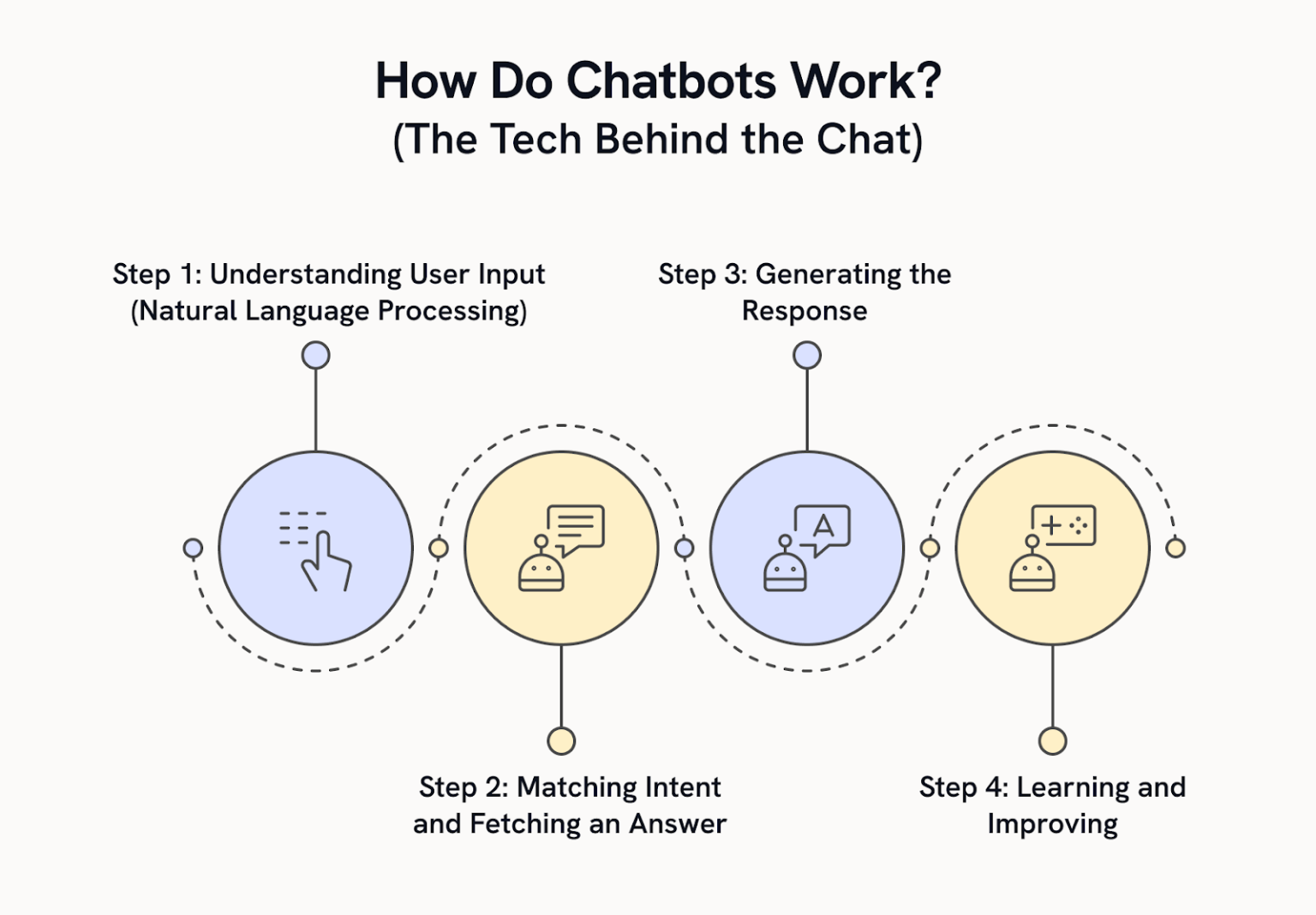
- Input Processing: The user’s query is received (text or voice).
- Intent Recognition: The system identifies the user’s goal (e.g., "book a flight").
- Entity Extraction: Relevant details (e.g., date, destination) are extracted.
- Response Generation: The chatbot formulates a reply using NLP and ML.
- Output Delivery: The response is sent back to the user.
#Integration Methods
- APIs: Chatbots connect to databases or third-party services (e.g., weather APIs).
- Web/Mobile Interfaces: Deployed on websites, apps, or messaging platforms (e.g., WhatsApp, Slack).
- Voice Assistants: Integrated with smart speakers (e.g., Alexa, Siri).
#Important Facts
#
- Efficiency and Cost Savings - Chatbots can handle 80% of routine customer inquiries, reducing the need for human agents. - Businesses save up to 30% on customer service costs by automating responses.
#
- 24/7 Availability - Unlike human agents, chatbots operate round-the-clock, ensuring instant support.
#
- Multilingual Capabilities - Advanced chatbots support over 100 languages, breaking language barriers in global markets.
#
- Personalization - AI-driven chatbots learn user preferences to deliver tailored recommendations (e.g., e-commerce suggestions).
#
- Industry-Specific Applications
- Healthcare: Symptom checkers (e.g., Ada Health) and mental health chatbots (e.g., Woebot).
- Finance: Fraud detection and automated financial advice (e.g., Erica by Bank of America).
- Education: Language learning bots (e.g., Duolingo’s chat feature) and tutoring systems.
- Entertainment: Interactive storytelling (e.g., AI Dungeon) and gaming companions.
#
- Ethical and Security Concerns
- Data Privacy: Chatbots may collect sensitive user data, raising concerns about GDPR compliance.
- Bias and Misinformation: AI models can perpetuate biases present in training data.
- Deepfake Risks: Voice-enabled chatbots can be misused to impersonate individuals.
#
- Future Trends
- Emotion Recognition: Chatbots may detect and respond to user emotions in real time.
- Omnichannel Integration: Seamless transitions between text, voice, and video interactions.
- Autonomous Agents: Fully autonomous chatbots capable of performing complex tasks (e.g., booking travel).
#Timeline
- Foundational ideas
Core concepts and early methods shape Facts About Chatbots.
- Practical use
Tools, examples, and real-world deployments make the topic easier to evaluate.
- Responsible implementation
Current work focuses on reliability, governance, performance, and measurable impact.
#Related Terms
#FAQ
What does Facts About Chatbots cover?
Covers facts about chatbots, including core concepts, practical examples, benefits, limitations, and risks in Language AI.
Why is Facts About Chatbots important?
It helps readers understand key concepts, compare practical use cases, and evaluate how Language AI decisions affect outcomes, risks, and implementation choices.
What should readers verify before applying this topic?
Readers should compare benefits, limitations, data requirements, and related themes such as Facts, About, Chatbots before using the ideas in real projects.
#References
- Facts About Chatbots terminology and background research
- Facts About Chatbots use cases, implementation examples, and limitations
- Language AI best practices, standards, and risk guidance
- Facts case studies, benchmarks, and current industry analysis



Comments
No comments yet. Start the discussion with a useful note.