

#Short Answer
Covers the impact of deep learning on society, including core concepts, practical examples, benefits, limitations, and risks in Machine Learning.
#Infobox
#Overview
Deep learning represents a paradigm shift in artificial intelligence (AI), enabling machines to process and interpret complex data structures through layered neural networks. Unlike traditional machine learning, which relies on handcrafted features, deep learning automates feature extraction, allowing models to learn hierarchical representations directly from raw data. This capability has unlocked breakthroughs in fields where human expertise falls short, such as medical imaging, fraud detection, and real-time language translation. The societal impact of deep learning is profound, reshaping industries by enhancing efficiency, reducing costs, and introducing innovations that were previously unimaginable. From diagnosing diseases with higher accuracy than human radiologists to powering self-driving cars, deep learning has become a cornerstone of the Fourth Industrial Revolution. However, its rapid adoption also raises ethical and practical concerns, including data privacy, algorithmic bias, and the displacement of certain job roles.
#History / Background
#Early Foundations (1940s–1980s)
The conceptual roots of deep learning trace back to the 1940s with the introduction of artificial neurons by Warren McCulloch and Walter Pitts, inspired by biological neural networks. In 1958, Frank Rosenblatt developed the Perceptron, a single-layer neural network capable of basic pattern recognition. However, limitations in computational power and the lack of large datasets stifled progress during this era.
#The First AI Winter (1970s–1980s)
The field experienced a decline in interest due to the Perceptron’s inability to solve non-linear problems and the infamous "AI winter," a period marked by reduced funding and skepticism toward AI research. Despite this, advancements in backpropagation (developed by Paul Werbos in 1974 and popularized by Rumelhart, Hinton, and Williams in 1986) laid the groundwork for training multi-layer neural networks.
#Revival and Breakthroughs (1990s–2010s)
The 1990s saw the emergence of support vector machines (SVMs) and other machine learning techniques overshadowing neural networks. However, key contributions by Geoffrey Hinton, Yann LeCun, and Yoshua Bengio revitalized interest in deep learning. LeCun’s work on convolutional neural networks (CNNs) for handwritten digit recognition (1998) and Hinton’s breakthrough in training deep belief networks (2006) demonstrated the potential of deep architectures.
#The Deep Learning Revolution (2010s–Present)
The 2010s marked a turning point with the availability of massive datasets, advances in GPU computing, and the development of scalable frameworks like TensorFlow (2015) and PyTorch (2016). Landmark achievements include:
- 2012: AlexNet, a CNN by Alex Krizhevsky, won the ImageNet competition, achieving unprecedented accuracy in image classification.
- 2016: AlphaGo, developed by DeepMind, defeated a world champion Go player, showcasing deep learning’s prowess in complex decision-making.
- 2020s: Large language models (LLMs) like GPT-3 and diffusion models for image generation (e.g., DALL·E) have pushed the boundaries of generative AI.
#How It Works
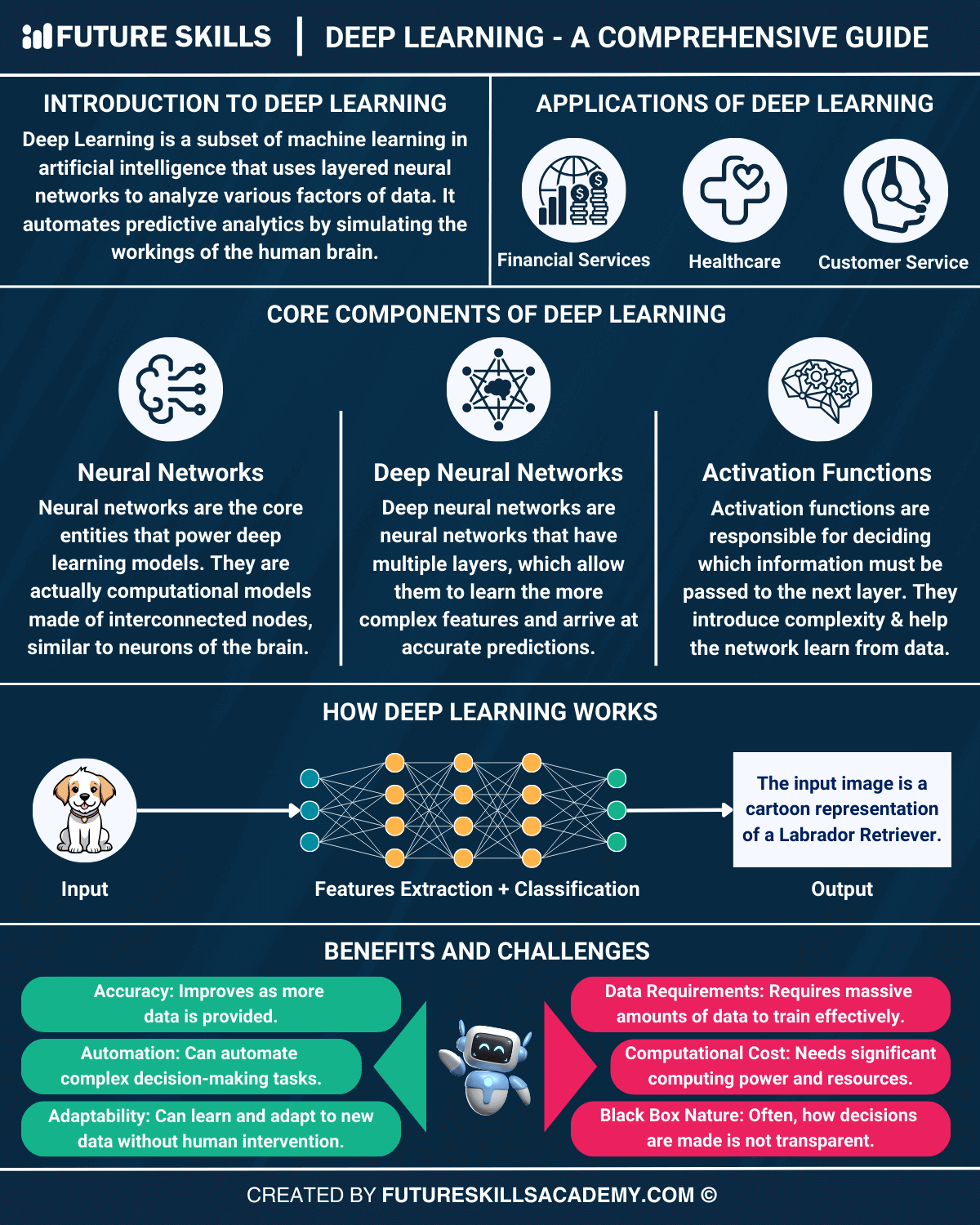
#Neural Networks: The Building Blocks Deep learning models are composed of interconnected layers of artificial neurons (nodes), organized into an input layer, multiple hidden layers, and an output layer. Each neuron applies a mathematical transformation to its inputs, weighted by learnable parameters, and passes the result through an activation function (e.g., ReLU, sigmoid) to introduce non-linearity.
#Key Architectures
- Convolutional Neural Networks (CNNs) - Specialized for grid-like data (e.g., images, videos). - Use convolutional layers to detect local patterns (edges, textures) and pooling layers to reduce dimensionality. - Applications: Facial recognition, medical imaging, autonomous driving.
- Recurrent Neural Networks (RNNs) and LSTMs - Designed for sequential data (e.g., time series, text). - RNNs process data in loops, allowing them to retain "memory" of previous inputs. - Long Short-Term Memory (LSTM) networks address the vanishing gradient problem in RNNs. - Applications: Speech recognition, language translation, stock market prediction.
- Transformers - Introduced in the 2017 paper "Attention Is All You Need," transformers rely on self-attention mechanisms to weigh the importance of different parts of the input data. - Enable parallel processing of sequences, making them highly efficient for large-scale tasks. - Applications: Natural language processing (NLP), chatbots, code generation.
- Generative Adversarial Networks (GANs) - Comprise two competing networks: a generator (creates data) and a discriminator (evaluates authenticity). - Used for generating realistic images, videos, and even synthetic data. - Applications: Art generation, drug discovery, deepfake technology.
#Training Process
Deep learning models are trained using supervised learning (labeled data), unsupervised learning (unlabeled data), or reinforcement learning (reward-based feedback). The training involves:
- Forward Propagation: Input data passes through the network to generate predictions.
- Loss Calculation: A loss function (e.g., cross-entropy, mean squared error) measures the difference between predictions and actual outcomes.
- Backpropagation: Gradients of the loss function are computed with respect to each parameter, and weights are updated using optimization algorithms like Stochastic Gradient Descent (SGD) or Adam.
- Iteration: The process repeats over multiple epochs until the model achieves acceptable performance.
#Hardware Acceleration Training deep learning models requires significant computational resources. Key hardware advancements include:
- Graphics Processing Units (GPUs): Enable parallel processing of matrix operations, drastically reducing training time.
- Tensor Processing Units (TPUs): Google’s custom ASICs designed for deep learning workloads.
- Distributed Training: Frameworks like Horovod and PyTorch Lightning allow models to be trained across multiple GPUs or machines.
#Important Facts
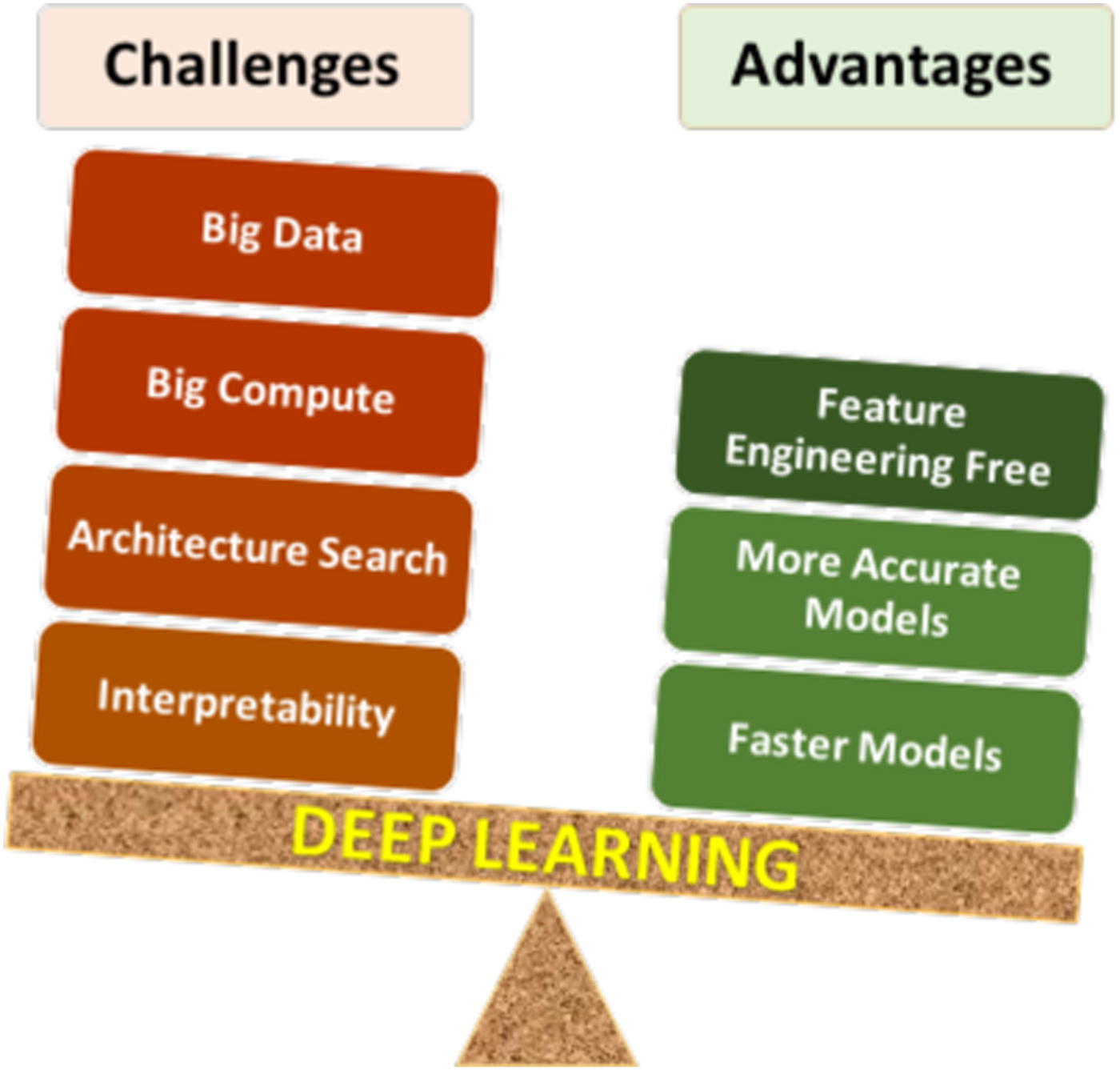
- Data Dependency: Deep learning models require vast amounts of labeled data for training. The quality and diversity of data directly impact model performance.
- Black Box Nature: Many deep learning models, particularly deep neural networks, are often considered "black boxes" due to their lack of interpretability. Techniques like SHAP (SHapley Additive exPlanations) and LIME (Local Interpretable Model-agnostic Explanations) are used to address this.
- Energy Consumption: Training large models (e.g., LLMs) consumes significant energy, raising concerns about environmental sustainability. Efforts like model pruning and quantization aim to reduce computational overhead.
- Bias and Fairness: Deep learning models can inherit biases present in training data, leading to unfair outcomes in applications like hiring, lending, and law enforcement. Mitigation strategies include diverse dataset curation and fairness-aware algorithms.
- Transfer Learning: Pre-trained models (e.g., BERT, ResNet) can be fine-tuned for specific tasks, reducing the need for large labeled datasets and accelerating deployment.
- Explainable AI (XAI): The field of XAI focuses on making deep learning models more transparent and understandable, crucial for applications in healthcare and finance.
- Edge AI: Deploying deep learning models on edge devices (e.g., smartphones, IoT sensors) enables real-time processing without cloud dependency, enhancing privacy and reducing latency.
#Timeline
- Foundational ideas
Core concepts and early methods shape The Impact of Deep Learning on Society.
- Practical use
Tools, examples, and real-world deployments make the topic easier to evaluate.
- Responsible implementation
Current work focuses on reliability, governance, performance, and measurable impact.
#Related Terms
#FAQ
What does The Impact of Deep Learning on Society cover?
Covers the impact of deep learning on society, including core concepts, practical examples, benefits, limitations, and risks in Machine Learning.
Why is The Impact of Deep Learning on Society important?
It helps readers understand key concepts, compare practical use cases, and evaluate how Machine Learning decisions affect outcomes, risks, and implementation choices.
What should readers verify before applying this topic?
Readers should compare benefits, limitations, data requirements, and related themes such as Impact, Deep, Learning before using the ideas in real projects.
#References
- The Impact of Deep Learning on Society terminology and background research
- The Impact of Deep Learning on Society use cases, implementation examples, and limitations
- Machine Learning best practices, standards, and risk guidance
- Impact case studies, benchmarks, and current industry analysis


Comments
No comments yet. Start the discussion with a useful note.