

#Short Answer
Covers deep learning: everything you need to know, including core concepts, practical examples, benefits, limitations, and risks in Machine Learning.
#Infobox
#Overview
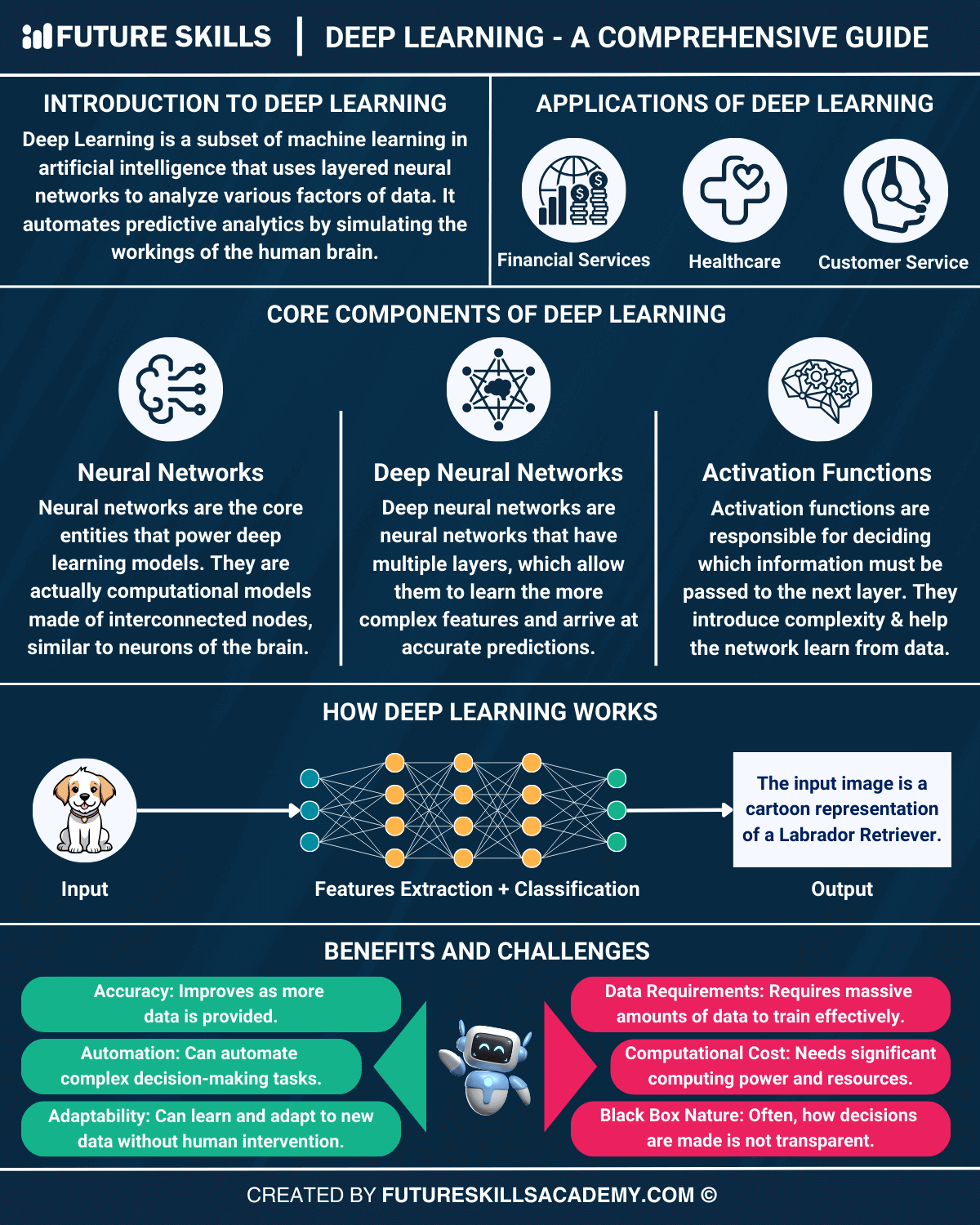
Deep learning is a revolutionary approach in artificial intelligence (AI) that mimics the hierarchical processing of the human brain through artificial neural networks (ANNs). Unlike traditional machine learning, which relies on handcrafted features, deep learning automatically extracts relevant features from raw data, making it highly effective for high-dimensional problems such as image classification, speech synthesis, and language translation. At its core, deep learning leverages deep neural networks (DNNs), which consist of:
- Input Layer: Receives raw data (e.g., pixels, text, audio).
- Hidden Layers: Multiple interconnected layers that transform data through weighted connections and activation functions (e.g., ReLU, Sigmoid).
- Output Layer: Produces predictions or classifications. The depth of these networks enables them to learn abstract representations at different levels, from edges in images to semantic meanings in sentences. This hierarchical learning is what gives deep learning its scalability and adaptability across diverse domains.
#History / Background
#Early Foundations (1940s–1980s)
The conceptual roots of deep learning trace back to 1943, when Warren McCulloch and Walter Pitts proposed the first mathematical model of a neural network. In 1958, Frank Rosenblatt developed the Perceptron, an early form of a neural network capable of binary classification. However, limitations in computational power and the XOR problem (a task the Perceptron couldn’t solve) led to the AI Winter of the 1970s.
#Revival and Breakthroughs (1980s–2000s)
The field revived in the 1980s with the introduction of backpropagation by Geoffrey Hinton, David Rumelhart, and Ronald Williams, enabling neural networks to learn from errors. Yann LeCun demonstrated the first convolutional neural network (CNN) in 1989, which became foundational for computer vision. Despite these advances, deep learning remained computationally expensive, limiting its practical applications.
#The Deep Learning Revolution (2010s–Present)
The 2010s marked a turning point due to:
- Big Data: The explosion of labeled datasets (e.g., ImageNet) provided the fuel for training deep models.
- Hardware Advancements: GPUs (graphics processing units) accelerated training by orders of magnitude.
- Algorithmic Innovations: Techniques like dropout, batch normalization, and attention mechanisms improved model performance and stability. Key milestones include:
- 2012: AlexNet, a CNN by Alex Krizhevsky, won the ImageNet Large Scale Visual Recognition Challenge (ILSVRC), surpassing traditional methods.
- 2014: Generative Adversarial Networks (GANs) were introduced by Ian Goodfellow, enabling realistic data generation.
- 2017: Transformers (e.g., BERT, GPT) revolutionized NLP by replacing recurrent networks with self-attention mechanisms.
- 2020s: Deep learning powers autonomous vehicles, drug discovery, and personalized medicine, with models like AlphaFold solving protein folding.
#How It Works
#Neural Network Architecture
Deep learning models are built on multi-layered neural networks, where each layer refines the representation of the input data. The key components include:
- Neurons (Nodes): Basic units that apply an activation function (e.g., ReLU, Sigmoid) to weighted inputs.
- Layers:
- Input Layer: Receives raw data (e.g., pixel values, word embeddings).
- Hidden Layers: Perform transformations via weights and biases, adjusted during training.
- Output Layer: Produces the final prediction (e.g., class probabilities).
- Connections: Neurons are connected via weights, which determine the strength of influence between layers.
#Training Process
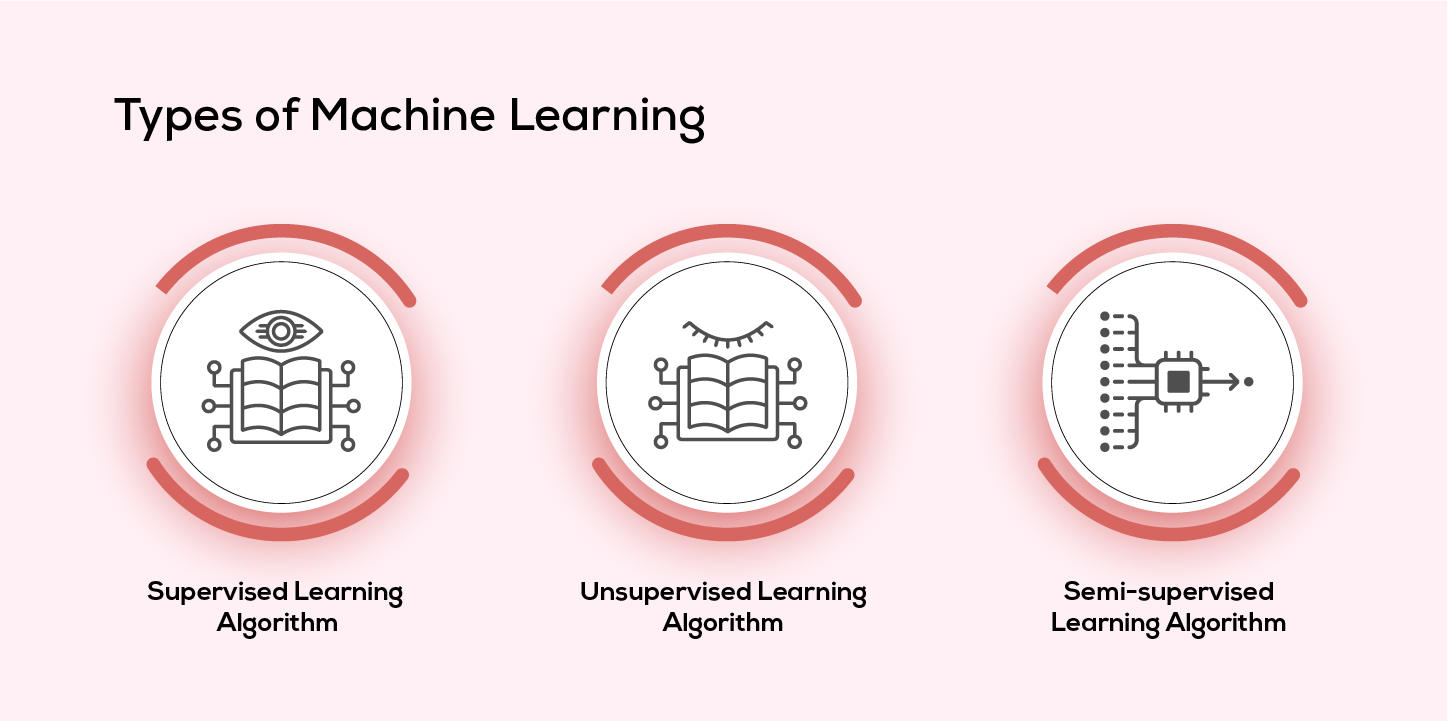
Deep learning models learn through supervised, unsupervised, or reinforcement learning:
- Forward Propagation: Input data passes through the network, generating predictions.
- Loss Function: Measures the difference between predictions and actual labels (e.g., Mean Squared Error for regression, Cross-Entropy for classification).
- Backpropagation: Computes gradients of the loss with respect to each weight using the chain rule, then updates weights via optimization algorithms (e.g., Stochastic Gradient Descent (SGD), Adam).
- Iteration: The process repeats over epochs until the model converges (minimizes loss).
#Key Techniques
- Convolutional Neural Networks (CNNs): Specialized for spatial data (e.g., images), using convolutional layers to detect local patterns (edges, textures).
- Recurrent Neural Networks (RNNs): Designed for sequential data (e.g., time series, text), with memory cells (e.g., LSTM, GRU) to retain context.
- Transformers: Replace RNNs with self-attention, enabling parallel processing of sequences (e.g., BERT, GPT-3).
- Autoencoders: Unsupervised models that compress data into a latent space and reconstruct it, useful for anomaly detection and dimensionality reduction.
- Generative Models: GANs and Variational Autoencoders (VAEs) generate new data (e.g., images, music) by learning data distributions.
#Challenges in Training
- Overfitting: When a model memorizes training data instead of generalizing. Mitigated via regularization (e.g., dropout, L2 regularization) and data augmentation.
- Vanishing/Exploding Gradients: Gradients become too small/large, hindering learning. Addressed with batch normalization, ReLU activation, and gradient clipping.
- Computational Cost: Training large models requires distributed computing (e.g., TPUs, multi-GPU setups).
- Interpretability: "Black-box" nature makes debugging difficult. Techniques like SHAP values, LIME, and attention visualization help explain predictions.
#Important Facts
- Biological Inspiration: Deep learning mimics the neocortex, where neurons process information hierarchically.
- No Manual Feature Engineering: Unlike traditional ML, deep learning automatically learns features from raw data.
- Data Hunger: Requires large datasets (e.g., ImageNet has 14M+ images) for optimal performance.
- Transfer Learning: Pre-trained models (e.g., ResNet, BERT) can be fine-tuned for new tasks, reducing training time.
- Ethical Concerns: Bias in training data can lead to discriminatory outcomes (e.g., facial recognition inaccuracies for certain demographics).
- Energy Consumption: Training large models (e.g., GPT-3) has a significant carbon footprint, comparable to multiple cars.
- Hardware Dependency: GPUs/TPUs are essential; CPUs alone are insufficient for most deep learning tasks.
- Explainability Gap: Unlike decision trees, deep models lack transparency, posing challenges in high-stakes domains (e.g., healthcare, finance).
#Timeline
- Foundational ideas
Core concepts and early methods shape Deep Learning: Everything You Need to Know.
- Practical use
Tools, examples, and real-world deployments make the topic easier to evaluate.
- Responsible implementation
Current work focuses on reliability, governance, performance, and measurable impact.
#Related Terms
#FAQ
What does Deep Learning: Everything You Need to Know cover?
Covers deep learning: everything you need to know, including core concepts, practical examples, benefits, limitations, and risks in Machine Learning.
Why is Deep Learning: Everything You Need to Know important?
It helps readers understand key concepts, compare practical use cases, and evaluate how Machine Learning decisions affect outcomes, risks, and implementation choices.
What should readers verify before applying this topic?
Readers should compare benefits, limitations, data requirements, and related themes such as Deep, Learning, AI before using the ideas in real projects.
#References
- Deep Learning: Everything You Need to Know terminology and background research
- Deep Learning: Everything You Need to Know use cases, implementation examples, and limitations
- Machine Learning best practices, standards, and risk guidance
- Deep case studies, benchmarks, and current industry analysis


Comments
No comments yet. Start the discussion with a useful note.