


#Short Answer
Covers the impact of ai on society, including core concepts, practical examples, benefits, limitations, and risks in AI Trends.
#Infobox
#Overview
Artificial Intelligence (AI) encompasses a range of technologies designed to enable machines to perform tasks typically requiring human intelligence. These tasks include reasoning, learning, perception, problem-solving, and decision-making. AI systems leverage algorithms, data, and computational power to analyze vast datasets, identify patterns, and make predictions or autonomous decisions. The integration of AI into society has accelerated in the 21st century, driven by advancements in computing power, big data, and breakthroughs in machine learning, particularly deep learning. The societal impact of AI is multifaceted, influencing economic productivity, labor markets, education, healthcare, and governance. While AI offers unprecedented opportunities for innovation and efficiency, it also presents challenges, including ethical dilemmas, job displacement, and the amplification of existing inequalities. The discourse surrounding AI’s societal role is complex, requiring interdisciplinary collaboration among technologists, policymakers, ethicists, and the public to ensure responsible development and deployment.
#History / Background
#Early Foundations (1940s–1950s)
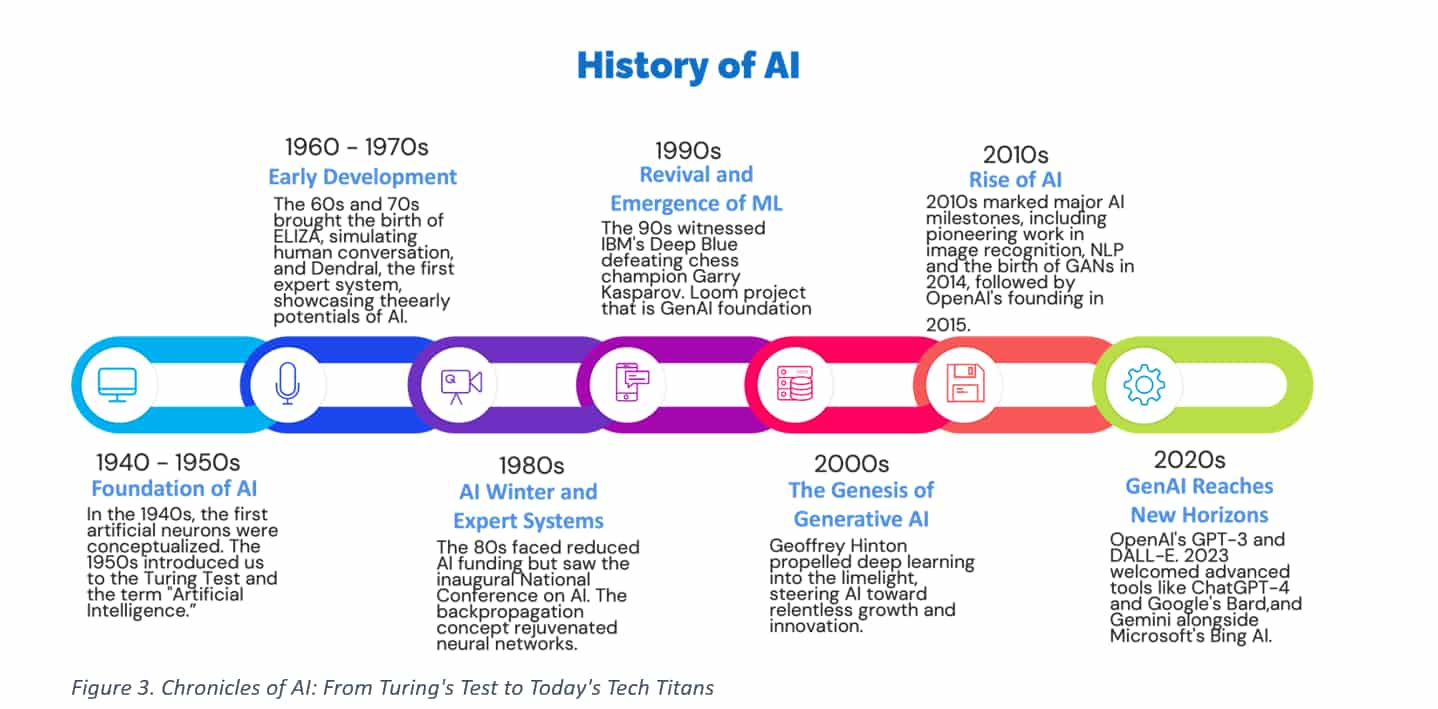
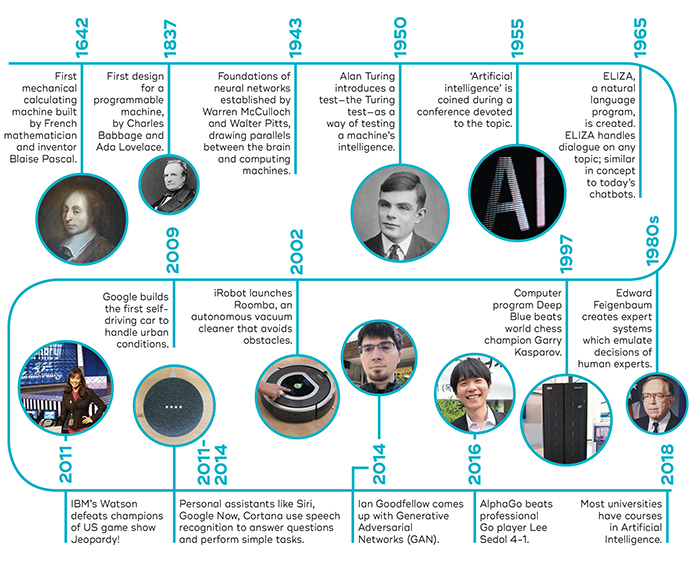
The conceptual roots of AI trace back to the mid-20th century. In 1943, Warren McCulloch and Walter Pitts proposed a model of artificial neurons, laying the groundwork for neural networks. Alan Turing’s 1950 paper "Computing Machinery and Intelligence" introduced the Turing Test, a criterion for determining a machine’s ability to exhibit intelligent behavior indistinguishable from a human. The term "Artificial Intelligence" was coined in 1956 by John McCarthy during the Dartmouth Conference, marking the formal birth of AI as a field.
#The Golden Age (1956–1974)
This period saw rapid progress, with early AI programs such as ELIZA (a natural language processing chatbot) and SHRDLU (a natural language understanding system) demonstrating rudimentary conversational and problem-solving capabilities. The development of expert systems in the 1970s, like MYCIN for medical diagnosis, showcased AI’s potential in specialized domains. However, limitations in computational power and the complexity of real-world problems led to the first "AI winter" in the late 1970s.
#Revival and Expansion (1980s–1990s)
The resurgence of AI in the 1980s was fueled by advancements in expert systems and the introduction of backpropagation algorithms for training neural networks. Japan’s Fifth Generation Computer Systems project (1982) aimed to create intelligent machines but ultimately fell short of expectations. The 1990s witnessed breakthroughs in machine learning, including the defeat of world chess champion Garry Kasparov by IBM’s Deep Blue in 1997, demonstrating AI’s prowess in strategic games.
#The Modern Era (2000s–Present)
The 21st century has been defined by the rise of big data, cloud computing, and deep learning. Key milestones include:
- 2011: IBM’s Watson wins Jeopardy!, showcasing AI’s ability to process natural language and answer complex questions.
- 2012: The ImageNet competition sees deep learning models achieve human-level performance in image recognition.
- 2016: AlphaGo, developed by DeepMind, defeats a world champion Go player, highlighting AI’s capability in complex decision-making.
- 2020s: The proliferation of generative AI models like DALL-E, Stable Diffusion, and ChatGPT democratizes AI, enabling widespread applications in creative and conversational domains.
#How It Works
AI systems operate through a combination of algorithms, data, and computational resources. The core methodologies include:
#Machine Learning (ML)
A subset of AI, ML enables systems to learn from data without explicit programming. Key techniques include:
- Supervised Learning: Models are trained on labeled datasets (e.g., spam detection, image classification).
- Unsupervised Learning: Models identify patterns in unlabeled data (e.g., clustering, anomaly detection).
- Reinforcement Learning: Agents learn by interacting with an environment to maximize rewards (e.g., robotics, game-playing AI).
#Deep Learning A specialized form of ML, deep learning uses artificial neural networks with multiple layers (hence "deep") to model complex data structures. Convolutional Neural Networks (CNNs) excel in image and video processing, while Recurrent Neural Networks (RNNs) and Transformers are pivotal in natural language processing (NLP).
#Natural Language Processing (NLP)
NLP enables machines to understand, interpret, and generate human language. Applications include chatbots, translation services (e.g., Google Translate), and sentiment analysis. Transformer models like BERT and GPT-3 have revolutionized NLP by capturing contextual relationships in language.
#Computer Vision This field focuses on enabling machines to interpret visual data. Techniques include object detection, facial recognition, and autonomous vehicle navigation. Convolutional Neural Networks (CNNs) are the backbone of modern computer vision systems.
#Robotics AI-driven robotics combines physical systems with intelligent control. Applications range from industrial automation (e.g., robotic arms in manufacturing) to autonomous drones and humanoid robots (e.g., Boston Dynamics’ Atlas).
#Key Components
- Data: High-quality, diverse datasets are essential for training AI models.
- Algorithms: Mathematical models that process data and make predictions or decisions.
- Computational Power: GPUs and TPUs accelerate training and inference.
- Feedback Loops: Continuous learning from user interactions improves model performance.
#Important Facts
- Economic Impact: AI is projected to contribute $15.7 trillion to the global economy by 2030, according to PwC.
- Job Market: While AI creates new jobs (e.g., AI ethicists, data scientists), it also displaces roles in manufacturing, customer service, and routine-based professions. The World Economic Forum estimates that 85 million jobs may be displaced by 2025, offset by 97 million new roles.
- Healthcare: AI enhances diagnostics, drug discovery, and personalized medicine. For example, AI models can detect breast cancer in mammograms with 94% accuracy, comparable to human radiologists.
- Education: Adaptive learning platforms (e.g., Duolingo, Khan Academy) use AI to personalize education, improving engagement and outcomes.
- Bias and Fairness: AI systems can perpetuate biases present in training data. For instance, facial recognition systems have higher error rates for darker-skinned individuals.
- Privacy Concerns: AI’s reliance on vast datasets raises issues about surveillance, data ownership, and consent. The EU’s General Data Protection Regulation (GDPR) addresses some of these concerns.
- Autonomous Systems: Self-driving cars (e.g., Tesla, Waymo) rely on AI to navigate complex environments, though challenges remain in safety and regulatory acceptance.
- Existential Risks: Prominent figures like Elon Musk and Stephen Hawking have warned about the potential for superintelligent AI to pose existential threats if not properly controlled.
#Timeline
- Foundational ideas
Core concepts and early methods shape The Impact of AI on Society.
- Practical use
Tools, examples, and real-world deployments make the topic easier to evaluate.
- Responsible implementation
Current work focuses on reliability, governance, performance, and measurable impact.
#Related Terms
#FAQ
What does The Impact of AI on Society cover?
Covers the impact of ai on society, including core concepts, practical examples, benefits, limitations, and risks in AI Trends.
Why is The Impact of AI on Society important?
It helps readers understand key concepts, compare practical use cases, and evaluate how AI Trends decisions affect outcomes, risks, and implementation choices.
What should readers verify before applying this topic?
Readers should compare benefits, limitations, data requirements, and related themes such as Impact, AI, Society before using the ideas in real projects.
#References
- The Impact of AI on Society terminology and background research
- The Impact of AI on Society use cases, implementation examples, and limitations
- AI Trends best practices, standards, and risk guidance
- Impact case studies, benchmarks, and current industry analysis

Comments
No comments yet. Start the discussion with a useful note.