

#Short Answer
Reviews review: best ai summarization tools in 2026, covering notable options, strengths, limitations, and practical selection factors.
#Infobox
#Overview
AI summarization tools have evolved significantly since their inception, transforming from basic extractive methods to sophisticated abstractive techniques powered by large language models (LLMs). In 2026, these tools are indispensable for professionals across industries, enabling them to process vast amounts of information efficiently. The demand for AI-driven summarization has surged due to the exponential growth of digital content, making these tools critical for knowledge workers, researchers, and content creators. Modern AI summarizers employ a combination of techniques, including:
- Extractive Summarization: Selecting and combining key sentences from the source text.
- Abstractive Summarization: Generating new sentences that capture the essence of the content using generative AI.
- Hybrid Approaches: Combining extractive and abstractive methods for improved coherence and accuracy. The integration of transformer-based models like BERT, T5, and proprietary LLMs has further enhanced the quality of summaries, making them indistinguishable from human-written ones in many cases.
#History / Background
#Early Developments
(Pre-2010s)
The concept of text summarization dates back to the 1950s, with early methods relying on statistical and heuristic approaches. The first automated summarization systems, such as those developed by IBM and MIT, used sentence extraction based on word frequency and position.
#The Rise of Machine Learning (2010s)
The advent of machine learning and NLP marked a turning point in summarization technology. Algorithms like Latent Semantic Analysis (LSA) and TextRank enabled more sophisticated extractive summarization. However, these methods often produced summaries that lacked coherence and contextual relevance.
#The Deep Learning Revolution (2018–2023)
The introduction of transformer models, particularly BERT (Bidirectional Encoder Representations from Transformers) by Google in 2018, revolutionized AI summarization. BERT and its successors, such as T5 and PEGASUS, enabled models to understand context better, leading to more accurate and human-like summaries.
#The LLM Era (2024–2026)
By 2026, large language models (LLMs) like GPT-4, Claude 3, and proprietary models have become the backbone of AI summarization tools. These models can generate abstractive summaries that not only condense text but also rephrase it in a way that maintains the original meaning. The focus has shifted toward real-time summarization, multi-modal input (text + audio/video), and domain-specific fine-tuning.
#How It Works
#Core Techniques
- Extractive Summarization
- Tokenization: The input text is broken down into sentences or phrases.
- Scoring: Sentences are ranked based on relevance using metrics like term frequency, sentence position, or semantic similarity.
- Selection: The top-ranked sentences are combined to form the summary.
- Abstractive Summarization
- Encoding: The input text is encoded into a numerical representation using a transformer-based model.
- Decoding: The model generates a summary word by word, using its learned knowledge of language patterns.
- Post-Processing: The output is refined to ensure fluency and coherence.
- Hybrid Summarization - Combines extractive and abstractive methods to leverage the strengths of both approaches. For example, an extractive model may first identify key sentences, which are then refined by an abstractive model.
#Key Components
- Preprocessing: Cleaning and normalizing text (removing stopwords, lemmatization, etc.).
- Feature Extraction: Identifying important phrases, entities, and relationships.
- Model Training: Fine-tuning pre-trained models on domain-specific datasets.
- Evaluation: Using metrics like ROUGE (Recall-Oriented Understudy for Gisting Evaluation) to assess summary quality.
#Advanced Features in 2026
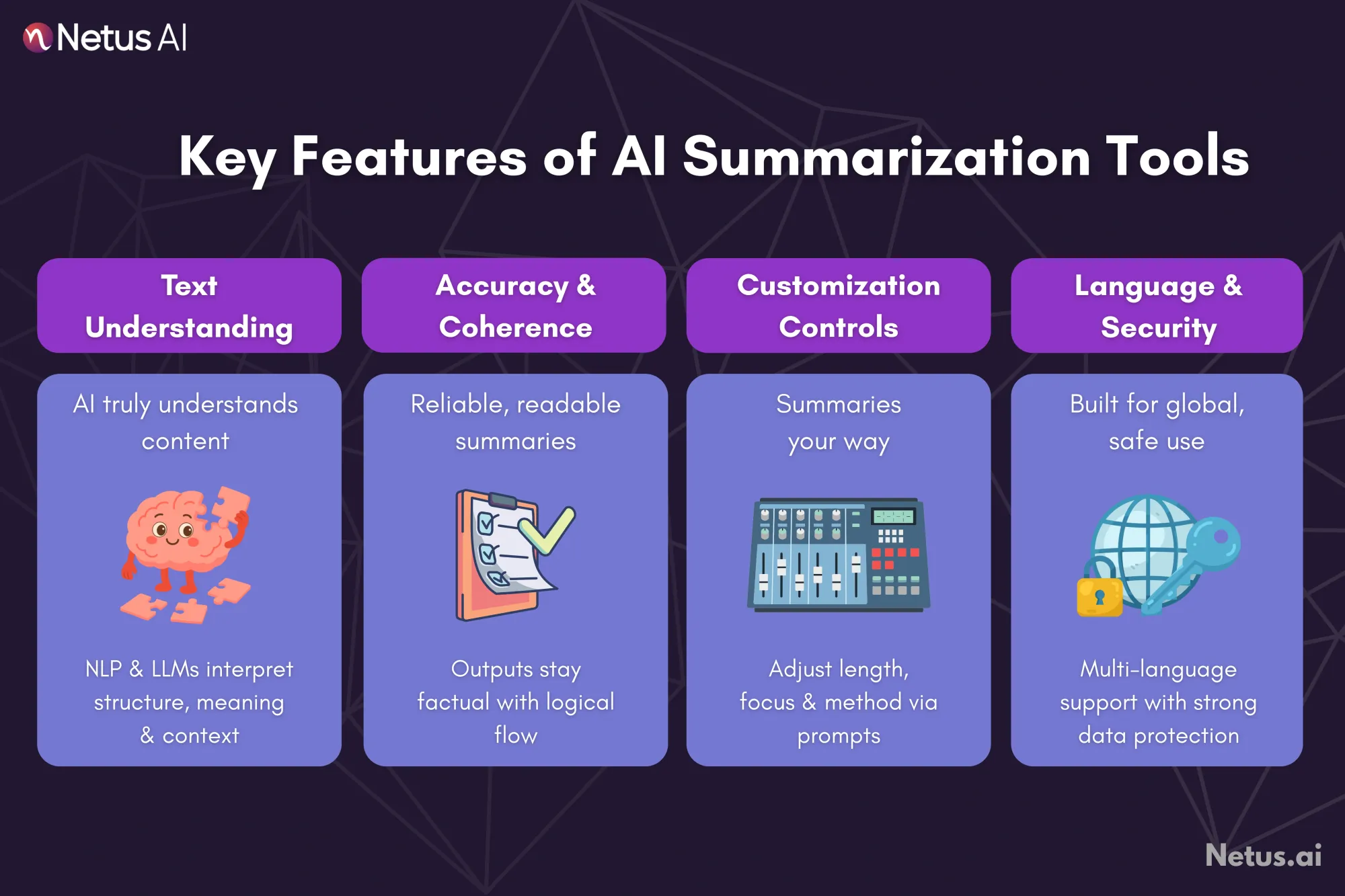
- Context-Aware Summarization: Tools can now summarize texts while considering the broader context, such as previous interactions or user preferences.
- Multi-Language Support: Advanced NLP models support summarization in over 100 languages, with real-time translation integration.
- Customization: Users can adjust summary length, style (e.g., formal vs. casual), and focus areas (e.g., technical vs. layman terms).
- Integration with LLMs: Summarization tools now often include chatbot-like interfaces, allowing users to ask follow-up questions or request refinements.
#Important Facts
- Accuracy Improvements: Modern AI summarizers achieve ROUGE-L scores of up to 0.50–0.60, compared to 0.30–0.40 in 2020.
- Speed: Real-time summarization is now possible, with tools processing documents in under a second.
- Cost Efficiency: Cloud-based summarization services have reduced costs, making them accessible to small businesses and individuals.
- Ethical Considerations: Bias mitigation and transparency in AI-generated summaries are major focus areas in 2026.
- Industry Adoption: Over 60% of Fortune 500 companies use AI summarization tools for internal knowledge management and external communications.
- Regulatory Compliance: Summarization tools are increasingly designed to comply with data privacy laws like GDPR and CCPA.
#Timeline
- Foundational ideas
Core concepts and early methods shape Review: Best AI Summarization Tools in 2026.
- Practical use
Tools, examples, and real-world deployments make the topic easier to evaluate.
- Responsible implementation
Current work focuses on reliability, governance, performance, and measurable impact.
#Related Terms
#FAQ
What does Review: Best AI Summarization Tools in 2026 cover?
Reviews review: best ai summarization tools in 2026, covering notable options, strengths, limitations, and practical selection factors.
Why is Review: Best AI Summarization Tools in 2026 important?
It helps readers understand key concepts, compare practical use cases, and evaluate how Generative AI decisions affect outcomes, risks, and implementation choices.
What should readers verify before applying this topic?
Readers should compare benefits, limitations, data requirements, and related themes such as Review, Best, AI before using the ideas in real projects.
#References
- Review: Best AI Summarization Tools in 2026 terminology and background research
- Review: Best AI Summarization Tools in 2026 use cases, implementation examples, and limitations
- Generative AI best practices, standards, and risk guidance
- Review case studies, benchmarks, and current industry analysis



Comments
No comments yet. Start the discussion with a useful note.