

#Short Answer
Covers facts about computer vision, including core concepts, practical examples, benefits, limitations, and risks in Computer Vision.
#Infobox
#Overview
Computer vision is a multidisciplinary field that integrates principles from computer science, mathematics, and cognitive science to enable machines to extract meaningful information from visual inputs. Unlike traditional image processing, which focuses on manipulating pixel data, computer vision aims to replicate human-like visual perception, allowing systems to recognize objects, classify scenes, and even interpret emotions. The field has evolved significantly with advancements in deep learning, particularly convolutional neural networks (CNNs), which have revolutionized tasks such as image classification, object detection, and segmentation. Today, computer vision powers applications in diverse sectors, including healthcare, transportation, security, and entertainment.
#History / Background
#Early Foundations (1950s–1970s)
The origins of computer vision trace back to the 1950s, when early researchers began exploring ways to automate visual tasks. One of the first notable contributions came from Marvin Minsky, who, along with Seymour Papert, developed the Perceptron, a rudimentary neural network model for pattern recognition. In the 1960s and 1970s, the field gained momentum with the work of David Marr, who proposed a computational theory of vision. Marr’s framework emphasized the importance of representation and processing in visual perception, laying the groundwork for modern computer vision algorithms. During this period, researchers also developed early techniques for edge detection and image segmentation.
#The AI Winter and Revival (1980s–1990s)
The 1980s and early 1990s saw a decline in AI research funding, often referred to as the "AI Winter." However, computer vision continued to progress, albeit at a slower pace. Key developments included:
- SIFT (Scale-Invariant Feature Transform) by David Lowe (1999), which enabled robust feature matching in images.
- Active vision approaches, where cameras actively moved to gather more information.
#The Deep Learning Revolution (2000s–Present)
The breakthrough in computer vision came with the advent of deep learning, particularly convolutional neural networks (CNNs). The pivotal moment arrived in 2012 when AlexNet, designed by Alex Krizhevsky, Ilya Sutskever, and Geoffrey Hinton, won the ImageNet Large Scale Visual Recognition Challenge (ILSVRC) by a significant margin. This victory demonstrated the superiority of deep learning over traditional methods. Subsequent advancements included:
- ResNet (2015) by Kaiming He et al., which introduced residual learning to train deeper networks.
- Generative Adversarial Networks (GANs) by Ian Goodfellow (2014), enabling realistic image generation.
- Vision Transformers (ViT, 2020) by Dosovitskiy et al., which applied transformer architectures from natural language processing to vision tasks. Today, computer vision is a cornerstone of artificial general intelligence (AGI) research, with applications in self-driving cars (Tesla, Waymo), medical diagnostics (IBM Watson, Google DeepMind), and augmented reality (ARKit, ARCore).
#How It Works
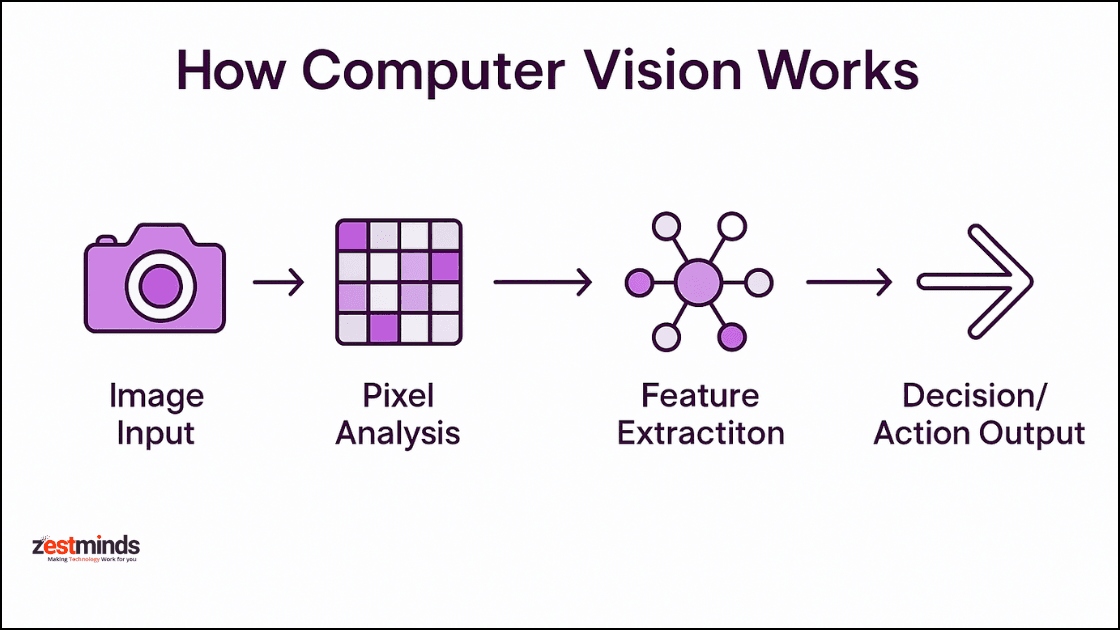
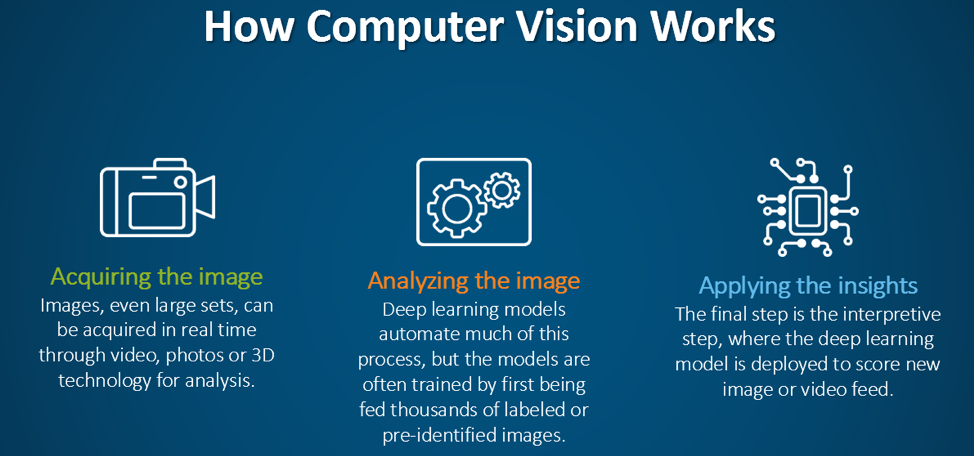
Computer vision systems process visual data through a series of steps, often involving preprocessing, feature extraction, and decision-making. The workflow can be broken down as follows:
#
- Image Acquisition Visual data is captured using cameras, sensors, or other imaging devices. Common formats include:
- RGB images (standard color images).
- Depth maps (from LiDAR or stereo cameras).
- Thermal images (for heat-based detection).
#
- Preprocessing Raw image data is often noisy or inconsistent, requiring preprocessing to enhance quality. Techniques include:
- Noise reduction (Gaussian blur, median filtering).
- Contrast enhancement (histogram equalization).
- Normalization (scaling pixel values to a standard range).
#
- Feature Extraction Features are distinctive patterns or structures in an image that help in recognition. Traditional methods include:
- Edge detection (Canny, Sobel filters).
- Corner detection (Harris corner detector).
- Texture analysis (Local Binary Patterns). Modern systems rely on deep learning-based feature extraction, where neural networks automatically learn hierarchical representations from raw pixels.
#
- Object Detection and Recognition This involves identifying and classifying objects within an image. Approaches include:
- Two-stage detectors (R-CNN, Faster R-CNN) that first propose regions of interest and then classify them.
- One-stage detectors (YOLO, SSD) that perform detection in a single pass.
- Semantic segmentation (U-Net, Mask R-CNN) for pixel-level classification.
#
- Scene Understanding Advanced systems aim to interpret entire scenes, including:
- 3D reconstruction (Structure from Motion, LiDAR).
- Activity recognition (tracking human actions in videos).
- Emotion and facial recognition (AffectNet, FaceNet).
#
- Decision Making The final output is used for decision-making, such as:
- Autonomous navigation (self-driving cars).
- Medical diagnosis (tumor detection in X-rays).
- Security systems (intruder detection).
#Important Facts
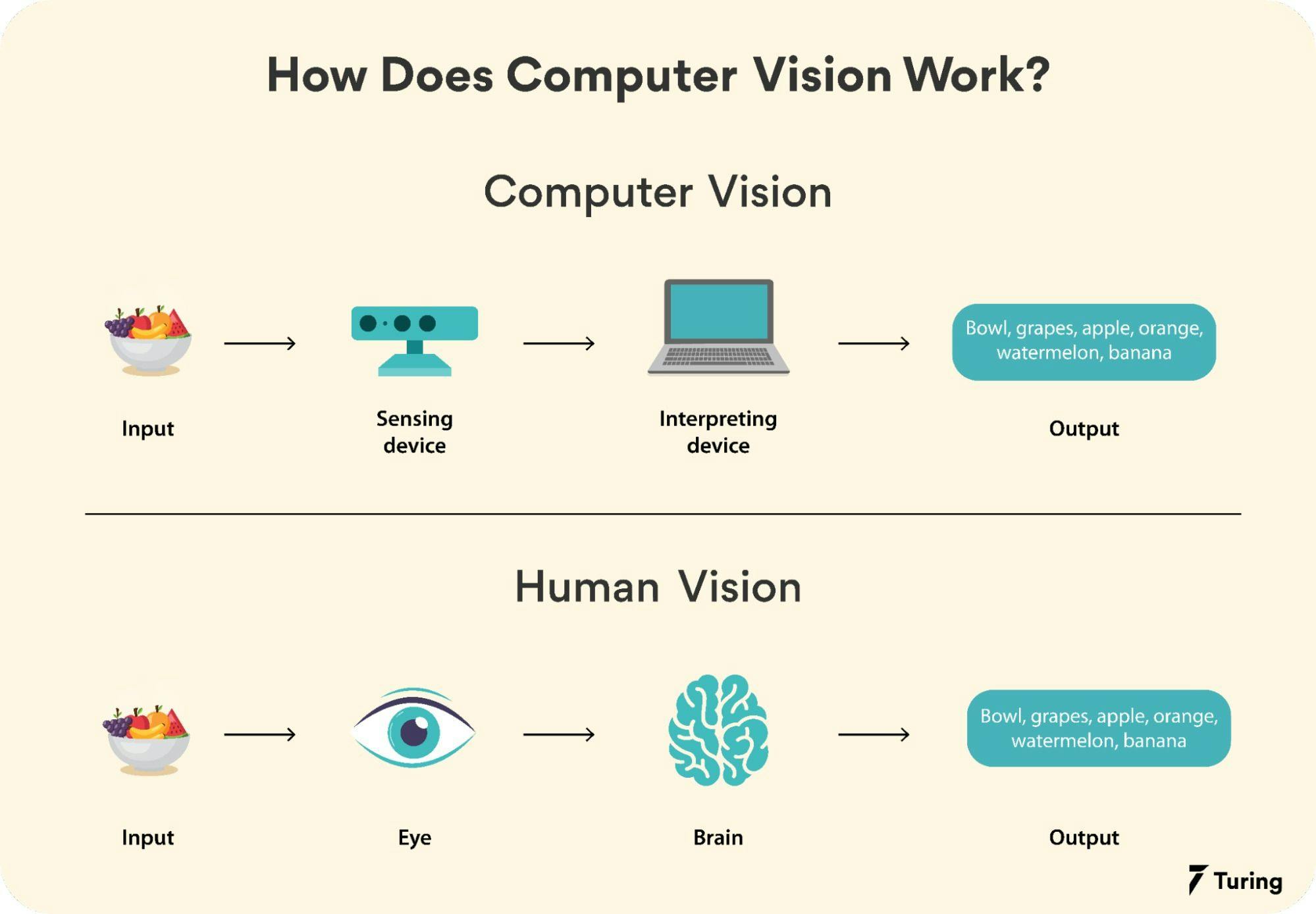
#1. Computer Vision vs. Human Vision While humans effortlessly recognize objects, computer vision systems require millions of training examples to achieve similar accuracy. However, machines excel in tasks like processing large datasets and performing repetitive tasks without fatigue.
#2. Key Technologies
- Convolutional Neural Networks (CNNs): The backbone of modern computer vision, used in tasks like image classification and object detection.
- Generative Adversarial Networks (GANs): Used for image synthesis, super-resolution, and data augmentation.
- Transformer Models (ViT, DETR): Adapted from NLP, these models treat images as sequences of patches for improved performance.
#3. Applications by Industry
| Industry | Applications | |-----------------------|-----------------------------------------------| | Healthcare | Tumor detection, X-ray analysis, surgical robots | | Automotive | Self-driving cars, lane detection, parking assistance | | Retail | Cashier-less stores, inventory management, personalized recommendations | | Security | Facial recognition, surveillance, biometric authentication | | Agriculture | Crop monitoring, pest detection, automated harvesting | | Entertainment | Augmented reality (AR), virtual reality (VR), video game AI |
#4. Challenges
- Data Bias: Models trained on biased datasets may perform poorly on underrepresented groups.
- Real-Time Processing: High computational requirements for real-time applications like autonomous driving.
- Explainability: Deep learning models are often "black boxes," making it difficult to interpret decisions.
- Adversarial Attacks: Malicious inputs can trick models into making incorrect predictions.
#5. Ethical Considerations
- Privacy Concerns: Facial recognition systems raise issues about surveillance and consent.
- Job Displacement: Automation in industries like manufacturing may lead to workforce changes.
- Bias and Fairness: Models must be trained on diverse datasets to avoid discriminatory outcomes.
#Timeline
- Foundational ideas
Core concepts and early methods shape Facts About Computer Vision.
- Practical use
Tools, examples, and real-world deployments make the topic easier to evaluate.
- Responsible implementation
Current work focuses on reliability, governance, performance, and measurable impact.
#Related Terms
#FAQ
What does Facts About Computer Vision cover?
Covers facts about computer vision, including core concepts, practical examples, benefits, limitations, and risks in Computer Vision.
Why is Facts About Computer Vision important?
It helps readers understand key concepts, compare practical use cases, and evaluate how Computer Vision decisions affect outcomes, risks, and implementation choices.
What should readers verify before applying this topic?
Readers should compare benefits, limitations, data requirements, and related themes such as Facts, About, Computer before using the ideas in real projects.
#References
- Facts About Computer Vision terminology and background research
- Facts About Computer Vision use cases, implementation examples, and limitations
- Computer Vision best practices, standards, and risk guidance
- Facts case studies, benchmarks, and current industry analysis


Comments
No comments yet. Start the discussion with a useful note.