


#Short Answer
Covers exploring the basics of machine learning, including core concepts, practical examples, benefits, limitations, and risks in Machine Learning.
#Infobox
#History / Background
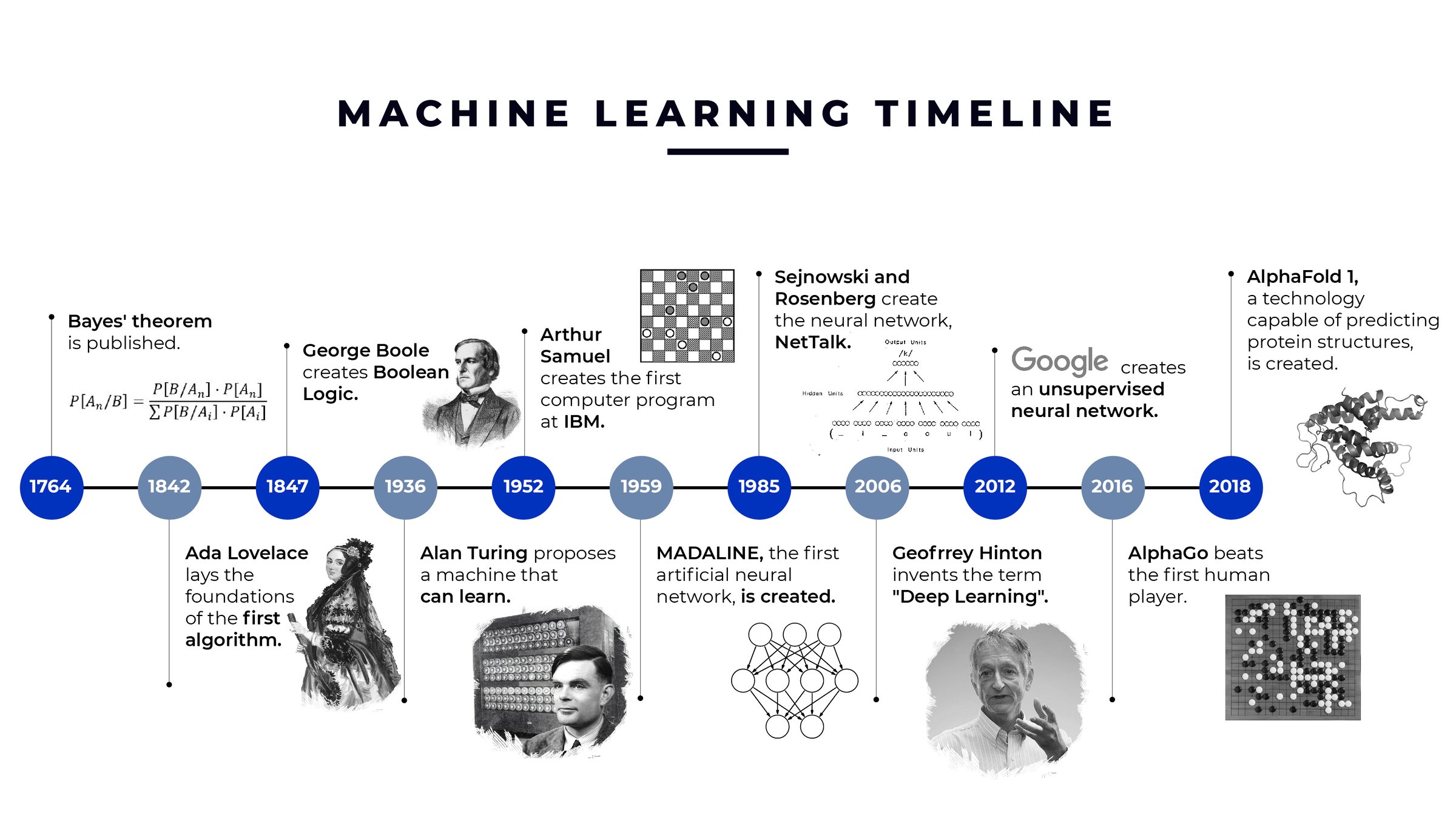
Early Foundations (1950s–1980s) The conceptual roots of machine learning trace back to the mid-20th century, with early work in cybernetics and neural networks. In 1950, Alan Turing proposed the "Turing Test" as a measure of machine intelligence, laying the groundwork for AI research. The term "machine learning" was coined by Arthur Samuel in 1959, who developed a program that improved its performance in checkers by playing against itself. During this period, key milestones included:
- 1958: Frank Rosenblatt introduced the Perceptron, an early neural network model capable of binary classification.
- 1967: The "Nearest Neighbor" algorithm was developed, enabling pattern recognition in data.
- 1980s: The rise of expert systems and symbolic AI dominated research, though limitations in scalability and adaptability led to a decline in interest.
Revival and Modern Era (1990s–Present) The 1990s marked a resurgence in ML, driven by advances in computational power and the availability of large datasets. Key developments included:
- 1997: IBM's Deep Blue defeated world chess champion Garry Kasparov, showcasing the potential of AI in complex decision-making.
- 2006: Geoffrey Hinton's work on deep belief networks reignited interest in neural networks, leading to the "deep learning" revolution.
- 2012: A convolutional neural network (CNN) won the ImageNet competition, demonstrating the power of deep learning in image recognition. Today, ML is a cornerstone of AI, powering technologies like autonomous vehicles, virtual assistants, and personalized medicine. The field continues to evolve with innovations in reinforcement learning, generative AI, and federated learning.
#How It Works
Core Components
- Data Collection: Gathering relevant datasets, which may include structured (e.g., spreadsheets) or unstructured (e.g., text, images) data.
- Data Preprocessing: Cleaning and transforming raw data to remove noise, handle missing values, and normalize features. Techniques include normalization, encoding categorical variables, and feature extraction.
- Model Selection: Choosing an appropriate algorithm based on the problem type:
- Supervised Learning: Uses labeled data (e.g., linear regression for predicting house prices).
- Unsupervised Learning: Identifies patterns in unlabeled data (e.g., k-means clustering for customer segmentation).
- Reinforcement Learning: Trains models through trial-and-error interactions with an environment (e.g., game-playing AI).
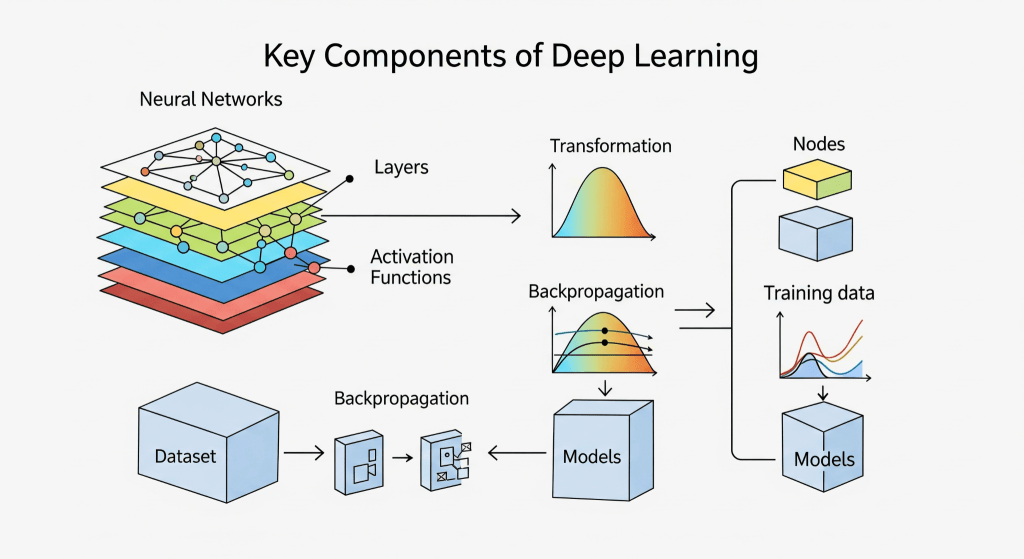
- Training: Feeding the model with training data to adjust its parameters. For example, in neural networks, this involves backpropagation to minimize error.
- Evaluation: Assessing model performance using metrics like accuracy, precision, recall, or mean squared error. Techniques such as cross-validation help prevent overfitting.
- Deployment: Integrating the trained model into real-world applications, such as recommendation engines or fraud detection systems.
Key Algorithms
- Linear Regression: Predicts continuous outcomes by modeling the relationship between input variables and a target.
- Decision Trees: Splits data into branches based on feature values to make classifications or predictions.
- Neural Networks: Mimics the human brain's structure with layers of interconnected nodes (neurons), excelling in tasks like image and speech recognition.
- Support Vector Machines (SVM): Classifies data by finding the optimal hyperplane that separates different classes.
- k-Nearest Neighbors (k-NN): Classifies new data points based on the majority class of their nearest neighbors in the training set.
#Important Facts
- Bias-Variance Tradeoff: A fundamental challenge in ML, where reducing bias (error due to overly simplistic models) may increase variance (error due to model complexity), and vice versa.
- Overfitting vs. Underfitting:
- Overfitting: Occurs when a model learns noise in the training data, performing poorly on new data.
- Underfitting: Happens when a model is too simple to capture underlying patterns.
- Feature Engineering: The process of selecting, transforming, or creating features to improve model performance. Techniques include scaling, one-hot encoding, and dimensionality reduction (e.g., PCA).
- Transfer Learning: Leveraging pre-trained models (e.g., BERT for NLP) to adapt to new tasks with minimal additional training.
- Explainability: The ability to interpret model decisions is critical in high-stakes applications like healthcare. Techniques like SHAP (SHapley Additive exPlanations) and LIME (Local Interpretable Model-agnostic Explanations) help demystify black-box models.
#Timeline
- Foundational ideas
Core concepts and early methods shape Exploring the Basics of Machine Learning.
- Practical use
Tools, examples, and real-world deployments make the topic easier to evaluate.
- Responsible implementation
Current work focuses on reliability, governance, performance, and measurable impact.
#Related Terms
#FAQ
What does Exploring the Basics of Machine Learning cover?
Covers exploring the basics of machine learning, including core concepts, practical examples, benefits, limitations, and risks in Machine Learning.
Why is Exploring the Basics of Machine Learning important?
It helps readers understand key concepts, compare practical use cases, and evaluate how Machine Learning decisions affect outcomes, risks, and implementation choices.
What should readers verify before applying this topic?
Readers should compare benefits, limitations, data requirements, and related themes such as Exploring, Basics, Machine before using the ideas in real projects.
#References
- Exploring the Basics of Machine Learning terminology and background research
- Exploring the Basics of Machine Learning use cases, implementation examples, and limitations
- Machine Learning best practices, standards, and risk guidance
- Exploring case studies, benchmarks, and current industry analysis


Comments
No comments yet. Start the discussion with a useful note.