

#Short Answer
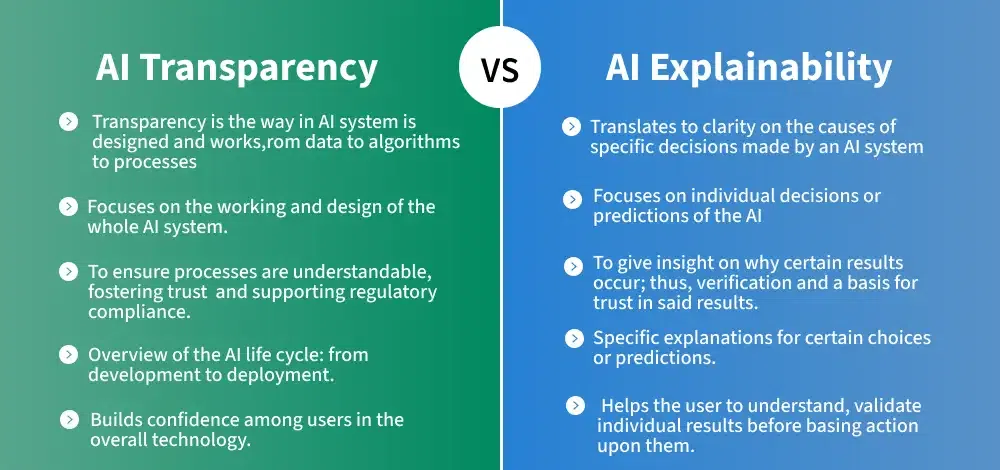
AI Transparency is a critical component of responsible artificial intelligence, focusing on the clarity and interpretability of AI-driven decisions. As AI systems become increasingly integrated into sectors such as healthcare, finance, criminal justice, and autonomous vehicles, the need for transparency grows. Without it, users and stakeholders may struggle to trust AI outputs, leading to resistance in adoption and potential legal or ethical violations.
#Infobox
#Overview
AI Transparency is a critical component of responsible artificial intelligence, focusing on the clarity and interpretability of AI-driven decisions. As AI systems become increasingly integrated into sectors such as healthcare, finance, criminal justice, and autonomous vehicles, the need for transparency grows. Without it, users and stakeholders may struggle to trust AI outputs, leading to resistance in adoption and potential legal or ethical violations.
Transparency in AI encompasses several dimensions:
- Explainability: The ability to provide understandable reasons for an AI's decisions.
- Interpretability: The degree to which a human can comprehend the internal workings of an AI model.
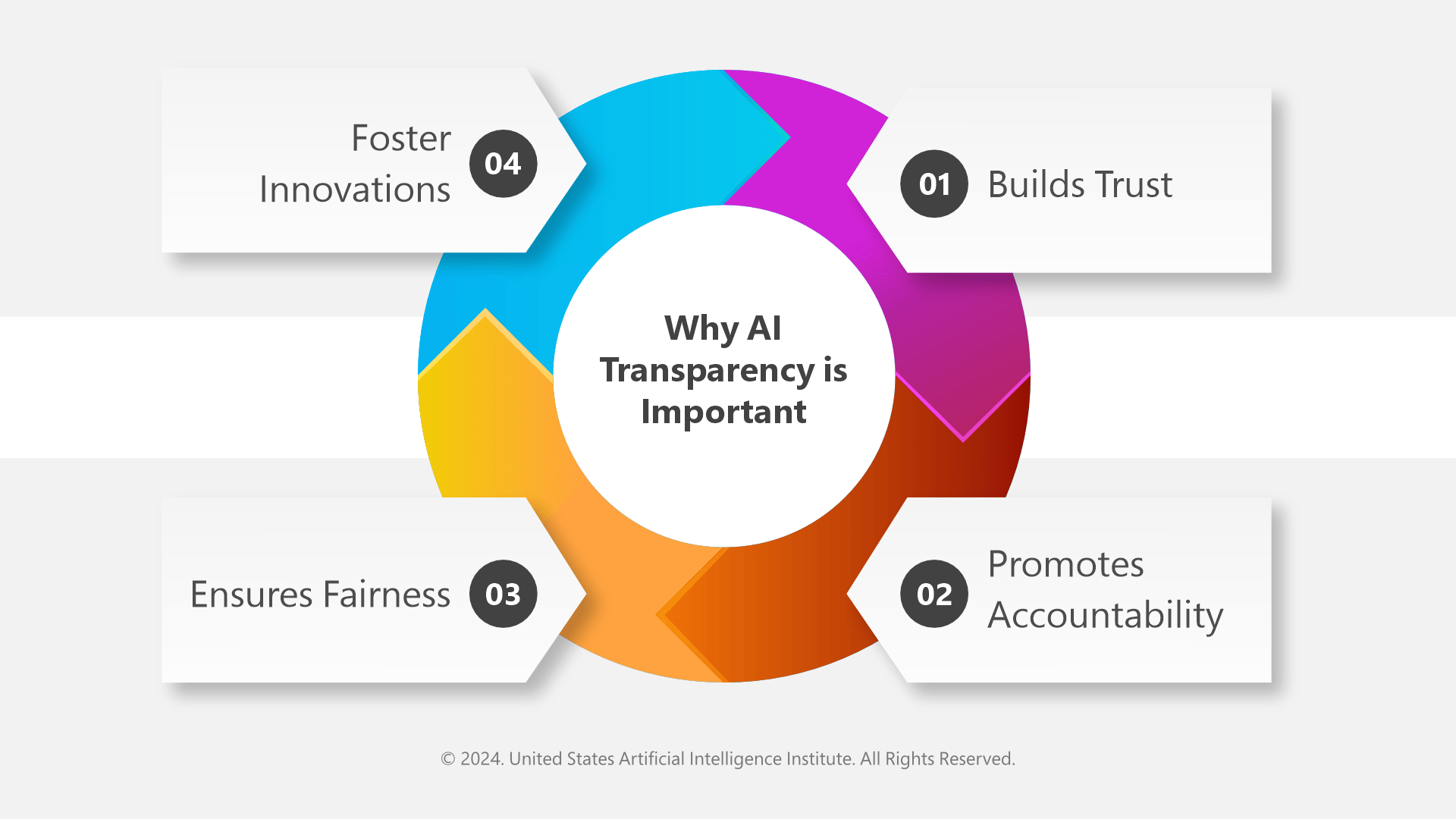
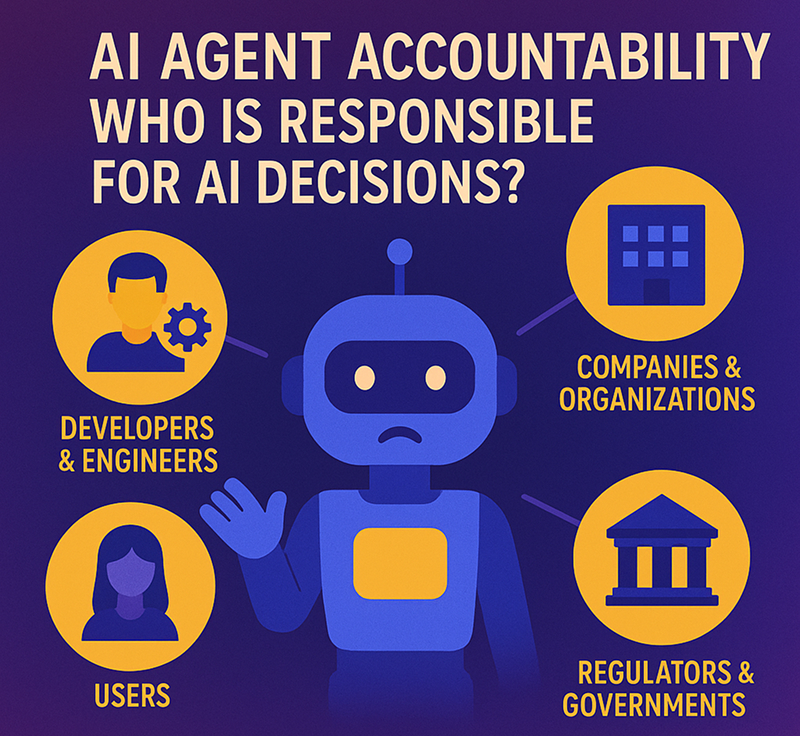
- Accountability: Ensuring that AI systems can be held responsible for their actions and outcomes.
- Fairness: Detecting and mitigating biases in AI decision-making to ensure equitable treatment.
- Trustworthiness: Building confidence among users and regulators that AI systems operate reliably and ethically.
AI Transparency is closely linked to the field of Explainable AI (XAI), which develops methods to make complex AI models more interpretable. It also intersects with ethical AI, which emphasizes the moral implications of AI deployment, and algorithmic accountability, which seeks to ensure that AI systems are auditable and free from discriminatory practices.
#History / Background
The concept of AI Transparency emerged alongside the rapid advancement of machine learning and deep learning technologies in the 21st century. Early AI systems, such as rule-based expert systems, were inherently transparent because their decision-making processes were explicitly defined by human-crafted rules. However, the rise of black-box models—particularly deep neural networks—posed significant challenges to transparency.
Key milestones in the evolution of AI Transparency include:
- 2016: The term "Explainable AI" gained prominence with the publication of DARPA's XAI program, which aimed to develop techniques for interpreting complex AI models.
- 2018: The European Union's General Data Protection Regulation (GDPR) introduced the "right to explanation," granting individuals the right to request explanations for automated decisions that significantly affect them.
- 2020: The AI Ethics Guidelines published by the European Commission emphasized transparency as a core principle for trustworthy AI.
- 2021: The Algorithmic Accountability Act in the United States proposed requirements for companies to assess and mitigate risks associated with automated decision systems.
- 2023: The G7 Hiroshima AI Process included transparency as a key pillar in the international framework for AI governance.
These developments reflect a growing recognition that transparency is essential for ensuring that AI systems align with societal values and legal standards.
#How It Works
AI Transparency is achieved through a combination of techniques, tools, and frameworks designed to make AI systems more interpretable and accountable. The methods vary depending on the type of AI model and the context in which it is used. Below are the primary approaches to achieving transparency:
#Model-Specific Techniques
These techniques are tailored to specific types of AI models, providing insights into their internal workings:
- Linear Models: Simple models like linear regression or logistic regression are inherently interpretable because their decision-making process can be expressed as a set of weighted features. The coefficients of these models directly indicate the influence of each input feature on the output.
- Decision Trees: Decision trees are transparent because their structure consists of a series of if-then rules that can be easily followed. Each node in the tree represents a decision based on a specific feature, making it straightforward to trace the path leading to a prediction.
- Rule-Based Systems: Systems that rely on explicit rules (e.g., expert systems) are inherently transparent, as their decision-making logic is defined by human-readable rules.
#Model-Agnostic Techniques
These methods can be applied to any AI model, regardless of its architecture, to provide explanations for its decisions:
- Local Interpretable Model-agnostic Explanations (LIME): LIME generates local explanations by approximating the behavior of a complex model in the vicinity of a specific prediction. It perturbs the input data and observes how the model's output changes, then fits a simple, interpretable model (e.g., linear regression) to these perturbations to explain the original prediction.
- SHapley Additive exPlanations (SHAP): SHAP is a game-theoretic approach to explain the output of any machine learning model. It assigns each feature an importance value based on its contribution to the prediction, providing a unified measure of feature importance across different models.
- Partial Dependence Plots (PDPs): PDPs visualize the relationship between a feature and the predicted outcome while averaging out the effects of all other features. This helps users understand how changes in a specific feature influence the model's predictions.
- Counterfactual Explanations: These explanations describe how the input would need to change to achieve a different output. For example, in a loan approval scenario, a counterfactual explanation might state, "If your income were $10,000 higher, your loan would have been approved."
#Post-Hoc Explanations
Post-hoc explanations are generated after a model has made a prediction, providing insights into why a particular decision was reached. While these explanations do not reveal the internal workings of the model, they offer a way to interpret its behavior:
- Attention Mechanisms: In neural networks, attention mechanisms highlight the parts of the input data that the model focuses on when making a prediction. For example, in natural language processing, attention weights can show which words in a sentence were most influential in determining the output.
- Saliency Maps: Used primarily in computer vision, saliency maps identify the regions of an image that are most important for the model's prediction. These maps help users understand which parts of the image contributed most to the decision.
#Transparency Frameworks
Several frameworks and guidelines have been developed to standardize transparency practices in AI:
- European Commission's Ethics Guidelines for Trustworthy AI: This framework outlines seven key requirements for trustworthy AI, including transparency, accountability, and human oversight.
- OECD AI Principles: The OECD's AI Principles emphasize transparency, robustness, and accountability as core values for the responsible development of AI.
- NIST AI Risk Management Framework: The National Institute of Standards and Technology (NIST) in the U.S. has developed a framework to manage risks associated with AI systems, including transparency and explainability.
#Important Facts
- Black-Box Models: Deep learning models, such as convolutional neural networks (CNNs) and transformers, are often considered "black boxes" because their decision-making processes are difficult to interpret. This opacity has led to increased research in explainable AI techniques.
- Trade-Off Between Accuracy and Interpretability: There is often a trade-off between the accuracy of an AI model and its interpretability. Highly accurate models, such as deep neural networks, are typically less interpretable than simpler models like decision trees or linear regression.
- Regulatory Requirements: Laws such as GDPR in the EU and the Algorithmic Accountability Act in the U.S. mandate transparency in AI systems, particularly in high-stakes domains like healthcare and finance.
- Bias and Fairness: Transparency is crucial for detecting and mitigating biases in AI systems. Without clear explanations, it is difficult to identify whether an AI model is making fair or discriminatory decisions.
- Human-in-the-Loop: Many transparency frameworks advocate for human oversight in AI decision-making to ensure that explanations are meaningful and aligned with human values.
- Industry Adoption: Companies like Google, IBM, and Microsoft have developed tools and frameworks for AI transparency, such as Google's What-If Tool, IBM's AI Explainability 360, and Microsoft's InterpretML.
#Timeline
- Alan Turing's seminal paper
Alan Turing's seminal paper 'Computing Machinery and Intelligence' introduces the concept of machine intelligence, laying the groundwork for future discussions on AI interpretability.
- Development of the first
Development of the first rule-based expert systems, which are inherently transparent due to their explicit decision-making logic.
- DARPA launches the Explainable
DARPA launches the Explainable AI (XAI) program to develop techniques for interpreting complex AI models.
- GDPR's 'right to explanation'
GDPR's 'right to explanation' comes into effect, granting individuals the right to request explanations for automated decisions.
- European Commission publishes
European Commission publishes Ethics Guidelines for Trustworthy AI, emphasizing transparency as a core principle.
- U.S. introduces the Algorithmi
U.S. introduces the Algorithmic Accountability Act, proposing requirements for transparency in automated decision systems.
- Google releases the What-If
Google releases the What-If Tool, a tool for exploring and explaining machine learning models.
- G7 adopts the Hiroshima
G7 adopts the Hiroshima AI Process, including transparency as a key pillar in international AI governance.
#Related Terms
#FAQ
What does AI Transparency: Explaining Decisions cover?
AI transparency: explaining decisions covers practical examples, benefits, limitations, and important considerations for readers.
Why is AI Transparency: Explaining Decisions important?
It helps readers understand key concepts, compare practical use cases, and evaluate how AI Ethics decisions affect outcomes, risks, and implementation choices.
What should readers verify before applying this topic?
Readers should compare the benefits, limitations, data requirements, and related themes such as Transparency, Explaining, Decision before using the ideas in real projects.
#References
- AI Transparency: Explaining Decisions terminology and background research
- AI Transparency: Explaining Decisions use cases, implementation examples, and limitations
- AI Ethics best practices, standards, and risk guidance
- Transparency case studies, benchmarks, and current industry analysis
Comments
No comments yet. Start the discussion with a useful note.