

#Short Answer
Compares AI in business with traditional models, clarifying differences, strengths, limitations, and practical use cases.
#Infobox
Comparison of AI in Business vs Traditional Models Primary Focus Automation, prediction, and decision-making Key Technologies Machine learning, deep learning, generative AI Data Usage Structured and unstructured data Output Insights, recommendations, and automated actions Adoption Rate Widespread in enterprise and SMEs Cost High initial investment, lower long-term operational costs
#Overview
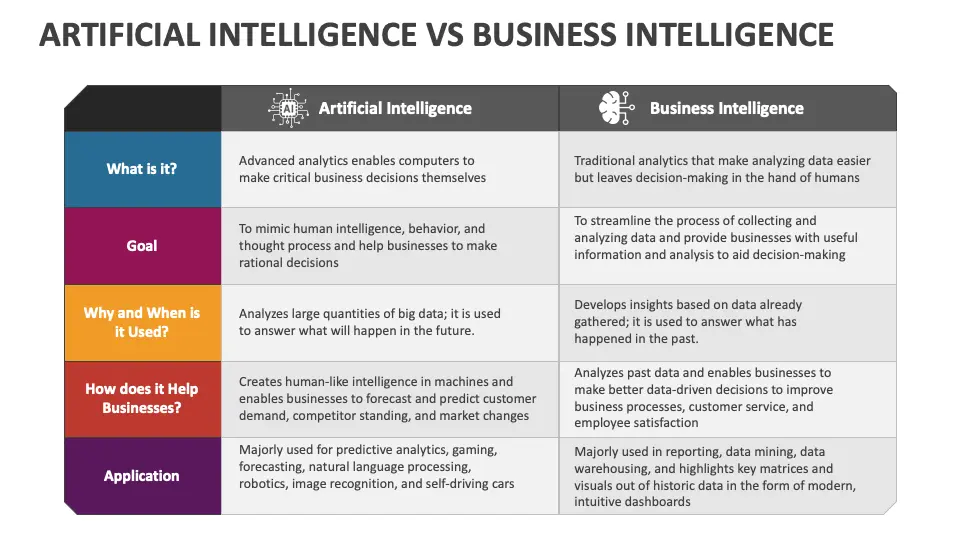
Artificial intelligence (AI) has transformed the business landscape by enabling organizations to leverage data-driven insights, automate repetitive tasks, and enhance customer experiences. Unlike traditional business models, which often rely on static processes and human decision-making, AI-driven approaches incorporate machine learning, natural language processing, and generative AI to adapt and improve over time. This shift has led to increased efficiency, cost savings, and competitive advantages for businesses across industries.
AI in business encompasses a range of applications, including customer service automation, predictive analytics, fraud detection, supply chain optimization, and personalized marketing. Traditional business models, on the other hand, typically follow rigid structures with limited scalability and adaptability. The integration of AI allows businesses to move beyond conventional limitations, fostering innovation and agility in dynamic markets.
#History / Background
#Early developments
The concept of AI dates back to the 1950s, with early research focusing on symbolic reasoning and rule-based systems. However, these traditional AI models required explicit programming and struggled with complex, real-world data. Businesses initially adopted AI in limited capacities, such as expert systems for decision support in industries like finance and healthcare.
#Rise of machine learning
The 2000s marked a significant shift with the advent of machine learning, which enabled systems to learn from data without explicit programming. Businesses began leveraging machine learning for tasks like customer segmentation, demand forecasting, and recommendation engines. This era saw the rise of data-driven decision-making, though traditional models still dominated many operational workflows.
#Emergence of generative AI
In the 2010s and 2020s, generative AI—capable of creating new content, such as text, images, and code—gained prominence. Tools like large language models (LLMs) and diffusion models enabled businesses to automate creative processes, enhance customer interactions, and generate synthetic data for training. This evolution further blurred the lines between AI-driven and traditional business models, as generative AI introduced capabilities that were previously unimaginable.
#How it works
#Traditional AI in business
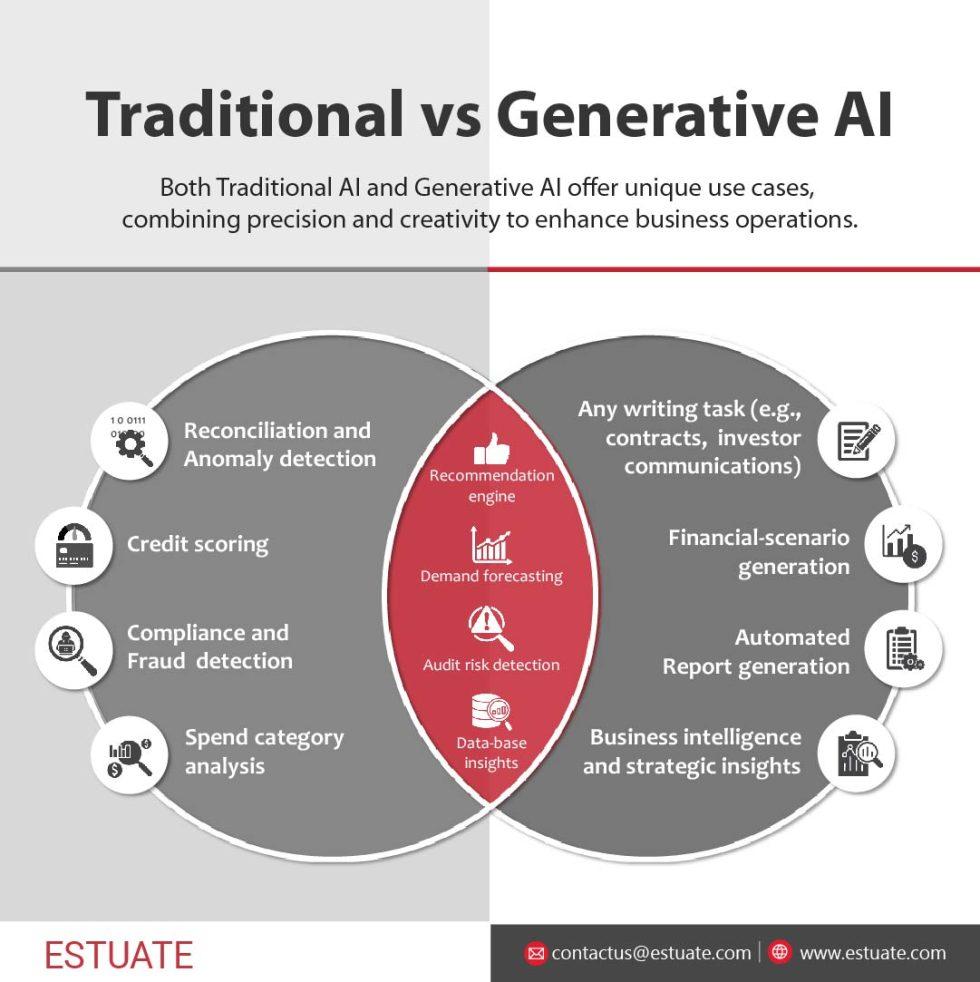
Traditional AI models, such as rule-based systems and early machine learning algorithms, operate on predefined logic or statistical methods. These systems require human experts to define rules or train models on labeled datasets. For example, a traditional AI chatbot might rely on a decision tree to respond to customer queries, while a fraud detection system could use statistical anomaly detection to flag suspicious transactions.
#Modern AI in business
Modern AI integrates deep learning, neural networks, and generative models to process vast amounts of data and generate insights or content autonomously. These systems learn from unstructured data, such as text, images, and audio, and adapt their behavior based on feedback. For instance, a generative AI tool can create personalized marketing copy, design product prototypes, or simulate customer interactions without manual input.
#Integration with business processes
AI in business is typically integrated through cloud-based platforms, APIs, or custom software solutions. Businesses deploy AI models in stages, starting with pilot projects to validate their effectiveness before scaling. Common integration points include customer relationship management (CRM) systems, enterprise resource planning (ERP) software, and supply chain management tools. The goal is to embed AI into existing workflows to enhance efficiency and decision-making.
#Important facts
- Efficiency gains: AI can automate up to 30% of repetitive tasks in business operations, reducing human error and operational costs.
- Data dependency: AI models require high-quality, diverse datasets to function effectively; poor data quality can lead to biased or inaccurate outcomes.
- Cost considerations: While AI implementation involves significant upfront costs (e.g., infrastructure, talent, and training), long-term savings often outweigh these expenses.
- Regulatory challenges: Businesses must navigate ethical and legal considerations, such as data privacy (e.g., GDPR, CCPA) and algorithmic transparency.
- Industry adoption: Sectors like finance, healthcare, retail, and manufacturing are leading in AI adoption, while others lag due to resource constraints or regulatory hurdles.
- Generative AI impact: Generative AI tools, such as those for content creation and code generation, are projected to add trillions of dollars to the global economy by 2030.
#Timeline
Year Event 1950s Early AI research begins with symbolic reasoning and expert systems. 1980s Rule-based AI gains traction in business applications like financial analysis. 2000s Machine learning becomes mainstream, enabling data-driven decision-making. 2012 Deep learning breakthroughs (e.g., AlexNet) revolutionize image and speech recognition. 2016 Generative adversarial networks (GANs) emerge, paving the way for synthetic data generation. 2018 Large language models (LLMs) like BERT gain prominence for natural language processing tasks. 2020 AI adoption accelerates in response to the COVID-19 pandemic, particularly in healthcare and remote work. 2022 Generative AI tools like DALL-E and Stable Diffusion become widely accessible, transforming creative industries. 2023 Businesses integrate AI into core operations, with a focus on explainability and ethical AI.
#Related Terms
#FAQ
What does AI In Business Vs Traditional Models: What’s The Difference? cover?
Compares AI in business with traditional models, clarifying differences, strengths, limitations, and practical use cases.
Why is AI In Business Vs Traditional Models: What’s The Difference? important?
It helps readers understand key concepts, compare practical use cases, and evaluate how Business & Marketing decisions affect outcomes, risks, and implementation choices.
What should readers verify before applying this topic?
Readers should compare the benefits, limitations, data requirements, and related themes such as Comparison, Trade Offs, Busines before using the ideas in real projects.
#References
- AI In Business Vs Traditional Models: What’s The Difference? terminology and background research
- AI In Business Vs Traditional Models: What’s The Difference? use cases, implementation examples, and limitations
- Business & Marketing best practices, standards, and risk guidance
- Comparison case studies, benchmarks, and current industry analysis


Comments
No comments yet. Start the discussion with a useful note.