

#Short Answer
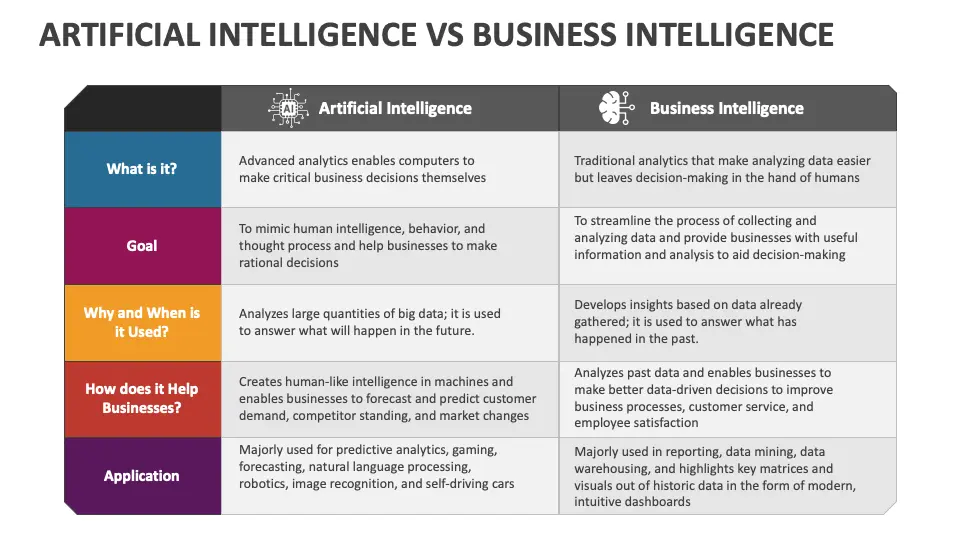
Artificial Intelligence (AI) and Business Intelligence (BI) represent two pillars of modern data-driven decision-making. AI, a subset of computer science, enables machines to perform tasks that typically require human intelligence, such as reasoning, learning, and problem-solving. Business Intelligence, on the other hand, refers to the technologies, applications, and practices used to collect, integrate, analyze, and present business information to support better decision-making.
#Infobox
#Overview
Artificial Intelligence (AI) and Business Intelligence (BI) represent two pillars of modern data-driven decision-making. AI, a subset of computer science, enables machines to perform tasks that typically require human intelligence, such as reasoning, learning, and problem-solving. Business Intelligence, on the other hand, refers to the technologies, applications, and practices used to collect, integrate, analyze, and present business information to support better decision-making.
The relationship between AI and BI is symbiotic. AI enhances BI by introducing predictive capabilities, automating data analysis, and uncovering hidden patterns in large datasets. Conversely, BI provides the structured data and contextual understanding that AI systems need to function effectively. Together, they form a powerful ecosystem that transforms raw data into actionable insights, driving innovation and efficiency across industries.
#Key Differences
- Purpose: AI aims to mimic human intelligence and automate complex tasks, while BI focuses on extracting meaningful information from data to guide business strategies.
- Methodology: AI relies on machine learning, deep learning, and neural networks, whereas BI utilizes data warehousing, ETL (Extract, Transform, Load) processes, and visualization tools.
- Output: AI generates predictions, recommendations, and autonomous decisions, while BI produces reports, dashboards, and performance metrics.
- Human Interaction: AI systems often operate with minimal human intervention, whereas BI requires ongoing human input for interpretation and strategic application.
#History / Background
#Evolution of AI
The concept of AI dates back to the 1950s, when mathematician Alan Turing proposed the idea of machines that could simulate human intelligence. The term "Artificial Intelligence" was coined in 1956 by John McCarthy at the Dartmouth Conference. Early AI research focused on symbolic reasoning and rule-based systems, but progress was limited by computational constraints.
The 1980s and 1990s saw the rise of expert systems and machine learning, which enabled computers to learn from data. The breakthrough came in the 2010s with the advent of deep learning, powered by advances in computing power and big data. Today, AI is integrated into various applications, from virtual assistants to autonomous vehicles, transforming industries such as healthcare, finance, and retail.
#Development of BI
Business Intelligence has its roots in the 1960s and 1970s, when organizations began using mainframe computers to generate reports and analyze financial data. The term "Business Intelligence" was popularized by Howard Dresner in the 1980s, who defined it as "concepts and methods to improve business decision-making by using fact-based support systems."
In the 1990s, BI tools evolved to include data warehousing and online analytical processing (OLAP), enabling businesses to store and analyze large volumes of data. The 2000s saw the rise of self-service BI tools like Tableau and Power BI, which democratized data access and visualization. Today, BI is a cornerstone of enterprise strategy, helping organizations monitor performance, identify trends, and optimize operations.
#How It Works
#AI Methodologies
AI systems operate through a combination of algorithms, data, and computational power. The core methodologies include:
- Machine Learning (ML): Algorithms that learn from data and improve over time without explicit programming. Common techniques include supervised learning (e.g., classification, regression), unsupervised learning (e.g., clustering, association), and reinforcement learning (e.g., decision-making in dynamic environments).
- Deep Learning: A subset of ML that uses neural networks with multiple layers to model complex patterns. Applications include image recognition, natural language processing (NLP), and autonomous systems.
- Natural Language Processing (NLP): Enables machines to understand, interpret, and generate human language. Used in chatbots, sentiment analysis, and language translation.
- Computer Vision: Allows machines to analyze and interpret visual data, such as images and videos. Applications include facial recognition, medical imaging, and autonomous driving.
#BI Processes
Business Intelligence involves a structured process to transform raw data into actionable insights:
- Data Collection: Gathering data from various sources, including databases, spreadsheets, and external APIs.
- Data Integration: Combining data from disparate sources into a unified format using ETL processes.
- Data Storage: Storing integrated data in data warehouses or data lakes for efficient retrieval and analysis.
- Data Analysis: Applying statistical methods, query tools, and ML algorithms to identify trends, patterns, and anomalies.
- Data Visualization: Presenting insights through dashboards, charts, and reports using tools like Tableau, Power BI, or Qlik.
- Decision Support: Using insights to guide strategic decisions, optimize operations, and improve performance.
#Important Facts
- AI Adoption: According to a 2023 report by McKinsey, 50% of companies have adopted AI in at least one business function, with the highest adoption rates in marketing, sales, and supply chain management.
- BI Market Growth: The global BI market is projected to reach $43.03 billion by 2028, growing at a CAGR of 8.7% from 2021 to 2028 (Grand View Research).
- AI vs. BI in Decision-Making: While AI can make autonomous decisions based on real-time data, BI provides the historical context and structured analysis needed to validate those decisions.
- Data Quality: Both AI and BI rely heavily on high-quality data. Poor data quality can lead to inaccurate predictions in AI and misleading insights in BI.
- Ethical Considerations: AI raises concerns about bias, privacy, and accountability, whereas BI focuses on transparency and compliance with data regulations like GDPR.
#Timeline
- Concept conceptualized
Initial research and foundations established for AI And Business Intelligence: Informed Decisions.
- First integration
First successful deployment and testing phase of AI And Business Intelligence: Informed Decisions in the industry.
- Global standards
Global standards are released for unified deployment and validation of AI And Business Intelligence: Informed Decisions.
- Modern scaling
Widespread global adoption and real-time optimization of AI And Business Intelligence: Informed Decisions networks.
#Related Terms
#FAQ
What does AI And Business Intelligence: Informed Decisions cover?
Explores how artificial intelligence shapes business intelligence and informed decisions, covering practical use cases, benefits, limitations, and risks.
Why is AI And Business Intelligence: Informed Decisions important?
It helps readers understand key concepts, compare practical use cases, and evaluate how Business & Marketing decisions affect outcomes, risks, and implementation choices.
What should readers verify before applying this topic?
Readers should compare the benefits, limitations, data requirements, and related themes such as Busines, Intelligence, Informed before using the ideas in real projects.
#References
- AI And Business Intelligence: Informed Decisions terminology and background research
- AI And Business Intelligence: Informed Decisions use cases, implementation examples, and limitations
- Business & Marketing best practices, standards, and risk guidance
- Busines case studies, benchmarks, and current industry analysis



Comments
No comments yet. Start the discussion with a useful note.