

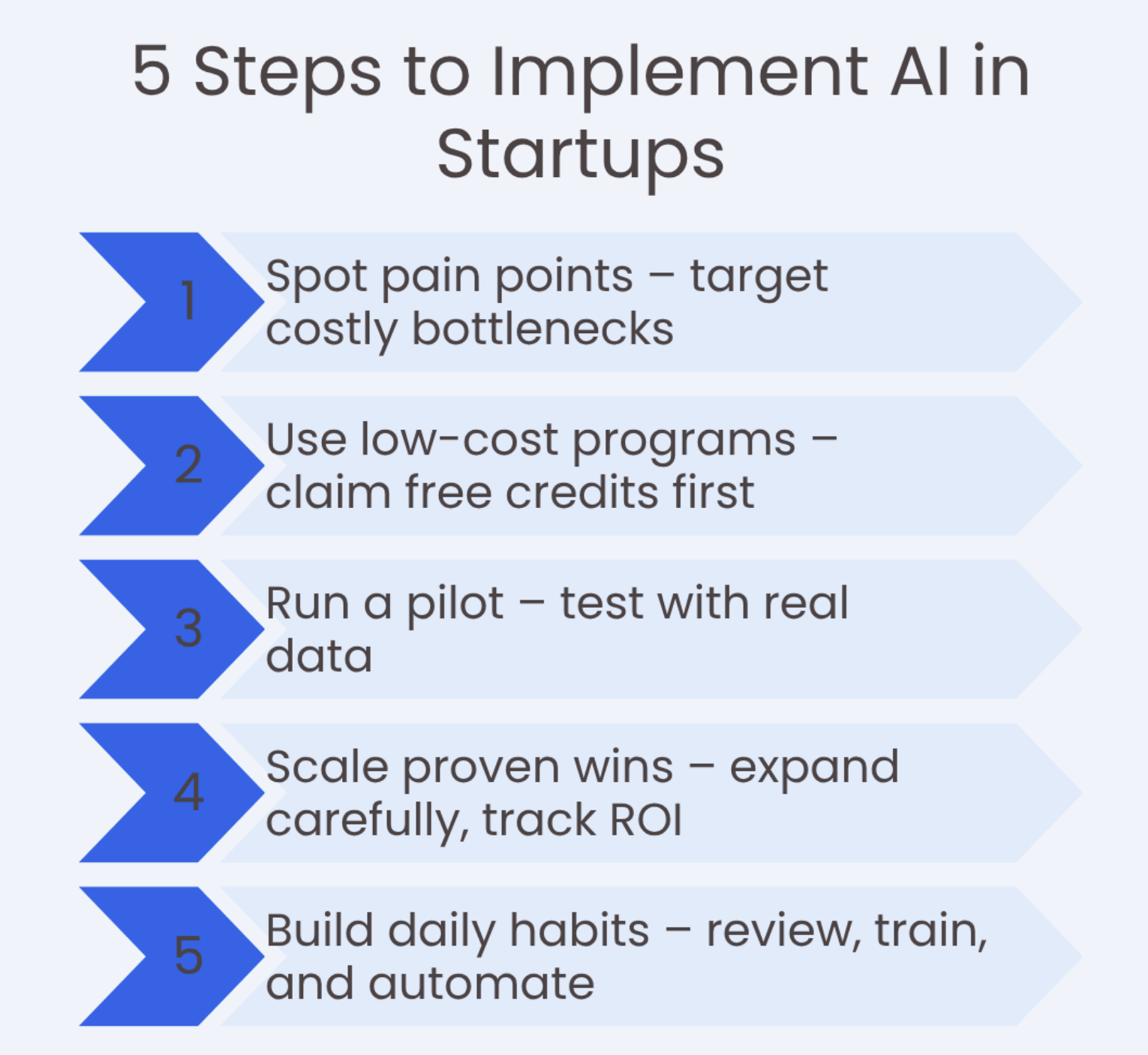
#Short Answer
Shows how AI can support startups through how to get started, including tools, examples, benefits, and responsible-use tips.
#Infobox
AI for startups: Strategies, tools, and best practices to leverage artificial intelligence for competitive advantage and scalable growth.
AI for Startups Focus Artificial Intelligence, Machine Learning, Business Strategy Applications Customer support, marketing automation, product development, data analysis Key Technologies Natural Language Processing (NLP), Computer Vision, Predictive Analytics, Generative AI Benefits Cost reduction, scalability, competitive differentiation, improved decision-making Challenges High initial costs, data privacy, talent acquisition, integration complexity First Introduced Early 2010s (widespread adoption in 2016–2020)
#Overview
Artificial Intelligence (AI) for startups refers to the strategic integration of AI technologies into business operations to enhance efficiency, drive innovation, and create competitive advantages. Startups across industries—from fintech and healthcare to e-commerce and SaaS—are increasingly adopting AI to automate repetitive tasks, analyze large datasets, and deliver personalized customer experiences. Unlike traditional businesses, startups often possess agility and a willingness to experiment, making them ideal candidates for AI-driven transformation.
AI enables startups to operate at scale with minimal overhead, optimize resource allocation, and uncover insights from customer behavior and market trends. By leveraging machine learning models, natural language processing, and computer vision, startups can build intelligent systems that improve over time without proportional increases in human labor. This democratization of advanced technology levels the playing field, allowing smaller companies to compete with industry giants.
#History / Background
The concept of AI in business gained traction in the late 20th century, but practical applications for startups began to emerge in the early 2010s. The proliferation of cloud computing, open-source AI frameworks (such as TensorFlow and PyTorch), and accessible APIs (like those from Google Cloud AI and AWS) lowered the barriers to entry. The breakthrough of deep learning in 2012, demonstrated by AlexNet’s performance in image recognition, accelerated interest in AI across sectors.
By 2016, AI adoption among startups became more mainstream, driven by the rise of chatbots, recommendation engines, and predictive analytics tools. The launch of generative AI models like GPT-3 in 2020 further revolutionized how startups approach content creation, customer interaction, and product development. Today, AI is no longer a luxury but a necessity for startups seeking rapid growth and sustainability in competitive markets.
#How It Works
AI for startups operates through a combination of data collection, model training, and real-time application. The process typically begins with gathering structured and unstructured data from sources such as customer interactions, sales records, social media, and IoT devices. This data is cleaned, normalized, and labeled to prepare it for machine learning models.
Startups then select appropriate AI models based on their use case. For example:
- Natural Language Processing (NLP): Used for chatbots, sentiment analysis, and content generation.
- Computer Vision: Applied in image recognition for product tagging, quality control, or facial authentication.
- Predictive Analytics: Helps forecast demand, churn risk, or sales trends using historical data.
- Generative AI: Enables automated content creation, code generation, or personalized marketing copy.
Once deployed, AI systems continuously learn from new data through feedback loops, improving accuracy and relevance over time. Cloud-based AI platforms (e.g., Google Vertex AI, Microsoft Azure AI) allow startups to scale their AI initiatives without investing in on-premise infrastructure.
#Important Facts
- AI adoption can reduce operational costs by up to 30% for startups by automating routine tasks.
- Startups using AI in customer service report a 40% improvement in response times and customer satisfaction.
- Over 60% of early-stage startups integrate AI tools within their first two years of operation.
- The global AI startup ecosystem is valued at over $200 billion as of 2024, with annual growth exceeding 25%.
- Data privacy regulations (e.g., GDPR, CCPA) require startups to implement AI systems with built-in compliance features.
- AI-powered personalization can increase conversion rates by up to 20% in e-commerce startups.
- Startups leveraging AI for product development reduce time-to-market by an average of 4 months.
#Timeline
Year Milestone 2012 AlexNet wins ImageNet competition, sparking interest in deep learning. 2014 Microsoft introduces Cortana, demonstrating AI in consumer products. 2016 Chatbots gain popularity; startups begin adopting AI for customer support. 2018 GDPR enforcement begins, influencing AI data handling practices. 2020 GPT-3 released, enabling startups to automate content creation and coding. 2022 Stable Diffusion and DALL-E 2 popularize AI-generated imagery for startups. 2023 AI startups raise over $50 billion in venture capital globally. 2024 EU AI Act introduces regulatory framework for AI systems, including startups.
#Related Terms
#FAQ
What does AI For Startups: How To Get Started cover?
Shows how AI can support startups through how to get started, including tools, examples, benefits, and responsible-use tips.
Why is AI For Startups: How To Get Started important?
It helps readers understand key concepts, compare practical use cases, and evaluate how Business & Marketing decisions affect outcomes, risks, and implementation choices.
What should readers verify before applying this topic?
Readers should compare the benefits, limitations, data requirements, and related themes such as Tutorial, Startup, Get before using the ideas in real projects.
#References
- AI For Startups: How To Get Started terminology and background research
- AI For Startups: How To Get Started use cases, implementation examples, and limitations
- Business & Marketing best practices, standards, and risk guidance
- Tutorial case studies, benchmarks, and current industry analysis
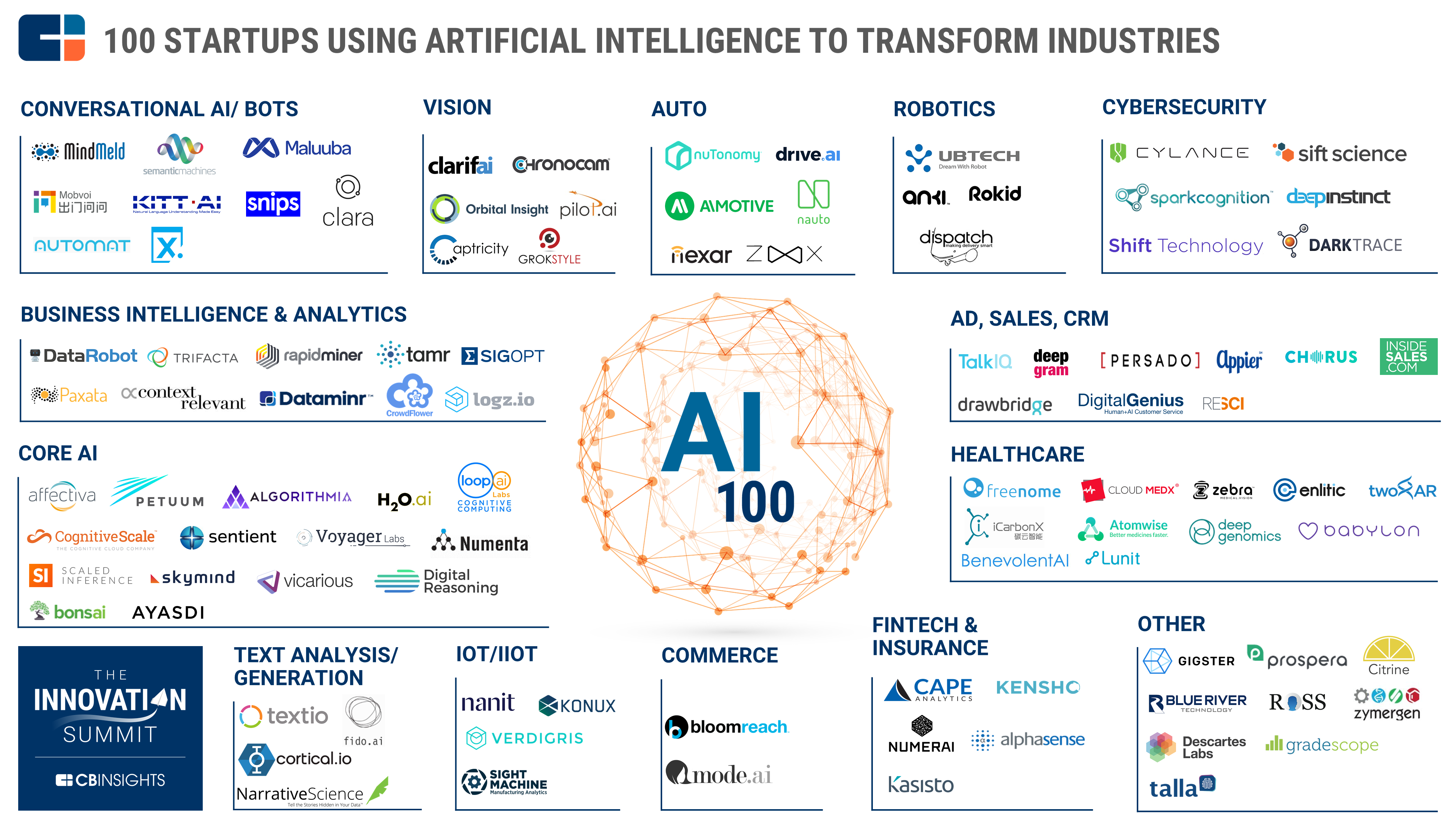
.jpg)

Comments
No comments yet. Start the discussion with a useful note.