

#Short Answer
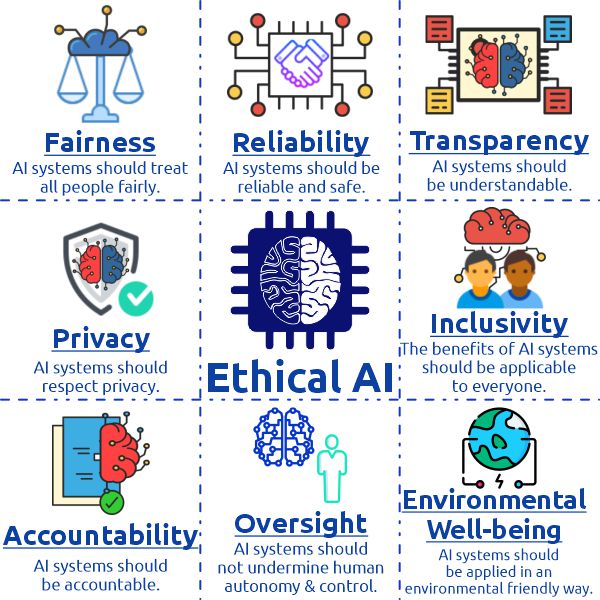
AI Ethics explores the moral principles guiding the development and deployment of artificial intelligence systems to ensure fairness, transparency, and accountability.
#Infobox
#Overview
AI Ethics refers to the moral principles and guidelines that govern the responsible development, deployment, and use of artificial intelligence technologies. As AI systems become increasingly integrated into daily life—from healthcare diagnostics to autonomous vehicles—the need for ethical frameworks has grown significantly. These principles aim to address concerns such as algorithmic bias, privacy infringement, and the potential for AI to exacerbate social inequalities. Key ethical considerations include transparency in decision-making, accountability for AI-driven outcomes, and ensuring that AI systems do not perpetuate discrimination. Organizations and governments worldwide are developing policies and guidelines to standardize ethical AI practices, emphasizing the importance of human oversight and alignment with societal values.
#History / Background
The concept of AI Ethics emerged alongside the advancements in artificial intelligence during the mid-20th century. Early discussions on the ethical implications of AI can be traced back to the 1950s and 1960s, when pioneers like Alan Turing and Joseph Weizenbaum began exploring the philosophical and practical challenges posed by intelligent machines. Turing's seminal work on machine intelligence raised questions about the potential for AI to surpass human cognitive abilities, while Weizenbaum's critique of AI in his 1976 book Computer Power and Human Reason highlighted the risks of over-reliance on automated systems.
In the 1980s and 1990s, the field gained traction as AI applications expanded into critical domains such as finance, healthcare, and law enforcement. Scholars like Joseph Raz and Ronald Dworkin contributed to the discourse by examining the legal and moral frameworks necessary to regulate AI. The turn of the 21st century saw a surge in public and academic interest, driven by high-profile cases of algorithmic bias, such as biased hiring algorithms and discriminatory facial recognition systems. This period also witnessed the establishment of organizations dedicated to AI ethics, including the Partnership on AI and the AI Now Institute.
#How It Works
AI Ethics operates through a combination of theoretical frameworks, practical guidelines, and regulatory mechanisms designed to ensure that AI systems are developed and used responsibly. One of the foundational approaches is the establishment of ethical principles, such as those outlined in the Ethical Guidelines for Trustworthy AI by the European Commission. These guidelines emphasize four key requirements: transparency, accountability, human oversight, and technical robustness.
Transparency involves making AI systems' decision-making processes understandable to users and stakeholders. This can be achieved through techniques like explainable AI (XAI), which provides insights into how algorithms arrive at specific conclusions. Accountability ensures that developers and organizations are held responsible for the outcomes of AI systems, including unintended consequences. Human oversight involves maintaining human control over AI systems, particularly in high-stakes scenarios such as medical diagnoses or judicial decisions. Technical robustness refers to the reliability and safety of AI systems, ensuring they perform as intended without causing harm.
Another critical aspect of AI Ethics is the mitigation of bias in AI systems. Bias can arise from flawed training data, algorithmic design, or the historical prejudices embedded in societal structures. To address this, ethical AI frameworks advocate for diverse and representative datasets, regular audits of AI systems, and the inclusion of multidisciplinary teams in the development process. Additionally, privacy concerns are addressed through data protection measures, such as anonymization and encryption, to safeguard individuals' personal information.
#Important Facts
- Algorithmic Bias: AI systems can inadvertently perpetuate or amplify biases present in their training data, leading to discriminatory outcomes in areas such as hiring, lending, and law enforcement.
- Explainable AI (XAI): Techniques like LIME (Local Interpretable Model-agnostic Explanations) and SHAP (SHapley Additive exPlanations) are used to make AI decisions more interpretable.
- Regulatory Frameworks: The European Union's General Data Protection Regulation (GDPR) includes provisions for automated decision-making, requiring transparency and user consent.
- Ethical AI Certifications: Organizations such as the IEEE Standards Association have developed ethical AI certification programs to standardize best practices.
- AI in Healthcare: Ethical considerations in healthcare AI include ensuring patient privacy, obtaining informed consent, and preventing the misuse of sensitive medical data.
- Autonomous Weapons: The development of lethal autonomous weapons systems (LAWS) has sparked global debates about the ethical implications of delegating life-and-death decisions to machines.
- AI and Employment: The automation of jobs raises ethical questions about economic inequality, the need for reskilling programs, and the role of governments in supporting displaced workers.
#Timeline
- Alan Turing publishes *Computi
Alan Turing publishes *Computing Machinery and Intelligence*, introducing the Turing Test and raising early questions about AI's ethical implications.
- Joseph Weizenbaum develops ELI
Joseph Weizenbaum develops ELIZA, an early natural language processing program, and later critiques AI in *Computer Power and Human Reason* (1976).
- Increased use of AI
Increased use of AI in finance and law enforcement sparks debates about bias and privacy; scholars like Ronald Dworkin begin exploring legal frameworks for AI.
- The 9/11 attacks lead
The [9/11 attacks](# '9/11 attacks') lead to the expansion of surveillance AI, raising concerns about privacy and civil liberties.
- ProPublica's investigation rev
ProPublica's investigation reveals racial bias in COMPAS, a software used to predict recidivism, highlighting the dangers of algorithmic bias.
- The European Commission releas
The European Commission releases its [Ethical Guidelines for Trustworthy AI](# 'Ethical Guidelines for Trustworthy AI'), outlining seven key requirements for ethical AI.
- The Partnership on AI
The [Partnership on AI](# 'Partnership on AI') publishes guidelines for responsible AI development, emphasizing fairness, transparency, and accountability.
- Global initiatives, such as
Global initiatives, such as the [UNESCO Recommendation on the Ethics of AI](# 'UNESCO Recommendation on the Ethics of AI'), are adopted to promote ethical AI practices worldwide.
#Related Terms
#FAQ
What does AI Ethics: Expert Insights cover?
AI ethics: expert insights covers practical examples, benefits, limitations, and important considerations for readers.
Why is AI Ethics: Expert Insights important?
It helps readers understand key concepts, compare practical use cases, and evaluate how AI Ethics decisions affect outcomes, risks, and implementation choices.
What should readers verify before applying this topic?
Readers should compare the benefits, limitations, data requirements, and related themes such as Ethics, Insight, Responsible AI before using the ideas in real projects.
#References
- AI Ethics: Expert Insights terminology and background research
- AI Ethics: Expert Insights use cases, implementation examples, and limitations
- AI Ethics best practices, standards, and risk guidance
- Ethics case studies, benchmarks, and current industry analysis


Comments
No comments yet. Start the discussion with a useful note.