

#Short Answer
Explores how artificial intelligence shapes retail and inventory management, covering practical use cases, benefits, limitations, and risks.
#Infobox
AI in Retail Inventory Management Field Details Primary Use Demand forecasting, stock optimization Key Technologies Machine learning, computer vision, NLP Benefits Reduced stockouts, lower holding costs Challenges Data quality, integration complexity Adoption Rate ~35% of retailers (2024)
#Overview
AI-driven inventory management represents a transformative shift in retail operations, moving away from traditional static stock control methods toward dynamic, predictive systems. These systems leverage advanced algorithms to process vast datasets in real time, enabling retailers to respond swiftly to changing consumer behavior, supply chain disruptions, and market fluctuations. The integration of AI into inventory management supports just-in-time (JIT) inventory models, reduces carrying costs, and enhances customer satisfaction by ensuring product availability.
Modern AI inventory systems often incorporate multiple technologies, including machine learning for demand forecasting, computer vision for shelf monitoring, and natural language processing (NLP) for analyzing customer reviews and social media trends. Cloud-based platforms and Internet of Things (IoT) sensors further enhance data collection and processing capabilities, enabling end-to-end visibility across the supply chain.
#History / Background
#Early Developments
The concept of automated inventory management began in the mid-20th century with the introduction of barcode scanning and electronic data interchange (EDI) systems in the 1970s and 1980s. These technologies allowed retailers to track stock levels more accurately and reduce manual counting errors. However, the systems were largely rule-based and lacked predictive capabilities.
In the 1990s, enterprise resource planning (ERP) systems emerged, integrating inventory data with financial and operational systems. While these systems improved data centralization, they still relied on static forecasting models and required significant human input for adjustments.
#Rise of AI and Data Science
The 2000s saw the rise of data science and the availability of large-scale datasets, enabling the development of more sophisticated forecasting models. Retailers began experimenting with statistical methods like ARIMA (AutoRegressive Integrated Moving Average) and exponential smoothing to predict demand. However, these models struggled with nonlinear patterns and external variables.
The breakthrough came with the proliferation of big data technologies and the advancement of machine learning algorithms in the 2010s. The rise of cloud computing and open-source frameworks like TensorFlow and PyTorch democratized access to AI tools, allowing even small retailers to implement predictive inventory systems. Major retailers such as Amazon, Walmart, and Target pioneered AI-driven inventory solutions, setting new standards for efficiency and responsiveness.
#Modern Era
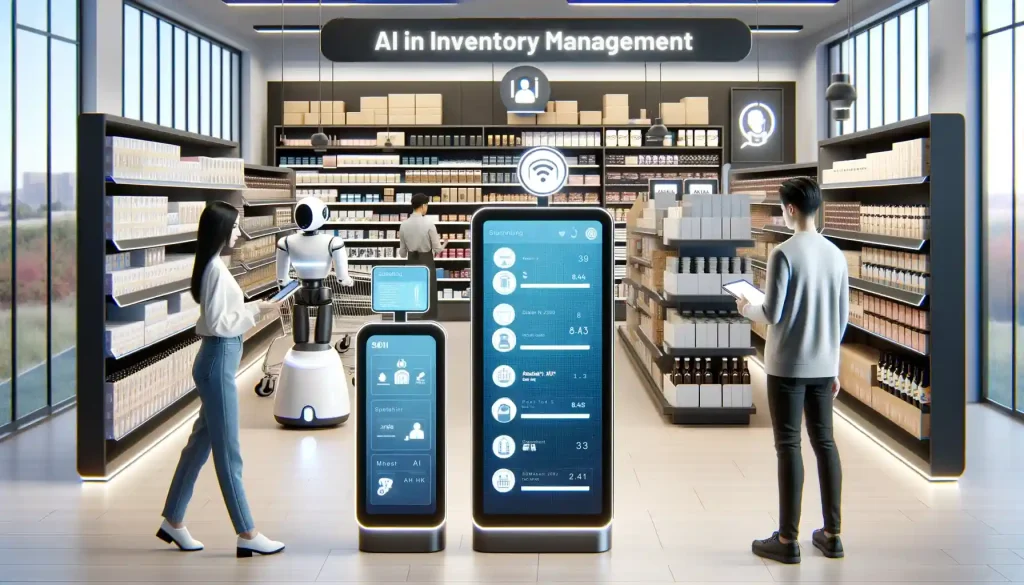
Today, AI inventory management is a cornerstone of digital transformation in retail. The integration of AI with IoT devices, such as smart shelves and RFID tags, enables real-time tracking and automated reordering. Retailers are increasingly adopting computer vision systems to monitor shelf stock levels and detect misplaced items, while NLP is used to analyze customer sentiment from reviews and social media to adjust inventory forecasts dynamically.
As of 2024, over a third of global retailers have implemented some form of AI-based inventory management, with adoption expected to grow as technology becomes more accessible and cost-effective.
#How It Works
#Data Collection
AI inventory systems rely on diverse data sources to build accurate models. These include:
- Historical Sales Data: Past sales trends, seasonality, and promotional impacts.
- External Factors: Weather patterns, economic indicators, local events, and competitor pricing.
- Supply Chain Data: Lead times, supplier reliability, transportation delays, and customs data.
- Customer Behavior: Online browsing patterns, cart abandonment rates, and purchase frequency.
- IoT and Sensor Data: Real-time stock levels from RFID tags, smart shelves, and warehouse sensors.
#Demand Forecasting
Using machine learning models—such as random forests, gradient boosting, or neural networks—AI systems analyze historical and real-time data to predict future demand. Advanced models can incorporate time series forecasting techniques and handle complex interactions between variables, such as how a heatwave might increase demand for cold beverages.
Some systems use ensemble methods, combining multiple models to improve accuracy and reduce overfitting.
#Stock Optimization
Once demand is predicted, AI systems determine optimal stock levels using optimization algorithms. These include:
- Economic Order Quantity (EOQ): Balances ordering and holding costs to minimize total inventory expenses.
- Safety Stock Calculation: Adds buffer stock to account for demand variability and supply chain uncertainty.
- Multi-Echelon Inventory Models: Optimizes stock across multiple warehouses and retail locations to reduce overall costs.
AI systems continuously adjust these parameters based on new data, ensuring responsiveness to market changes.
#Automation and Integration
AI inventory systems integrate with ERP, warehouse management systems (WMS), and point-of-sale (POS) systems to automate replenishment. When stock levels fall below a threshold, the system generates purchase orders or triggers internal transfers. Some platforms use robotic process automation (RPA) to handle supplier communications and confirmations.
Integration with CRM systems allows personalized inventory recommendations based on customer profiles and purchasing history.
#Monitoring and Alerts
AI systems provide real-time dashboards and alerts for anomalies such as sudden demand spikes, supply delays, or discrepancies between recorded and actual stock. Computer vision can detect empty shelves or misplaced items, triggering restocking actions. Alerts can be sent via email, SMS, or integrated into mobile apps for warehouse staff.
#Important Facts
- Accuracy Improvement: AI-based demand forecasting can improve accuracy by up to 50% compared to traditional methods.
- Cost Reduction: Retailers using AI inventory systems report average inventory cost reductions of 10–20%.
- Stockout Reduction: AI-driven replenishment reduces stockouts by 30–50% in many retail environments.
- Shrinkage Prevention: Computer vision and RFID systems reduce theft and misplacement by up to 40%.
- Sustainability Impact: Optimized inventory reduces overproduction and waste, contributing to lower carbon footprints.
- Scalability: Cloud-based AI systems can scale across thousands of SKUs and multiple locations without significant infrastructure investment.
#Timeline
Year Event 1970s Introduction of barcode scanning and EDI systems in retail. 1980s ERP systems begin integrating inventory with financial data. 1990s Widespread adoption of ERP and warehouse management systems. 2000s Data science and statistical forecasting gain traction in retail. 2010 Amazon patents anticipatory shipping, using AI to predict orders before they are placed. 2015 Walmart deploys AI-driven inventory management across thousands of stores. 2018 Google Cloud launches AI-powered inventory optimization tools for retailers. 2020 COVID-19 pandemic accelerates adoption of AI inventory systems due to supply chain disruptions. 2022 Computer vision-based shelf monitoring becomes mainstream in grocery retail. 2024 Over 35% of global retailers use AI for inventory management; adoption expected to reach 60% by 2027.
#Related Terms
#FAQ
What does AI And Retail: Inventory Management cover?
Explores how artificial intelligence shapes retail and inventory management, covering practical use cases, benefits, limitations, and risks.
Why is AI And Retail: Inventory Management important?
It helps readers understand key concepts, compare practical use cases, and evaluate how Business & Finance decisions affect outcomes, risks, and implementation choices.
What should readers verify before applying this topic?
Readers should compare the benefits, limitations, data requirements, and related themes such as Retail, Inventory, Management before using the ideas in real projects.
#References
- AI And Retail: Inventory Management terminology and background research
- AI And Retail: Inventory Management use cases, implementation examples, and limitations
- Business & Finance best practices, standards, and risk guidance
- Retail case studies, benchmarks, and current industry analysis



Comments
No comments yet. Start the discussion with a useful note.