

#Short Answer
Artificial Intelligence (AI) and Blockchain represent two of the most disruptive technologies of the 21st century. AI focuses on creating systems capable of performing tasks that typically require human intelligence, such as learning, reasoning, and problem-solving. Blockchain, on the other hand, is a decentralized digital ledger technology that records transactions across multiple computers in a way that ensures security, transparency, and immutability.
#Infobox
#Overview
Artificial Intelligence (AI) and Blockchain represent two of the most disruptive technologies of the 21st century. AI focuses on creating systems capable of performing tasks that typically require human intelligence, such as learning, reasoning, and problem-solving. Blockchain, on the other hand, is a decentralized digital ledger technology that records transactions across multiple computers in a way that ensures security, transparency, and immutability.
The convergence of AI and Blockchain is unlocking new possibilities across industries, including finance, healthcare, supply chain management, and cybersecurity. By leveraging AI’s ability to analyze vast datasets and Blockchain’s secure, tamper-proof infrastructure, organizations can achieve unprecedented levels of efficiency, trust, and innovation.
#Key Characteristics
- Decentralization: Blockchain operates without a central authority, reducing single points of failure and increasing resilience.
- Immutability: Once data is recorded on a Blockchain, it cannot be altered, ensuring data integrity.
- Transparency: All participants in a Blockchain network can view transactions, fostering trust.
- Autonomy: AI systems can operate independently, making decisions based on predefined algorithms and learned patterns.
- Adaptability: AI models improve over time through machine learning, enhancing their predictive and analytical capabilities.
#History / Background
#Origins of Blockchain
Blockchain technology was first conceptualized in 1991 by Stuart Haber and W. Scott Stornetta, who proposed a cryptographically secured chain of blocks to timestamp digital documents. However, it was not until 2008 that Blockchain gained widespread attention with the publication of the Bitcoin whitepaper by an anonymous entity known as Satoshi Nakamoto. Bitcoin introduced the first decentralized cryptocurrency, leveraging Blockchain to ensure secure and transparent transactions.
The Ethereum blockchain, launched in 2015 by Vitalik Buterin, expanded Blockchain’s capabilities by introducing smart contracts—self-executing contracts with the terms directly written into code. This innovation paved the way for decentralized applications (DApps) and decentralized finance (DeFi).
#Origins of AI
Artificial Intelligence has its roots in the mid-20th century, with early contributions from pioneers like Alan Turing, who proposed the concept of a "universal machine" capable of performing any computation. The term "Artificial Intelligence" was coined in 1956 at the Dartmouth Conference, where researchers explored the potential of machines to simulate human intelligence.
Over the decades, AI evolved through various phases, including symbolic AI in the 1960s, expert systems in the 1980s, and the resurgence of machine learning and deep learning in the 21st century. The development of neural networks and big data analytics has significantly advanced AI’s capabilities, enabling applications in natural language processing, computer vision, and autonomous systems.
#Convergence of AI and Blockchain
The integration of AI and Blockchain began gaining traction around 2016, as researchers and industry leaders recognized the potential synergies between the two technologies. Early discussions focused on how AI could enhance Blockchain’s scalability, security, and efficiency, while Blockchain could provide a secure and transparent framework for AI data and algorithms.
Today, the convergence is driving innovations such as decentralized AI marketplaces, AI-powered smart contracts, and secure data-sharing platforms. Projects like SingularityNET, Fetch.ai, and Ocean Protocol exemplify this fusion, enabling decentralized AI services and data monetization.
#How It Works
#Blockchain Technology
A Blockchain is a distributed ledger that records transactions across a network of computers. Each transaction is grouped into a "block," which is cryptographically linked to the previous block, forming a chain. This structure ensures that once data is recorded, it cannot be altered without consensus from the network participants.
Key components of Blockchain include:
- Nodes: Computers that participate in the Blockchain network, validating and relaying transactions.
- Consensus Mechanisms: Protocols like Proof of Work (PoW) and Proof of Stake (PoS) that ensure agreement on the state of the Blockchain.
- Smart Contracts: Self-executing contracts with terms written in code, automatically enforcing agreements when predefined conditions are met.
- Cryptographic Hashing: A process that converts data into a fixed-size string of characters, ensuring data integrity and security.
#Artificial Intelligence
Artificial Intelligence encompasses a range of technologies that enable machines to perform tasks requiring human-like intelligence. These tasks include:
- Machine Learning: Algorithms that learn from data and improve their performance over time without explicit programming.
- Deep Learning: A subset of machine learning that uses neural networks with multiple layers to model complex patterns in data.
- Natural Language Processing (NLP): Techniques that enable machines to understand, interpret, and generate human language.
- Computer Vision: Systems that analyze and interpret visual information from the world, such as images and videos.
AI systems rely on large datasets for training and continuous feedback loops to refine their models. The integration of AI with Blockchain involves using Blockchain’s secure and transparent infrastructure to store, share, and monetize AI data and algorithms.
#Integration of AI and Blockchain
The fusion of AI and Blockchain occurs through several mechanisms:
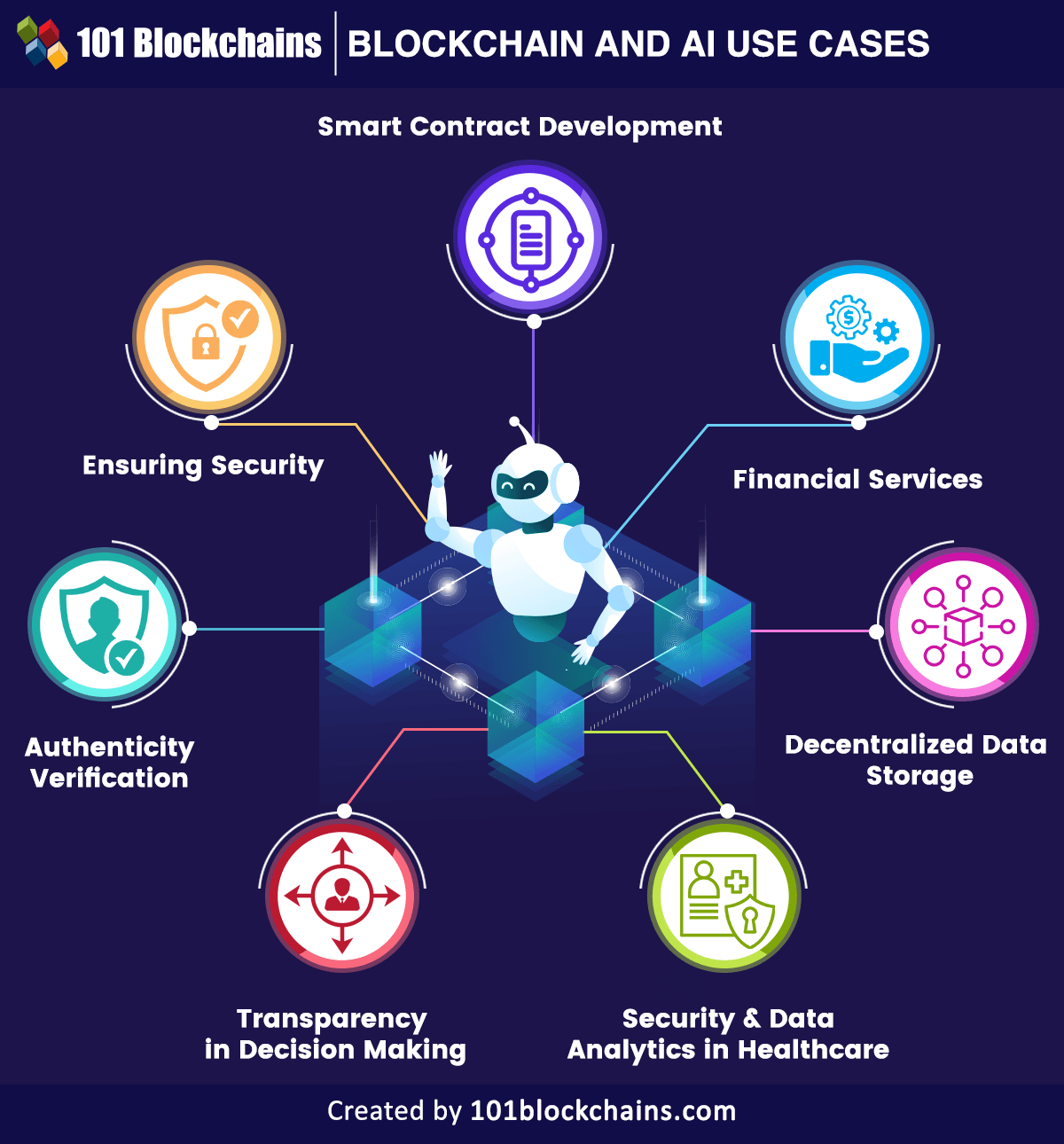
- Decentralized AI Marketplaces: Platforms where AI models and datasets are shared, traded, and monetized in a secure and transparent manner. Blockchain ensures that contributors are fairly compensated, and AI models are not tampered with.
- AI-Powered Smart Contracts: Smart contracts enhanced with AI capabilities can make autonomous decisions based on real-time data, such as adjusting insurance premiums or executing trades in decentralized finance (DeFi).
- Secure Data Sharing: Blockchain provides a tamper-proof ledger for storing AI training data, ensuring data integrity and provenance. This is particularly valuable in industries like healthcare, where patient data must be securely shared and analyzed.
- Fraud Detection and Prevention: AI algorithms can analyze Blockchain transactions to detect anomalies and potential fraud, while Blockchain’s immutable ledger ensures that fraudulent activities are recorded and cannot be altered.
- Autonomous Organizations: Decentralized Autonomous Organizations (DAOs) leverage AI to automate governance, decision-making, and resource allocation, operating without centralized control.
#Important Facts
- Security: Blockchain’s cryptographic security and AI’s anomaly detection create a robust defense against cyber threats.
- Transparency: All transactions on a Blockchain are publicly verifiable, while AI models can be audited for fairness and bias.
- Efficiency: AI automates complex processes, reducing the need for manual intervention, while Blockchain streamlines record-keeping and verification.
- Decentralization: Blockchain eliminates the need for intermediaries, while AI enables distributed decision-making.
- Data Monetization: Blockchain allows individuals and organizations to monetize their data, while AI enhances the value of that data through advanced analytics.
- Regulatory Compliance: Blockchain’s immutable records simplify audit trails, while AI can automate compliance checks and reporting.
#Timeline
- Stuart Haber and W
Stuart Haber and W. Scott Stornetta propose the concept of a cryptographically secured chain of blocks.
- Satoshi Nakamoto publishes the
Satoshi Nakamoto publishes the Bitcoin whitepaper, introducing Blockchain technology.
- Ethereum launches, introducing
Ethereum launches, introducing smart contracts and decentralized applications (DApps).
- Early discussions on the
Early discussions on the convergence of AI and Blockchain begin.
- SingularityNET, a decentralize
SingularityNET, a decentralized AI marketplace, is founded.
- Fetch.ai launches, focusing on
Fetch.ai launches, focusing on autonomous economic agents powered by AI and Blockchain.
- Ocean Protocol, a decentralize
Ocean Protocol, a decentralized data exchange, is introduced.
- DeFi (Decentralized Finance) g
DeFi (Decentralized Finance) gains prominence, leveraging AI and Blockchain for automated financial services.
- Numerai, a hedge fund
Numerai, a hedge fund using AI and Blockchain for predictive modeling, gains attention.
- AI-powered NFTs and generative
AI-powered NFTs and generative art platforms emerge, combining AI creativity with Blockchain’s provenance.
- Regulatory frameworks for AI
Regulatory frameworks for AI and Blockchain integration begin to take shape globally.
#Related Terms
#FAQ
What does AI And Blockchain: Secure Transactions cover?
Explores how artificial intelligence shapes blockchain and secure transactions, covering practical use cases, benefits, limitations, and risks.
Why is AI And Blockchain: Secure Transactions important?
It helps readers understand key concepts, compare practical use cases, and evaluate how Business & Finance decisions affect outcomes, risks, and implementation choices.
What should readers verify before applying this topic?
Readers should compare the benefits, limitations, data requirements, and related themes such as Blockchain, Secure, Transaction before using the ideas in real projects.
#References
- AI And Blockchain: Secure Transactions terminology and background research
- AI And Blockchain: Secure Transactions use cases, implementation examples, and limitations
- Business & Finance best practices, standards, and risk guidance
- Blockchain case studies, benchmarks, and current industry analysis

.png)
Comments
No comments yet. Start the discussion with a useful note.