


#Short Answer
Artificial intelligence and blockchain represent two of the most transformative technologies of the 21st century. While AI focuses on creating systems capable of performing tasks that typically require human intelligence, blockchain provides a decentralized, immutable ledger for recording transactions and data. When combined, these technologies address critical challenges in AI development, such as data privacy, security, and trustworthiness, while blockchain benefits from AI’s ability to process and analyze vast datasets efficiently.
#Infobox
#Overview
Artificial intelligence and blockchain represent two of the most transformative technologies of the 21st century. While AI focuses on creating systems capable of performing tasks that typically require human intelligence, blockchain provides a decentralized, immutable ledger for recording transactions and data. When combined, these technologies address critical challenges in AI development, such as data privacy, security, and trustworthiness, while blockchain benefits from AI’s ability to process and analyze vast datasets efficiently.
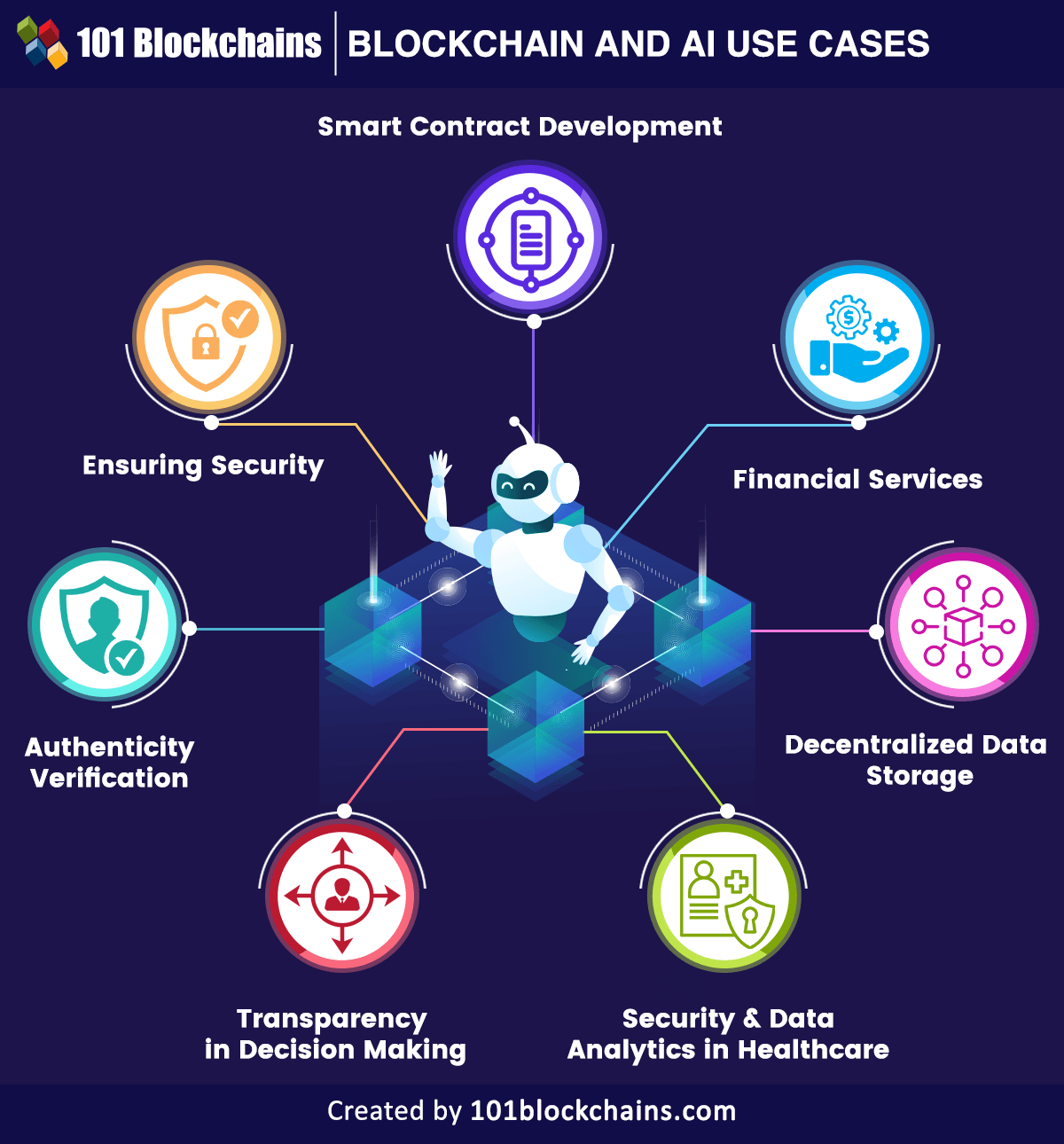
The synergy between AI and blockchain is particularly evident in areas such as smart contracts, where AI can optimize contract execution and decision-making, and in decentralized finance (DeFi), where AI-driven analytics enhance risk assessment and fraud detection. Additionally, blockchain’s immutable nature ensures that AI models trained on decentralized data remain transparent and auditable, reducing biases and improving accountability.
#History / Background
The concept of integrating AI with blockchain emerged in the late 2010s as both technologies matured. The foundational work in AI dates back to the 1950s with early developments in machine learning and neural networks, while blockchain was introduced in 2008 by Satoshi Nakamoto through the whitepaper for Bitcoin. The first notable discussions on their convergence appeared around 2017–2018, coinciding with the rise of Ethereum and other programmable blockchain platforms.
Early projects focused on using blockchain to secure AI data and models, such as storing training datasets on decentralized networks to prevent tampering. Conversely, AI was employed to enhance blockchain scalability and efficiency, for example, by optimizing consensus mechanisms like Proof of Stake (PoS) through machine learning algorithms. The term "Decentralized AI" gained traction as researchers explored ways to distribute AI computations across blockchain networks, reducing reliance on centralized cloud services.
#How It Works
#AI for Blockchain
- Optimization of Consensus Mechanisms: AI algorithms can analyze network conditions and adjust consensus parameters (e.g., block size, transaction fees) in real-time to improve blockchain performance and reduce energy consumption.
- Fraud Detection: Machine learning models trained on historical transaction data can identify anomalous patterns indicative of fraud, money laundering, or cyberattacks, enhancing security in decentralized networks.
- Smart Contract Automation: AI can interpret and execute smart contracts more intelligently by predicting outcomes, resolving ambiguities, and adapting to changing conditions without human intervention.
#Blockchain for AI
- Data Integrity and Provenance: Blockchain ensures that AI training datasets are authentic and unaltered by recording their origin, version history, and access logs on an immutable ledger.
- Decentralized AI Marketplaces: Blockchain enables peer-to-peer marketplaces where AI models and datasets can be traded without intermediaries, ensuring fair compensation for data contributors and model developers.
- Federated Learning: In federated learning, AI models are trained across multiple devices without centralizing data. Blockchain can manage model updates, reward contributions, and verify the integrity of shared learning parameters.
- Explainable AI (XAI): Blockchain can store explanations for AI decisions, making black-box models more transparent and auditable, which is critical for regulatory compliance in sectors like healthcare and finance.
#Important Facts
- Enhanced Security: Blockchain’s cryptographic hashing and decentralization reduce the risk of data breaches and model poisoning in AI systems.
- Reduced Bias: By aggregating diverse datasets from multiple sources (via blockchain), AI models can achieve greater fairness and reduce biases inherent in single-source training data.
- Energy Efficiency: AI-driven optimization of blockchain networks (e.g., dynamic sharding or adaptive PoS) can significantly lower energy consumption compared to traditional proof-of-work systems.
- Regulatory Compliance: Blockchain’s audit trail ensures that AI systems adhere to data protection laws (e.g., GDPR) by providing immutable records of data usage and model decisions.
- Interoperability: Projects like Polkadot and Cosmos enable cross-chain AI applications, allowing models to operate across multiple blockchain networks seamlessly.
#Timeline
- Satoshi Nakamoto publishes the
Satoshi Nakamoto publishes the Bitcoin whitepaper, introducing blockchain technology.
- Google’s Google Brain project
Google’s [Google Brain](# 'Google Brain') project demonstrates the scalability of deep learning, paving the way for advanced AI applications.
- Ethereum launches, enabling pr
Ethereum launches, enabling programmable smart contracts and decentralized applications (dApps).
- Researchers propose using bloc
Researchers propose using blockchain to secure AI models and datasets, addressing data integrity concerns.
- The term 'Decentralized AI'
The term 'Decentralized AI' gains prominence as projects like [SingularityNET](# 'SingularityNET') aim to create open marketplaces for AI services on blockchain.
- AI-driven blockchain optimizat
AI-driven blockchain optimization tools emerge, such as machine learning-based fraud detection in DeFi platforms.
- Federated learning combined wi
Federated learning combined with blockchain is tested in healthcare for collaborative AI model training without sharing sensitive patient data.
- Regulatory frameworks for AI-B
Regulatory frameworks for AI-Blockchain integration begin to take shape, with governments exploring standards for transparency and accountability.
#Related Terms
#FAQ
What does AI And Blockchain: A Powerful Combination cover?
Explores how artificial intelligence shapes blockchain and a powerful combination, covering practical use cases, benefits, limitations, and risks.
Why is AI And Blockchain: A Powerful Combination important?
It helps readers understand key concepts, compare practical use cases, and evaluate how Business & Finance decisions affect outcomes, risks, and implementation choices.
What should readers verify before applying this topic?
Readers should compare the benefits, limitations, data requirements, and related themes such as Blockchain, Powerful, Combination before using the ideas in real projects.
#References
- AI And Blockchain: A Powerful Combination terminology and background research
- AI And Blockchain: A Powerful Combination use cases, implementation examples, and limitations
- Business & Finance best practices, standards, and risk guidance
- Blockchain case studies, benchmarks, and current industry analysis
.png)
Comments
No comments yet. Start the discussion with a useful note.