

#Short Answer
Explores how artificial intelligence shapes real estate and property valuation, covering practical use cases, benefits, limitations, and risks.
#Infobox
Artificial Intelligence in Real Estate Field Real estate Focus Property valuation, market analysis, automation Key Technologies Machine learning, NLP, computer vision, predictive analytics Primary Applications Automated valuation models (AVMs), lead generation, fraud detection Industries Impacted Residential, commercial, rental markets
Artificial intelligence (AI) in real estate refers to the application of machine learning, natural language processing (NLP), and predictive analytics to enhance property valuation, streamline transactions, and improve decision-making processes within the real estate industry. AI systems analyze vast datasets, including historical sales records, market trends, and property characteristics, to generate accurate valuations, identify investment opportunities, and automate repetitive tasks such as document processing and customer inquiries.
#History
The integration of AI into real estate began in the late 20th century with the advent of automated valuation models (AVMs), which used basic statistical methods to estimate property values. Early AVMs, developed in the 1980s and 1990s, relied on linear regression and limited datasets, providing rough approximations rather than precise valuations. The proliferation of big data and advancements in machine learning in the 2000s significantly improved AI's capabilities in real estate.
By the 2010s, companies like Zillow, Redfin, and Realtor.com began incorporating AI-driven tools to refine property valuations and enhance user experiences. The rise of proptech startups further accelerated AI adoption, introducing solutions such as chatbots for customer service, virtual property tours powered by computer vision, and predictive analytics for market forecasting. Today, AI is a cornerstone of modern real estate technology, transforming how properties are bought, sold, and managed.
#How it works
#Data collection and processing
AI systems in real estate rely on diverse data sources to generate insights. These include:
- Property attributes: Square footage, number of bedrooms/bathrooms, lot size, age, and architectural style.
- Market data: Recent sales prices, rental yields, vacancy rates, and local economic indicators.
- Geospatial information: Proximity to amenities (schools, hospitals, public transport), neighborhood crime rates, and environmental factors (flood zones, air quality).
- Unstructured data: Property descriptions, listing photos, and customer reviews analyzed using NLP and computer vision.
Machine learning algorithms, particularly regression models and random forests, process this data to identify patterns and predict outcomes. For example, a model might determine that homes within 0.5 miles of a top-rated school command a 15% premium in price.
#Automated valuation models (AVMs)
AVMs are AI-powered tools that estimate a property's market value using algorithms trained on historical sales data. Unlike traditional appraisals, which rely on human appraisers, AVMs provide instant, data-driven valuations. They are widely used by mortgage lenders, real estate platforms, and investors to assess loan eligibility and investment potential. However, AVMs may struggle with unique or high-value properties where market comparables are scarce.
#Predictive analytics
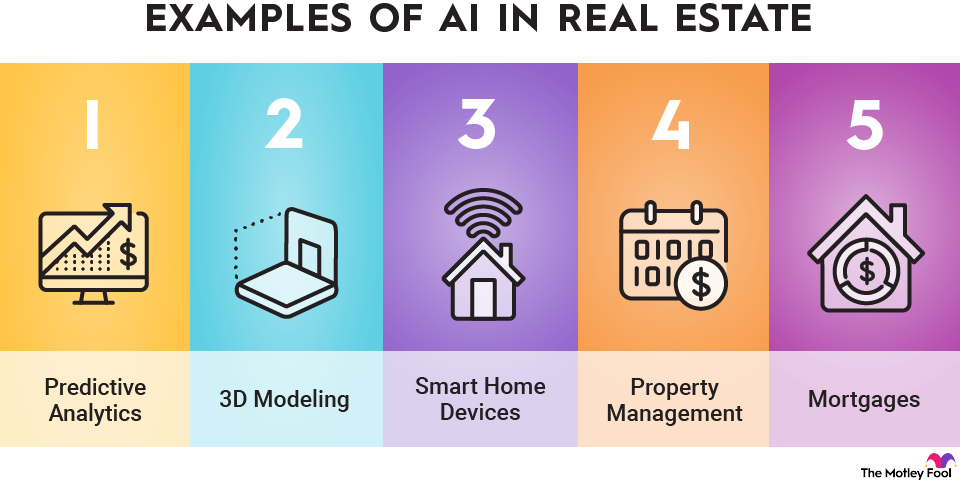
Predictive models forecast future real estate trends by analyzing historical data and external factors. For instance, AI can predict neighborhood gentrification by tracking demographic shifts, infrastructure developments, and economic growth. Investors use these insights to identify emerging markets before prices surge. Similarly, rental platforms leverage predictive analytics to optimize pricing strategies based on seasonal demand and local events.
#Natural language processing (NLP)
NLP enables AI to interpret and generate human language, facilitating tasks such as:
- Sentiment analysis: Evaluating buyer/seller sentiment from online reviews or social media to gauge market confidence.
- Chatbots: Automating customer inquiries, scheduling viewings, and providing instant responses to common questions.
- Document processing: Extracting key information from contracts, leases, and legal documents to reduce manual errors.
#Computer vision
Computer vision technology analyzes images and videos to assess property conditions and generate virtual tours. For example:
- Image recognition: Identifying structural issues (cracks, water damage) in property photos to flag potential problems for buyers.
- Virtual staging: Using AI to digitally furnish empty properties, helping buyers visualize spaces.
- Drones: Capturing aerial footage of properties and neighborhoods to assess curb appeal and accessibility.
#Applications
#Property valuation
AI enhances valuation accuracy by incorporating thousands of data points, including micro-market trends and economic indicators. Unlike traditional appraisals, which may be subjective, AI models provide consistent, data-backed estimates. Platforms like Zestimate use AI to update property values in real-time, reflecting market fluctuations.
#Lead generation
AI identifies high-potential leads by analyzing buyer behavior, search patterns, and demographic data. For example, if a user repeatedly searches for homes in a specific neighborhood, AI can prioritize that lead for agents. Additionally, AI-driven CRM systems segment leads based on likelihood to convert, enabling targeted marketing campaigns.
#Fraud detection
AI detects anomalies in transactions that may indicate fraud, such as inconsistent property histories or suspicious financing patterns. Machine learning models flag irregularities in appraisals, title searches, and loan applications, reducing financial risks for lenders and buyers.
#Smart home management
AI-powered smart home systems optimize energy usage, security, and maintenance. For instance, Nest thermostats learn user preferences to reduce energy costs, while AI-driven security cameras distinguish between residents and intruders. These systems increase property desirability and operational efficiency.
#Important facts
- AI can reduce property valuation errors by up to 30% compared to traditional methods, according to a McKinsey study.
- The global AI in real estate market is projected to reach $13.8 billion by 2027, growing at a CAGR of 35.6%.
- Over 70% of real estate firms use AI for lead generation and customer service, per a NAR survey.
- AI-driven chatbots handle 60% of routine inquiries in some real estate agencies, freeing agents to focus on high-value tasks.
- Computer vision can assess a property's condition from photos with 90% accuracy, comparable to human inspectors.
#Timeline
Year Milestone 1980s Early automated valuation models (AVMs) emerge, using basic statistical methods. 1990s Zillow launches in 2006, pioneering AI-driven property valuations with its Zestimate tool. 2010 Proptech startups begin integrating AI for lead generation and market analysis. 2015 Computer vision enters real estate, enabling virtual property tours and image-based condition assessments. 2018 NLP-powered chatbots become mainstream, handling customer inquiries for major real estate platforms. 2020 AI predicts pandemic-driven shifts in housing demand, such as increased interest in suburban properties. 2023 Generative AI tools create virtual staging and personalized property recommendations based on user preferences.
#Related Terms
#FAQ
What does AI And Real Estate: Property Valuation cover?
Explores how artificial intelligence shapes real estate and property valuation, covering practical use cases, benefits, limitations, and risks.
Why is AI And Real Estate: Property Valuation important?
It helps readers understand key concepts, compare practical use cases, and evaluate how Business & Finance decisions affect outcomes, risks, and implementation choices.
What should readers verify before applying this topic?
Readers should compare the benefits, limitations, data requirements, and related themes such as Real, Estate, Property before using the ideas in real projects.
#References
- AI And Real Estate: Property Valuation terminology and background research
- AI And Real Estate: Property Valuation use cases, implementation examples, and limitations
- Business & Finance best practices, standards, and risk guidance
- Real case studies, benchmarks, and current industry analysis




Comments
No comments yet. Start the discussion with a useful note.