

#Short Answer
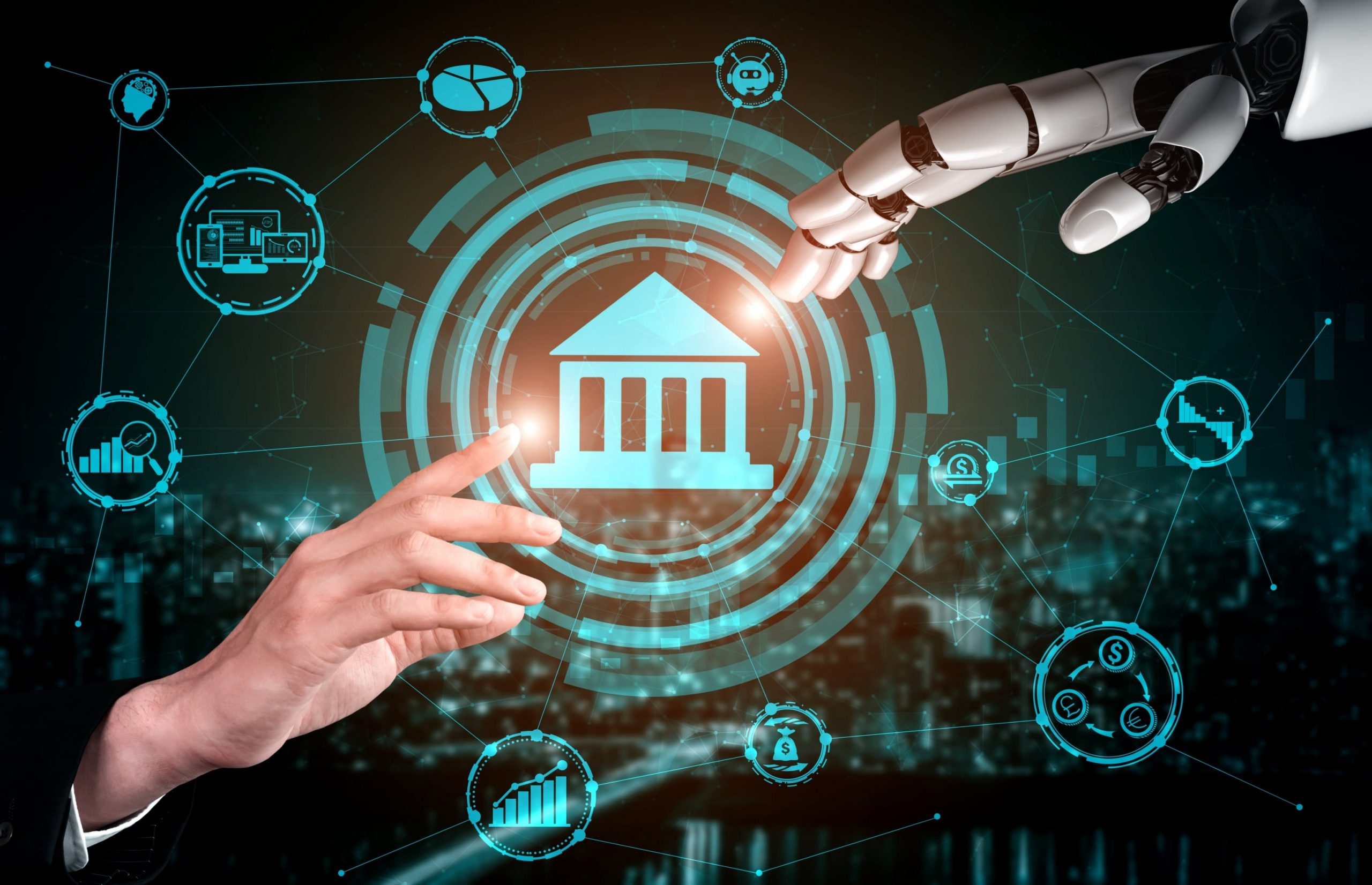
Artificial intelligence has become a cornerstone of modern banking, reshaping how financial institutions operate and interact with customers. By leveraging AI, banks can process vast amounts of data in real time, identify patterns, and automate complex tasks that were previously manual and time-consuming. This integration supports a wide range of applications, from fraud detection and credit risk assessment to personalized financial advice and customer support through chatbots.
#Infobox
#Overview
Artificial intelligence has become a cornerstone of modern banking, reshaping how financial institutions operate and interact with customers. By leveraging AI, banks can process vast amounts of data in real time, identify patterns, and automate complex tasks that were previously manual and time-consuming. This integration supports a wide range of applications, from fraud detection and credit risk assessment to personalized financial advice and customer support through chatbots.
The adoption of AI in banking is driven by the need for greater operational efficiency, cost reduction, and enhanced customer experiences. As digital transformation accelerates, AI-powered tools are enabling banks to stay competitive in an increasingly digital marketplace. Moreover, AI helps institutions comply with stringent regulatory requirements by automating compliance checks and monitoring transactions for suspicious activities.
#Key Areas of AI in Banking
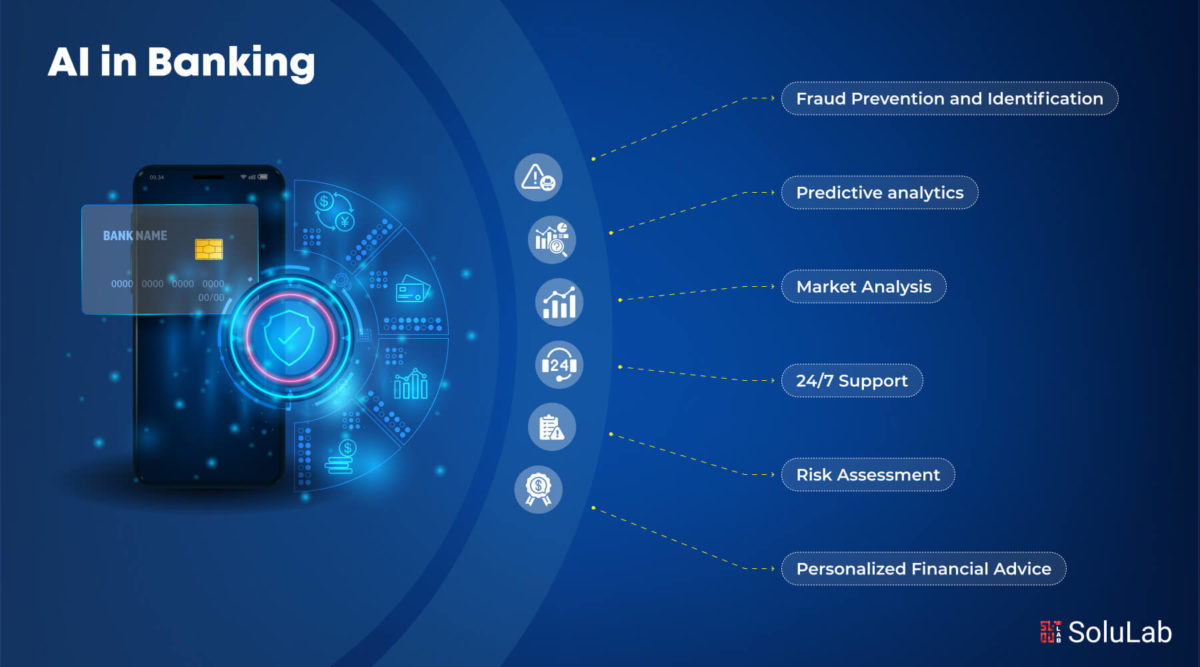
- Fraud Detection and Prevention: AI systems analyze transaction patterns to identify anomalies and potential fraud in real time, reducing financial losses and protecting customer assets.
- Credit Scoring and Loan Approvals: Machine learning models evaluate borrower creditworthiness by analyzing alternative data sources, improving the accuracy of loan decisions and expanding access to credit.
- Customer Service and Chatbots: AI-powered chatbots and virtual assistants provide 24/7 customer support, handling queries, processing transactions, and offering personalized financial recommendations.
- Algorithmic Trading: AI-driven trading systems analyze market data, execute trades at optimal times, and adapt strategies based on changing market conditions, enhancing profitability and reducing human error.
- Risk Management: AI models assess market, credit, and operational risks by processing large datasets, enabling banks to make informed decisions and mitigate potential threats.
- Personalized Banking: AI enables hyper-personalization by analyzing customer behavior and preferences, offering tailored product recommendations, and improving engagement through targeted marketing.
#History / Background
The concept of using artificial intelligence in banking dates back to the 1980s, when early expert systems were developed to assist with financial decision-making. However, the widespread adoption of AI in banking began in the 2010s, fueled by advancements in computing power, big data analytics, and machine learning algorithms.
In the early stages, AI applications were primarily focused on automating back-office processes and improving data analysis. The introduction of chatbots in the mid-2010s marked a significant milestone, as banks began using natural language processing to enhance customer interactions. The rise of fintech companies and digital-only banks further accelerated AI adoption, as these institutions leveraged AI to compete with traditional banks by offering innovative, low-cost services.
Regulatory changes, such as the GDPR in Europe and the Dodd-Frank Act in the United States, also played a role in shaping AI adoption in banking. These regulations required financial institutions to implement robust data protection and compliance mechanisms, which AI systems were well-suited to support.
#How It Works
AI in banking operates through a combination of advanced technologies, including machine learning, natural language processing (NLP), and robotic process automation (RPA). These technologies enable banks to process and analyze data more efficiently, automate repetitive tasks, and make predictive decisions.
#Machine Learning
Machine learning (ML) is a subset of AI that enables systems to learn from data and improve their performance over time without explicit programming. In banking, ML algorithms are used for:
- Predictive Analytics: Forecasting customer behavior, market trends, and financial risks by analyzing historical data.
- Credit Scoring: Assessing borrower creditworthiness using alternative data sources such as social media activity, utility payments, and rental history.
- Fraud Detection: Identifying suspicious transactions by detecting deviations from normal patterns in real time.
#Natural Language Processing
Natural language processing (NLP) enables computers to understand, interpret, and generate human language. In banking, NLP is used for:
- Chatbots and Virtual Assistants: Providing automated customer support, answering queries, and processing transactions through conversational interfaces.
- Sentiment Analysis: Analyzing customer feedback from social media, emails, and reviews to gauge satisfaction and identify areas for improvement.
- Document Processing: Extracting and analyzing data from unstructured documents such as loan applications, contracts, and regulatory filings.
#Robotic Process Automation
Robotic process automation (RPA) involves using software robots to automate repetitive, rule-based tasks. In banking, RPA is applied to:
- Data Entry: Automating the input of customer information into banking systems.
- Compliance Checks: Ensuring adherence to regulatory requirements by automating reporting and audit processes.
- Account Management: Handling routine tasks such as balance inquiries, fund transfers, and account updates.
#Important Facts
- Efficiency Gains: AI can reduce operational costs in banking by up to 30% by automating routine tasks and improving process efficiency.
- Fraud Reduction: AI-powered fraud detection systems can reduce false positives by up to 50%, improving the accuracy of fraud alerts.
- Customer Satisfaction: Banks using AI-driven chatbots report a 30% increase in customer satisfaction due to faster response times and 24/7 availability.
- Regulatory Compliance: AI systems help banks comply with regulations such as AML and KYC by automating identity verification and transaction monitoring.
- Market Growth: The global AI in banking market is projected to reach $31.7 billion by 2027, growing at a compound annual growth rate (CAGR) of 29.7%.
- Job Transformation: While AI automates routine tasks, it also creates new roles in data science, AI ethics, and customer experience management, requiring reskilling of the workforce.
#Timeline
- Early expert systems for
Early expert systems for financial decision-making are developed.
- Banks begin using basic
Banks begin using basic AI for data analysis and risk management.
- AI adoption expands with
AI adoption expands with the growth of digital banking and online transactions.
- First AI-powered chatbots are
First AI-powered chatbots are introduced in banking customer service.
- Machine learning models are
Machine learning models are widely used for credit scoring and fraud detection.
- Regulatory frameworks such as
Regulatory frameworks such as GDPR drive the adoption of AI for compliance.
- AI-driven personalized banking
AI-driven personalized banking and algorithmic trading gain prominence.
- AI in banking becomes
AI in banking becomes mainstream, with over 80% of banks adopting AI technologies.
#Related Terms
#FAQ
What does AI And Banking: Digital Services cover?
Explores how artificial intelligence shapes banking and digital services, covering practical use cases, benefits, limitations, and risks.
Why is AI And Banking: Digital Services important?
It helps readers understand key concepts, compare practical use cases, and evaluate how Business & Finance decisions affect outcomes, risks, and implementation choices.
What should readers verify before applying this topic?
Readers should compare the benefits, limitations, data requirements, and related themes such as Banking, Digital, Service before using the ideas in real projects.
#References
- AI And Banking: Digital Services terminology and background research
- AI And Banking: Digital Services use cases, implementation examples, and limitations
- Business & Finance best practices, standards, and risk guidance
- Banking case studies, benchmarks, and current industry analysis

Comments
No comments yet. Start the discussion with a useful note.