

#Short Answer
Explores how artificial intelligence shapes pharmacy and drug development, covering practical use cases, benefits, limitations, and risks.
#Infobox
Exploration of artificial intelligence applications in pharmaceutical sciences, including drug discovery, development, and personalized medicine.
Artificial Intelligence in Pharmacy Field Pharmacy Subfields Drug discovery, Clinical trials, Pharmacovigilance, Personalized medicine Key Technologies Machine learning, Deep learning, Natural language processing, Robotics Major Applications Target identification, Lead optimization, Adverse drug reaction prediction, Dosage optimization Notable Achievements AlphaFold, Drug repurposing, Virtual screening Challenges Data quality, Regulatory approval, Interpretability, Ethical concerns
#Overview
Artificial intelligence (AI) in pharmacy refers to the integration of machine learning (ML), deep learning (DL), and other computational techniques to enhance various aspects of pharmaceutical sciences. This interdisciplinary field combines computer science, statistics, biology, and chemistry to accelerate drug discovery, optimize clinical trials, improve pharmacovigilance, and enable personalized medicine. AI systems analyze vast datasets—including genomic sequences, protein structures, electronic health records (EHRs), and scientific literature—to identify patterns, predict outcomes, and generate actionable insights that were previously inaccessible through traditional methods.
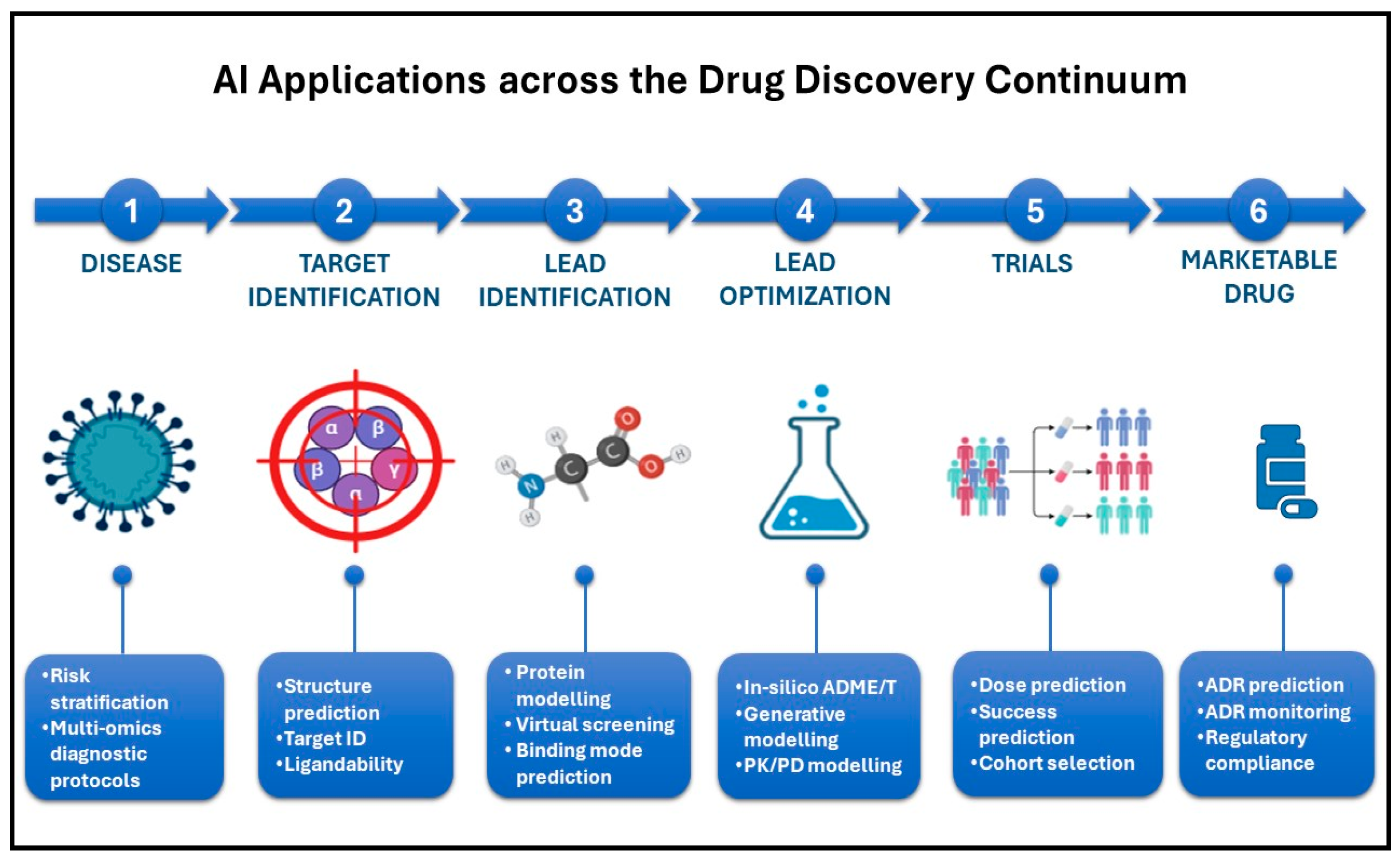
The application of AI in pharmacy spans the entire drug development pipeline, from target identification and lead compound screening to post-market surveillance. By automating repetitive tasks, reducing human error, and uncovering hidden correlations in data, AI has the potential to significantly reduce the time and cost associated with bringing new drugs to market. According to industry estimates, AI-driven drug discovery can cut development timelines by up to 50% and reduce costs by billions of dollars per drug.
#History / Background
The concept of using computational methods in pharmaceutical research dates back to the 1960s with the advent of early molecular modeling techniques. However, the integration of AI specifically began in the 1980s and 1990s, when researchers started applying expert systems and neural networks to predict drug interactions and analyze chemical structures. One of the earliest milestones was the development of Dendral, an expert system created in 1965 at Stanford University, which used rule-based reasoning to deduce molecular structures from mass spectrometry data.
The 2000s saw a surge in AI applications with the rise of high-throughput screening and the availability of large-scale biological datasets. The Human Genome Project (completed in 2003) provided a wealth of genetic data that AI systems could mine for potential drug targets. In 2012, a breakthrough occurred when a deep learning model developed by Stanford researchers outperformed traditional methods in predicting the activity of drug compounds. This success catalyzed widespread adoption of AI in the pharmaceutical industry.
A pivotal moment came in 2020 when DeepMind's AlphaFold, an AI system designed to predict protein structures, achieved unprecedented accuracy in the CASP14 competition. This advancement revolutionized target identification in drug discovery, as protein folding had long been a major bottleneck in the process. Since then, AI has become a cornerstone of modern pharmaceutical innovation, with major pharmaceutical companies and biotech startups investing heavily in AI-driven platforms.
#How It Works
#Data Collection and Preprocessing
AI systems in pharmacy rely on diverse datasets, including:
- Chemical Data: Molecular structures, binding affinities, and drug-target interactions from databases like PubChem and ChEMBL.
- Biological Data: Genomic sequences, proteomic profiles, and single-cell RNA sequencing data.
- Clinical Data: Electronic health records, clinical trial results, and real-world evidence from sources like FAERS.
- Literature Data: Scientific publications indexed in databases such as PubMed and arXiv.
Data preprocessing involves cleaning, normalizing, and annotating these datasets to ensure consistency and relevance. Techniques such as natural language processing (NLP) are used to extract meaningful information from unstructured text in scientific literature.
#Machine Learning and Deep Learning Models
Several AI models are employed in pharmaceutical applications:
- Supervised Learning: Used for classification and regression tasks, such as predicting drug efficacy or toxicity. Models like random forests, support vector machines (SVM), and gradient boosting are commonly applied.
- Unsupervised Learning: Helps identify patterns in unlabeled data, such as clustering similar drug compounds or detecting anomalies in clinical trial data. Techniques include k-means clustering and principal component analysis (PCA).
- Reinforcement Learning: Used in dynamic environments like adaptive clinical trial design, where the model learns optimal dosing strategies through trial and error.
- Deep Learning: Particularly effective for handling complex, high-dimensional data. Convolutional neural networks (CNNs) are used for image-based tasks (e.g., analyzing microscopy images), while recurrent neural networks (RNNs) and transformers process sequential data like time-series clinical records.
- Generative Models: Includes variational autoencoders (VAEs) and generative adversarial networks (GANs), which are used to design novel drug molecules or simulate biological pathways.
#Key AI Applications in Pharmacy
The following are major areas where AI is transforming pharmaceutical sciences:
Drug Discovery and Development
- Target Identification: AI analyzes genomic and proteomic data to identify disease-associated proteins or genes that can serve as drug targets. For example, AI models have been used to identify novel targets for Alzheimer's disease and cancer.
- Virtual Screening: AI accelerates the screening of large chemical libraries to identify potential drug candidates. This process, known as in silico screening, reduces the need for costly and time-consuming in vitro and in vivo experiments.
- Lead Optimization: AI predicts the pharmacokinetic and pharmacodynamic properties of drug candidates, helping researchers optimize their chemical structures for better efficacy and safety.
- De Novo Drug Design: Generative AI models can design entirely new drug molecules with desired properties, bypassing the limitations of traditional combinatorial chemistry.
Clinical Trials
- Patient Recruitment: AI analyzes EHRs and other data sources to identify eligible participants for clinical trials, reducing recruitment timelines and costs.
- Trial Design: AI optimizes trial protocols by simulating different scenarios to determine the most efficient study design, including dosage regimens and patient stratification.
- Adaptive Trials: AI enables real-time adjustments to trial parameters based on interim data, improving the likelihood of success and reducing the risk of failure.
- Adverse Event Prediction: AI models predict potential adverse drug reactions by analyzing historical data and identifying high-risk patients or drug combinations.
Pharmacovigilance
- Signal Detection: AI monitors post-market drug safety data to detect emerging adverse events or drug interactions. For example, NLP models can scan social media and medical literature for mentions of drug side effects.
- Risk Stratification: AI assesses the risk-benefit profile of drugs by analyzing large-scale patient data, helping regulators and healthcare providers make informed decisions.
Personalized Medicine
- Genomic Profiling: AI interprets genetic data to identify biomarkers that predict individual responses to drugs, enabling tailored treatment plans.
- Drug Repurposing: AI identifies new therapeutic uses for existing drugs by analyzing their mechanisms of action and disease pathways. For example, AI has been used to repurpose drugs like sildenafil (originally developed for angina) for erectile dysfunction.
- Dose Optimization: AI models predict optimal drug dosages based on patient-specific factors such as genetics, age, and comorbidities, reducing the risk of under- or over-dosing.
#Important Facts
- Speed and Efficiency: AI can analyze millions of chemical compounds in hours, a task that would take human researchers years.
- Cost Reduction: The average cost of developing a new drug is estimated at $2.6 billion, but AI-driven approaches can reduce this by up to 70%.
- Success Rates: AI improves the success rate of drug candidates in clinical trials by up to 50% compared to traditional methods.
- Regulatory Approval: The FDA has approved several AI-driven tools for drug discovery and development, including BenevolentAI's AI platform for identifying drug targets.
- Collaborations: Major pharmaceutical companies like Pfizer, Novartis, and Roche have partnered with AI startups such as Recursion Pharmaceuticals and Exscientia to accelerate drug discovery.
- Ethical Considerations: The use of AI in pharmacy raises ethical questions about data privacy, algorithmic bias, and the potential for over-reliance on automated systems.
#Timeline
Year Milestone 1965 Development of Dendral, the first expert system for molecular structure elucidation. 1980s Early applications of neural networks in drug discovery and toxicology. 2003 Completion of the Human Genome Project, providing vast genetic data for AI analysis. 2012 Stanford researchers demonstrate deep learning outperforms traditional methods in drug activity prediction. 2016 IBM Watson for Oncology is introduced, using AI to assist in cancer treatment decisions. 2018 Exscientia and Sumitomo Dainippon Pharma collaborate on the first AI-designed drug to enter clinical trials. 2020 DeepMind's AlphaFold achieves breakthrough accuracy in protein structure prediction. 2021 FDA approves the first AI-driven drug discovery platform, BenevolentAI's platform for identifying targets in amyotrophic lateral sclerosis (ALS). 2022 Recursion Pharmaceuticals raises $400 million to expand AI-driven drug discovery efforts. 2023 AI models begin to be used for real-time monitoring of drug safety in post-market surveillance.
#Related Terms
#FAQ
What does AI And Pharmacy: Drug Development cover?
Explores how artificial intelligence shapes pharmacy and drug development, covering practical use cases, benefits, limitations, and risks.
Why is AI And Pharmacy: Drug Development important?
It helps readers understand key concepts, compare practical use cases, and evaluate how Healthcare AI decisions affect outcomes, risks, and implementation choices.
What should readers verify before applying this topic?
Readers should compare the benefits, limitations, data requirements, and related themes such as Pharmacy, Drug, Development before using the ideas in real projects.
#References
- AI And Pharmacy: Drug Development terminology and background research
- AI And Pharmacy: Drug Development use cases, implementation examples, and limitations
- Healthcare AI best practices, standards, and risk guidance
- Pharmacy case studies, benchmarks, and current industry analysis


Comments
No comments yet. Start the discussion with a useful note.