


#Short Answer
AI-driven approaches transforming drug discovery through computational modeling, machine learning, and data-driven optimization.
#Infobox
#Overview
Artificial intelligence (AI) in drug discovery refers to the application of computational techniques, particularly machine learning (ML) and deep learning (DL), to streamline and enhance various stages of the pharmaceutical research and development (R&D) pipeline. These AI-driven methodologies leverage large-scale biological, chemical, and clinical datasets to predict drug-target interactions, optimize molecular structures, and forecast pharmacokinetic properties. The integration of AI has revolutionized traditional drug discovery by reducing timeframes from years to months and lowering costs associated with experimental trials.
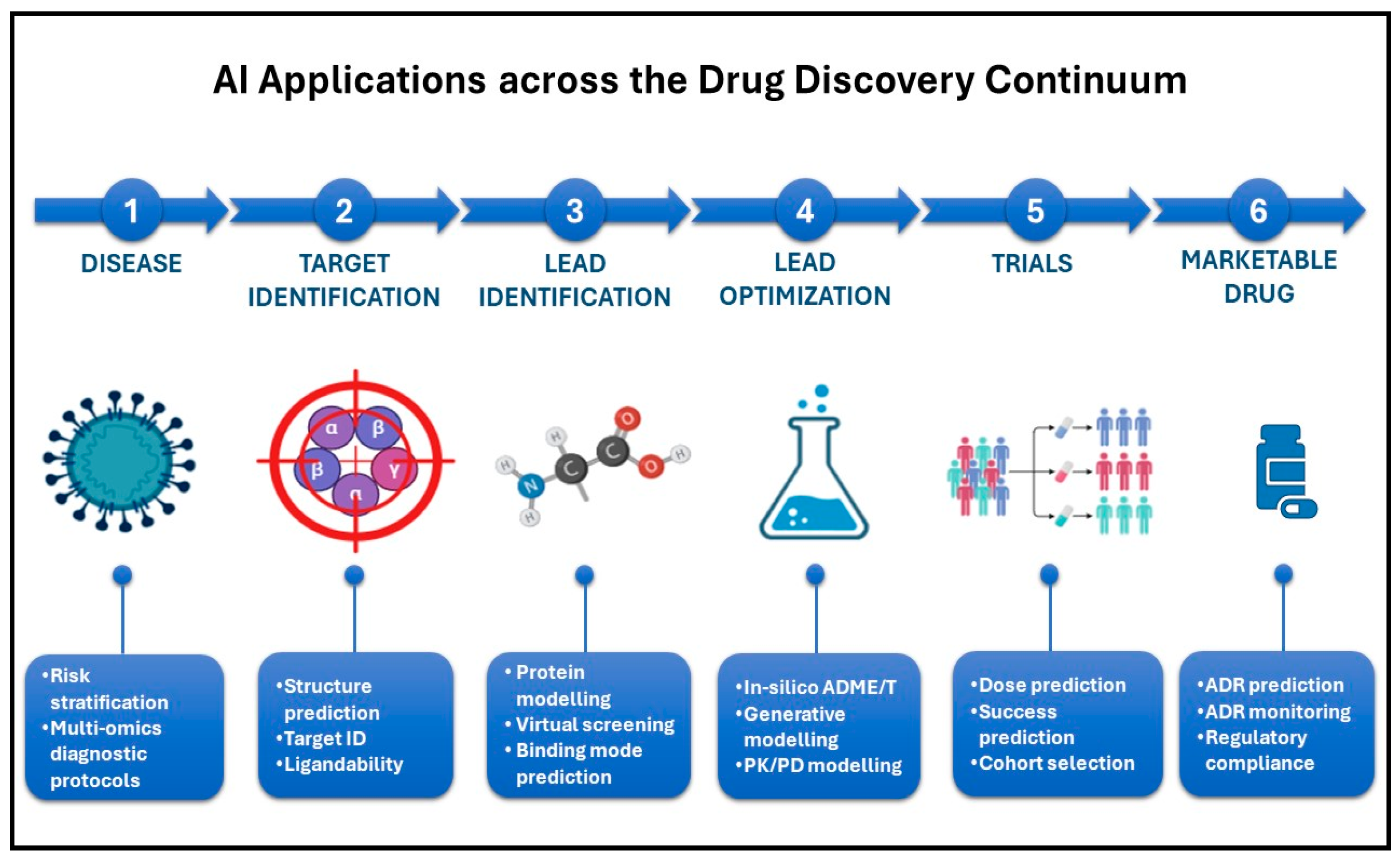
AI applications span multiple domains within drug discovery, including target identification, hit discovery, lead optimization, and preclinical validation. By automating repetitive tasks and identifying patterns in complex datasets, AI enables researchers to focus on high-value experimental work. The field intersects with cheminformatics, bioinformatics, and systems biology, forming a multidisciplinary approach to modern pharmaceutical innovation.
#History / Background
#Early Developments
The conceptual foundation of AI in drug discovery emerged in the 1960s with early computational chemistry tools such as quantum chemistry methods and molecular mechanics simulations. In the 1980s and 1990s, rule-based expert systems like DEREK were developed to predict toxicity, marking the first attempts to automate chemical reasoning. The advent of machine learning in the late 20th century introduced statistical models capable of learning from molecular data, though computational limitations restricted their widespread adoption.
#Modern Era
The 2010s witnessed a paradigm shift with the rise of deep learning and big data analytics. Breakthroughs such as AlphaFold (2020), developed by DeepMind, demonstrated the ability of AI to predict protein structures with near-experimental accuracy, addressing a long-standing challenge in structural biology. Concurrently, advances in graph neural networks (GNNs) enabled the modeling of molecular graphs, facilitating de novo drug design. The integration of AI platforms like IBM Watson and BenevolentAI into pharmaceutical workflows marked a new era of data-driven drug discovery.
#Current Trends
Today, AI is increasingly embedded in all phases of drug development. Companies such as Recursion Pharmaceuticals and Insitro use AI to analyze cellular imaging and genetic data at scale. Open-source frameworks like DeepChem and RDKit democratize access to AI tools for researchers. Regulatory agencies, including the FDA, are exploring AI-based models to support drug approval processes, reflecting growing institutional acceptance.
#How It Works
#Data Collection and Preprocessing
AI-driven drug discovery begins with the aggregation of diverse datasets, including genomic sequences, protein structures, chemical compound libraries, and clinical trial outcomes. High-throughput screening (HTS) data, electronic health records (EHRs), and literature-mined information are curated and standardized. Preprocessing involves normalization, feature extraction, and handling missing data to ensure model compatibility. Techniques such as natural language processing (NLP) are used to extract relevant information from scientific publications and patents.
#Machine Learning Models
Several ML paradigms are employed:
- Supervised Learning: Used for predicting drug properties (e.g., solubility, toxicity) or binding affinities. Models like random forests, support vector machines (SVM), and gradient-boosted trees are trained on labeled datasets.
- Unsupervised Learning: Applied to cluster molecules with similar properties or identify hidden patterns in chemical space. Techniques include k-means clustering and principal component analysis (PCA).
- Reinforcement Learning: Utilized in generative models to iteratively optimize molecular structures for desired properties, such as potency and safety.
- Deep Learning: Neural networks, particularly CNNs and RNNs, process raw data like molecular graphs or 3D protein structures. Generative adversarial networks (GANs) and variational autoencoders (VAEs) generate novel drug-like molecules.
#Key Applications
- Target Identification: AI analyzes omics data (e.g., transcriptomics, proteomics) to identify disease-associated biological targets, such as genes or proteins.
- Hit Discovery: Virtual screening uses ML models to prioritize compounds from large libraries based on predicted binding affinity to a target protein.
- Lead Optimization: AI models predict structure-activity relationships (SAR) and guide chemical modifications to improve efficacy and reduce side effects.
- ADMET Prediction: ADMET properties are forecasted using quantitative structure-activity relationship (QSAR) models, reducing late-stage failures.
- De Novo Drug Design: Generative AI creates entirely new molecular structures with desired properties, bypassing traditional trial-and-error synthesis.
- Repurposing: AI identifies existing drugs that may be effective for new indications by analyzing drug-target networks and disease pathways.
#Important Facts
- AI can reduce drug discovery timelines by up to 50% and cut costs by billions of dollars annually.
- AlphaFold has predicted structures for over 200 million proteins, covering nearly all known proteins in the UniProt database.
- The global AI in drug discovery market is projected to exceed $10 billion by 2030, growing at a compound annual growth rate (CAGR) of over 25%.
- Generative AI models have produced novel compounds with nanomolar binding affinities, comparable to those discovered through traditional methods.
- AI-driven repurposing efforts led to the rapid identification of baricitinib as a potential treatment for COVID-19.
- Challenges include data bias, interpretability of black-box models, and the need for experimental validation of AI predictions.
#Timeline
- First computational chemistry
First computational chemistry software, [CNDO/2](# 'CNDO/2'), developed for quantum chemical calculations.
- DEREK expert system released
DEREK expert system released for toxicity prediction.
- First application of neural
First application of neural networks in QSAR modeling.
- IBM Watson begins development
IBM Watson begins development for healthcare applications.
- DeepMind introduces deep reinf
DeepMind introduces deep reinforcement learning for Atari games, laying groundwork for AI in biology.
- AlphaFold wins CASP13, achievi
AlphaFold wins CASP13, achieving breakthrough accuracy in protein folding.
- AlphaFold 2 achieves near-expe
AlphaFold 2 achieves near-experimental accuracy in protein structure prediction.
- BenevolentAI identifies barici
BenevolentAI identifies baricitinib as a COVID-19 treatment candidate.
- FDA approves first AI-designed
FDA approves first AI-designed drug candidate (Insilico Medicine’s [ISM001-055](# 'ISM001-055')) for clinical trials.
#Related Terms
#FAQ
What does AI And Chemistry: Drug Discovery cover?
Explores how artificial intelligence shapes chemistry and drug discovery, covering practical use cases, benefits, limitations, and risks.
Why is AI And Chemistry: Drug Discovery important?
It helps readers understand key concepts, compare practical use cases, and evaluate how Healthcare AI decisions affect outcomes, risks, and implementation choices.
What should readers verify before applying this topic?
Readers should compare the benefits, limitations, data requirements, and related themes such as Chemistry, Drug, Discovery before using the ideas in real projects.
#References
- AI And Chemistry: Drug Discovery terminology and background research
- AI And Chemistry: Drug Discovery use cases, implementation examples, and limitations
- Healthcare AI best practices, standards, and risk guidance
- Chemistry case studies, benchmarks, and current industry analysis

Comments
No comments yet. Start the discussion with a useful note.