


#Short Answer
AI-powered personalized shopping in e-commerce uses artificial intelligence to analyze customer data, predict preferences, and deliver tailored product recommendations, enhancing the shopping experience and increasing sales.
#Infobox
#Overview
Artificial intelligence (AI) has revolutionized e-commerce by enabling personalized shopping experiences through data-driven insights. AI algorithms analyze user behavior, purchase history, and preferences to recommend products, optimize pricing, and improve customer engagement. This technology enhances conversion rates, customer satisfaction, and brand loyalty by delivering relevant content in real time.
Personalized shopping leverages AI to create dynamic user interfaces, chatbots, and virtual assistants that guide customers through their purchasing journey. By integrating machine learning (ML) and natural language processing (NLP), e-commerce platforms can understand and anticipate customer needs more accurately than traditional recommendation systems.
#Key Components
- Machine Learning Models: Algorithms that learn from user interactions to predict future behavior.
- Natural Language Processing (NLP): Enables chatbots and voice assistants to understand and respond to customer queries.
- Computer Vision: Analyzes images and videos to enhance product discovery and virtual try-ons.
- Recommendation Engines: Systems that suggest products based on collaborative filtering, content-based filtering, or hybrid approaches.
- Predictive Analytics: Forecasts trends, demand, and customer churn to optimize inventory and marketing strategies.
#History / Background
The concept of personalized shopping predates AI, with early e-commerce platforms using basic rule-based systems to suggest products. The introduction of collaborative filtering in the 1990s, popularized by Amazon and Netflix, marked a significant milestone in recommendation technology. However, the widespread adoption of AI in e-commerce began in the 2010s with advancements in deep learning and big data analytics.
Key milestones include:
- 1990s: Early recommendation systems like Firefly and Amazon’s collaborative filtering.
- 2000s: Growth of personalized email marketing and dynamic pricing strategies.
- 2010s: Rise of AI-driven chatbots, voice assistants (e.g., Alexa, Siri), and deep learning-based recommendation engines.
- 2020s: Integration of generative AI for hyper-personalized content, AI-generated product descriptions, and virtual shopping assistants.
#How It Works
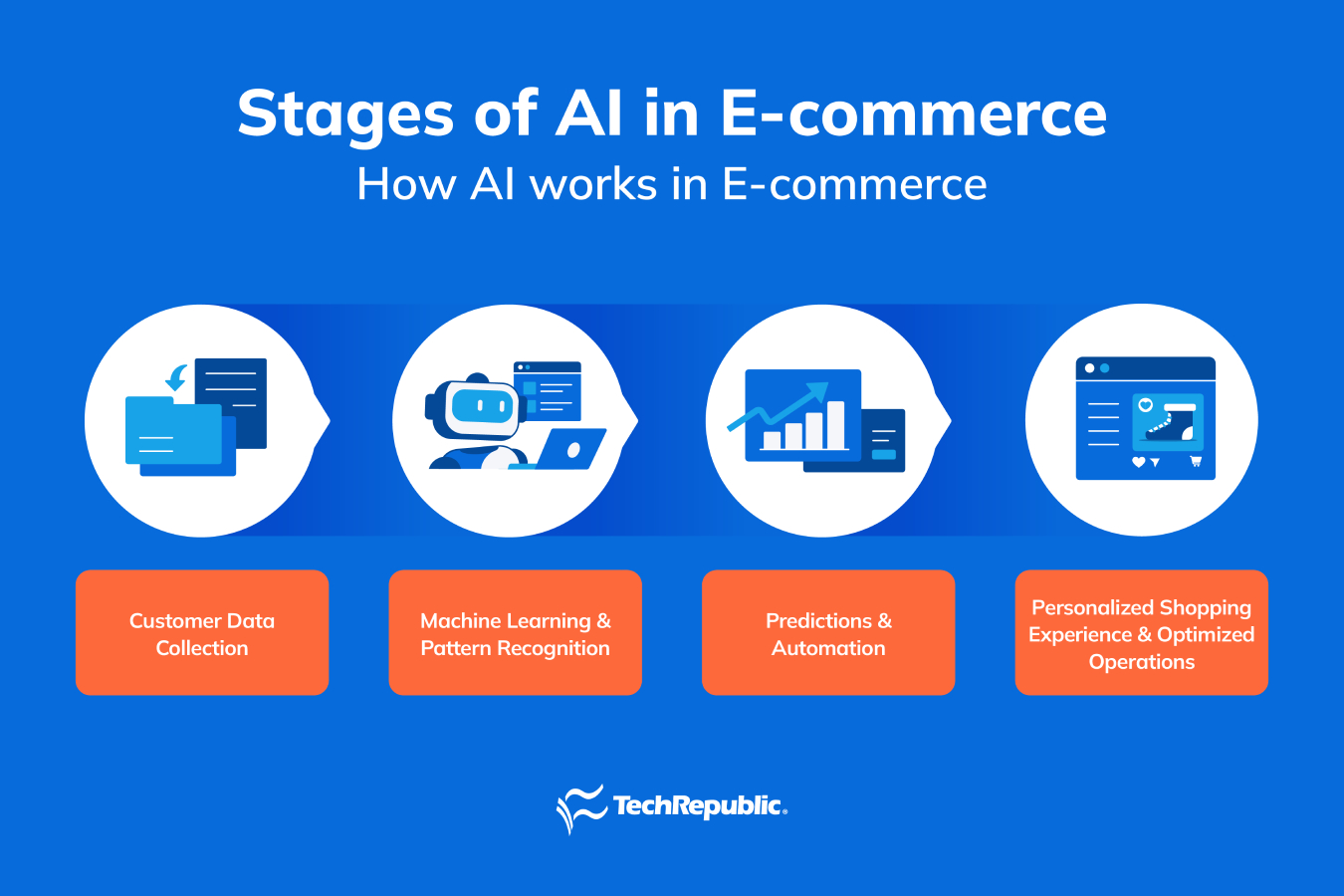
AI-powered personalized shopping relies on a combination of data collection, algorithmic processing, and real-time delivery of tailored experiences. The process can be broken down into several stages:
#Data Collection
E-commerce platforms gather vast amounts of data from multiple sources, including:
- User Behavior: Clickstream data, browsing history, time spent on pages, and cart abandonment rates.
- Purchase History: Past orders, frequency of purchases, and average order value.
- Demographics: Age, gender, location, and income level.
- Explicit Feedback: Ratings, reviews, and survey responses.
- Third-Party Data: Social media activity, search queries, and external market trends.
#Data Processing
Collected data is processed using AI techniques to extract meaningful insights:
- Feature Engineering: Transforming raw data into structured formats suitable for machine learning models.
- Clustering: Grouping users with similar preferences (e.g., k-means, hierarchical clustering).
- Classification: Predicting user segments or purchase intent (e.g., logistic regression, decision trees).
- Natural Language Processing: Analyzing text data from reviews, chat logs, and product descriptions.
- Computer Vision: Processing images for visual search, product tagging, and virtual try-ons.
#Recommendation Generation
AI models generate personalized recommendations using various techniques:
- Collaborative Filtering: Recommends products based on the preferences of similar users (e.g., "Users who bought X also bought Y").
- Content-Based Filtering: Suggests items similar to those a user has previously interacted with (e.g., recommending books by the same author).
- Hybrid Models: Combines collaborative and content-based filtering for improved accuracy.
- Deep Learning: Uses neural networks to capture complex patterns in user behavior (e.g., recurrent neural networks for sequential data).
- Context-Aware Recommendations: Considers real-time factors like time of day, device type, and location.
#Delivery and Interaction
Personalized recommendations are delivered through multiple touchpoints:
- Website & App Interfaces: Dynamic product carousels, personalized homepages, and email recommendations.
- Chatbots & Virtual Assistants: AI-driven conversational agents that assist with product searches and purchases.
- Push Notifications & Emails: Targeted messages based on user behavior (e.g., abandoned cart reminders).
- Voice Commerce: Voice-activated shopping assistants (e.g., Alexa, Google Assistant).
- Augmented Reality (AR): Virtual try-ons for fashion, furniture, and cosmetics.
#Important Facts
- Efficiency: AI-driven personalization can increase conversion rates by up to 30% and boost average order value by 10-15%.
- Customer Retention: Personalized experiences can improve customer loyalty by up to 40%.
- Data Privacy: Compliance with regulations like GDPR and CCPA is critical to maintain user trust.
- Bias Mitigation: AI models must be trained on diverse datasets to avoid reinforcing biases in recommendations.
- Real-Time Processing: Modern AI systems can process and update recommendations in milliseconds, enabling dynamic pricing and inventory adjustments.
- Omnichannel Integration: Personalization extends across websites, mobile apps, social media, and physical stores.
#Related Terms
#FAQ
What does AI And E-Commerce: Personalized Shopping cover?
Explores how artificial intelligence shapes e-commerce and personalized shopping, covering practical use cases, benefits, limitations, and risks.
Why is AI And E-Commerce: Personalized Shopping important?
It helps readers understand key concepts, compare practical use cases, and evaluate how Business & Finance decisions affect outcomes, risks, and implementation choices.
What should readers verify before applying this topic?
Readers should compare the benefits, limitations, data requirements, and related themes such as Ecommerce, Personalized, Shopping before using the ideas in real projects.
#References
- AI And E-Commerce: Personalized Shopping terminology and background research
- AI And E-Commerce: Personalized Shopping use cases, implementation examples, and limitations
- Business & Finance best practices, standards, and risk guidance
- Ecommerce case studies, benchmarks, and current industry analysis

Comments
No comments yet. Start the discussion with a useful note.