

#Short Answer
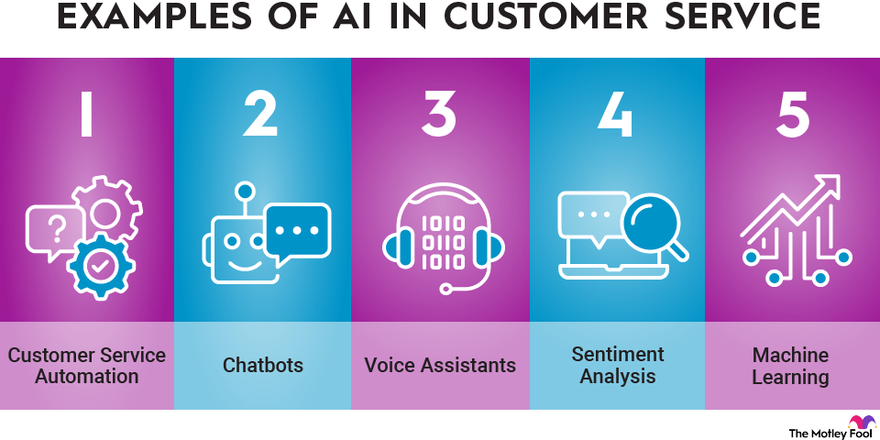
Artificial intelligence (AI) in customer service refers to the use of AI technologies such as chatbots, virtual assistants, and sentiment analysis to automate responses, improve efficiency, and enhance customer experiences. These systems leverage natural language processing (NLP) and machine learning (ML) to understand and respond to customer inquiries in real time, reducing wait times and operational costs while maintaining service quality.
#Infobox
#Overview
AI in customer service encompasses a range of technologies designed to streamline interactions between businesses and customers. The primary goal is to provide immediate, accurate, and personalized responses while reducing the workload on human agents. Modern AI systems can handle routine queries, escalate complex issues to human representatives, and even predict customer needs through data analysis. This integration has become essential for industries where customer satisfaction directly impacts revenue and brand reputation.
Key components of AI-driven customer service include:
- Chatbots: Automated conversational agents that simulate human dialogue using NLP and ML.
- Virtual Assistants: Advanced AI systems capable of performing tasks such as scheduling, order processing, and troubleshooting.
- Sentiment Analysis: Tools that analyze customer emotions from text or voice interactions to gauge satisfaction levels.
- Automated Ticketing: Systems that categorize, prioritize, and route customer issues to appropriate departments.
#History / Background
The concept of AI in customer service emerged in the late 20th century with early rule-based chatbots. One of the first notable examples was ELIZA, developed in 1966, which simulated conversation by using pattern matching and predefined responses. However, these systems lacked contextual understanding and were limited to scripted interactions.
The 1990s and early 2000s saw the rise of more sophisticated chatbots, such as SmaterChild (2001), which integrated with instant messaging platforms. The breakthrough came with advancements in NLP and ML, enabling systems to learn from interactions and improve over time. The launch of IBM Watson in 2011 and Google Assistant in 2016 marked significant milestones, demonstrating AI’s ability to understand complex queries and provide nuanced responses.
By the 2020s, AI-powered customer service became mainstream, driven by the need for scalability during the COVID-19 pandemic and the growing adoption of omnichannel communication. Today, businesses across sectors use AI to handle millions of interactions daily, with platforms like Zendesk, Intercom, and Salesforce Einstein leading the market.
#How It Works
AI systems in customer service operate through a combination of technologies and workflows:
#Natural Language Processing (NLP)
NLP enables AI to interpret human language by breaking down text or speech into components such as intent, entities, and sentiment. Techniques include:
- Tokenization: Splitting sentences into words or phrases.
- Part-of-Speech Tagging: Identifying grammatical structures (e.g., nouns, verbs).
- Named Entity Recognition (NER): Detecting specific information like dates, names, or product IDs.
- Sentiment Analysis: Classifying text as positive, negative, or neutral to assess customer emotions.
#Machine Learning (ML)
ML algorithms train AI models on historical customer interactions to improve accuracy. Supervised learning uses labeled datasets to teach the system correct responses, while unsupervised learning identifies patterns in unlabeled data. Reinforcement learning further refines responses based on feedback from users and agents.
#Integration with Business Systems
AI tools connect with customer relationship management (CRM) platforms, knowledge bases, and backend databases to access real-time information. For example, a chatbot resolving a billing issue may pull data from an ERP system to verify account details. APIs facilitate seamless communication between these systems.
#Deployment Models
- On-Premises: AI systems hosted within a company’s infrastructure for enhanced security and control.
- Cloud-Based: Hosted on third-party servers (e.g., AWS, Azure) for scalability and accessibility.
- Hybrid: Combines on-premises and cloud solutions to balance performance and flexibility.
#Important Facts
- Efficiency: AI can resolve up to 80% of routine customer queries without human intervention.
- Cost Savings: Businesses reduce customer service costs by up to 30% by implementing AI.
- 24/7 Availability: AI systems operate round-the-clock, unlike human agents with limited shifts.
- Personalization: AI analyzes past interactions to tailor responses, improving customer satisfaction.
- Scalability: Handles thousands of simultaneous conversations, ideal for peak periods like holidays.
- Multilingual Support: Advanced NLP models support over 100 languages, enabling global customer service.
- Data-Driven Insights: AI identifies trends in customer feedback, helping businesses refine products and services.
#Related Terms
#FAQ
What does AI And Customer Service: Chatbots And More cover?
Explores how artificial intelligence shapes customer service and chatbots and more, covering practical use cases, benefits, limitations, and risks.
Why is AI And Customer Service: Chatbots And More important?
It helps readers understand key concepts, compare practical use cases, and evaluate how Business & Marketing decisions affect outcomes, risks, and implementation choices.
What should readers verify before applying this topic?
Readers should compare the benefits, limitations, data requirements, and related themes such as Customer, Service, Chatbot before using the ideas in real projects.
#References
- AI And Customer Service: Chatbots And More terminology and background research
- AI And Customer Service: Chatbots And More use cases, implementation examples, and limitations
- Business & Marketing best practices, standards, and risk guidance
- Customer case studies, benchmarks, and current industry analysis

Comments
No comments yet. Start the discussion with a useful note.