

#Short Answer
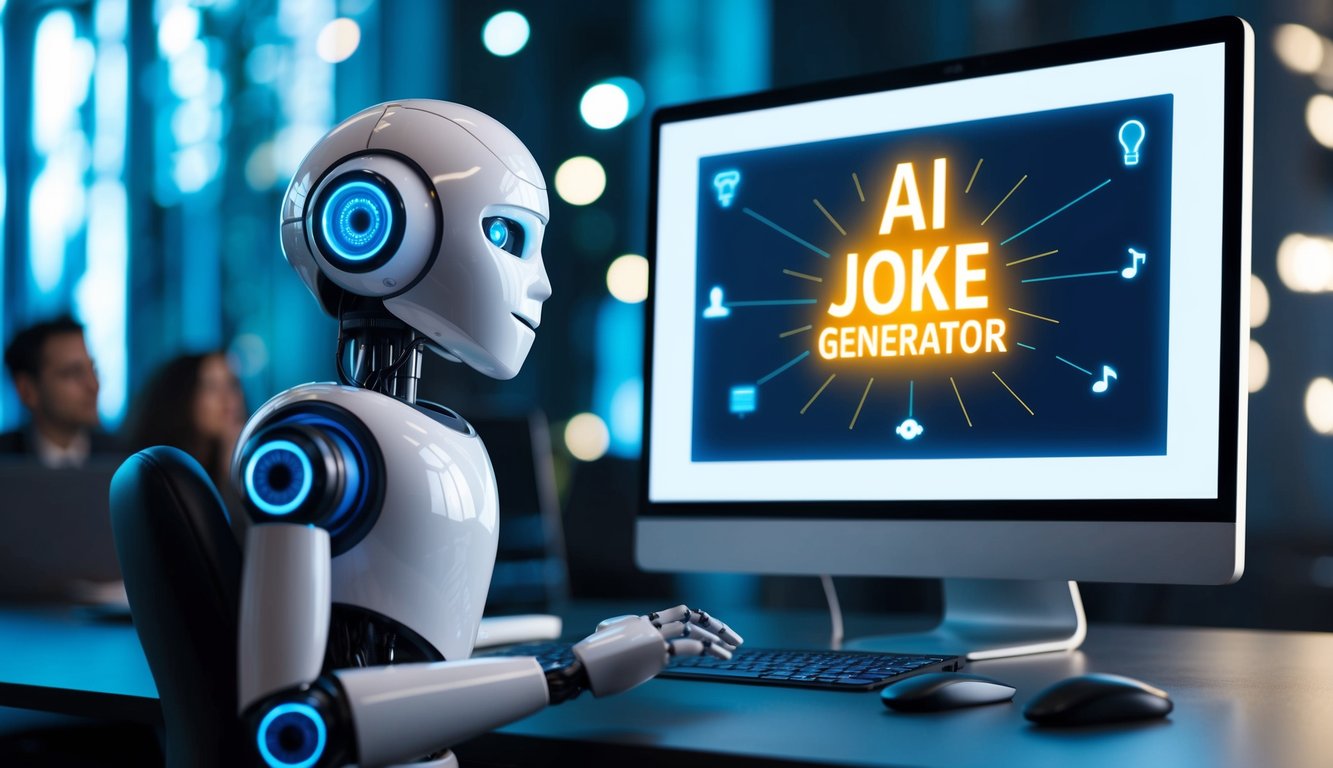
Artificial intelligence (AI) and comedy intersect in the field of computational humor, where algorithms are designed to generate, analyze, or inter...
#Infobox
Exploration of artificial intelligence's role in humor generation, techniques, and applications.
#Overview
Artificial intelligence (AI) and comedy intersect in the field of computational humor, where algorithms are designed to generate, analyze, or interpret humor. This interdisciplinary domain combines elements of natural language processing (NLP), machine learning, and computational linguistics to create systems capable of producing jokes, puns, or humorous content. The goal extends beyond mere entertainment; AI-driven humor systems are also explored for their potential in education, therapy, and human-computer interaction.
Computational humor research focuses on understanding the structure of jokes, the cognitive processes behind laughter, and the linguistic patterns that evoke humor. AI models, particularly those based on deep learning, have demonstrated the ability to generate jokes that mimic human creativity, though often with varying degrees of success. The challenge lies in capturing the nuance, timing, and contextual relevance that define effective humor.
#History / Background
#Early Developments
The concept of using machines to generate humor dates back to the 1960s, with early experiments in natural language generation. One of the first notable systems was JAPE (Joke Analysis and Production Engine), developed in the 1990s by Graeme Ritchie and colleagues. JAPE used template-based approaches to generate puns and simple jokes by manipulating linguistic structures. This work laid the foundation for understanding how humor could be algorithmically constructed.
In the late 1990s and early 2000s, researchers expanded on these ideas by incorporating more sophisticated linguistic rules and semantic analysis. Systems like HAHAcronym and STANDUP emerged, focusing on pun generation and the use of humor in educational contexts. These early systems were limited by computational power and the complexity of natural language, but they demonstrated the feasibility of AI-driven humor.
#Modern Advancements
The advent of deep learning and large-scale language models, such as Transformers, has revolutionized computational humor. Models like GPT and BERT can generate jokes by predicting sequences of words that align with humorous patterns. These models leverage vast datasets of human-generated humor to refine their outputs, though they still struggle with contextual appropriateness and originality.
Recent research has also explored the use of reinforcement learning to improve joke quality. By training models to maximize user ratings or engagement metrics, researchers aim to create systems that can adapt to different audiences and cultural contexts. Additionally, the integration of multimodal AI—combining text, audio, and visual elements—has opened new avenues for humor generation, such as meme creation and comedic video scripting.
#How It Works
#Rule-Based Systems
Early AI humor systems relied on rule-based approaches, where jokes were generated by applying predefined linguistic or semantic rules. For example, a pun might be created by replacing a word in a sentence with a homophone or near-homophone that changes the meaning in a humorous way. Systems like JAPE used templates to structure jokes, filling in variables with words that fit the desired humorous pattern.
Rule-based systems are transparent and controllable but lack flexibility. They require extensive manual input to define rules and are limited to the types of humor they can generate. Despite these limitations, they remain useful in specific applications, such as educational tools or constrained creative tasks.
#Statistical and Machine Learning Approaches
With the rise of machine learning, humor generation shifted toward statistical models that learn patterns from large datasets of jokes and humorous content. Techniques such as n-gram models and Hidden Markov Models (HMMs) were used to predict sequences of words that are likely to be perceived as funny. These models rely on the frequency of word combinations in training data to generate novel but statistically plausible jokes.
More recently, neural network-based models have become dominant. Recurrent Neural Networks (RNNs) and, later, Transformer models have been fine-tuned on humor datasets to generate jokes. These models can capture more complex patterns in language, including syntactic and semantic structures that contribute to humor. However, they often produce outputs that are grammatically correct but lack the wit or originality of human-created jokes.
#Deep Learning and Large Language Models
Large language models (LLMs) like GPT-3 and BERT have significantly advanced AI humor generation. These models are trained on vast corpora of text, including jokes, puns, and humorous exchanges, allowing them to generate jokes that mimic human creativity. LLMs can produce jokes in various styles, from simple puns to more complex, situational humor.
The process typically involves prompt engineering, where the model is given a specific input (e.g., a topic or a setup) and generates a humorous response. For example, a user might input "Why did the chicken cross the road?" and the model could respond with "To get to the other side... just like your ex after the breakup!" While these responses can be entertaining, they often lack the contextual awareness or timing that makes human humor effective.
#Evaluation and Metrics
Evaluating the quality of AI-generated humor is challenging. Traditional metrics like perplexity or BLEU score are not well-suited for humor, as they measure linguistic similarity rather than comedic effectiveness. Researchers often rely on human evaluation, where participants rate jokes based on humor, originality, and appropriateness. Metrics such as funny rating, surprise, and enjoyment are used to assess the success of AI-generated jokes.
Another approach is to use reinforcement learning, where models are trained to maximize user engagement or laughter metrics. This method allows the system to adapt to different audiences and refine its humor over time. However, it raises ethical concerns, such as the potential for reinforcing biases or generating inappropriate content.
#Important Facts
- First AI Joke Generator: JAPE (Joke Analysis and Production Engine), developed in the 1990s, was one of the first systems to generate jokes using rule-based templates.
- Pun Generation: Systems like HAHAcronym specialize in generating puns by manipulating word structures, such as replacing letters or syllables to create humorous meanings.
- Multimodal Humor: Modern AI systems can generate humor across multiple modalities, including text, images, and videos, enabling the creation of memes and comedic animations.
- Cultural Sensitivity: Humor is highly culturally dependent, and AI systems often struggle to generate jokes that resonate across different cultural contexts without extensive fine-tuning.
- Ethical Concerns: AI-generated humor raises ethical questions, such as the potential for offensive or inappropriate content, as well as the impact on human comedians and writers.
- Educational Applications: Humor generation systems are used in education to teach language skills, creativity, and critical thinking, particularly for non-native speakers.
- Commercial Use: Companies leverage AI humor generation for marketing, customer engagement, and content creation, such as generating social media posts or advertising copy.
#Timeline
- The study and application of algorithms to generate, analyze, or interpret humor.
- A field of AI focused on the interaction between computers and human language.
- A subset of AI that involves training models on data to make predictions or generate outputs.
- A type of machine learning that uses neural networks with multiple layers to model complex patterns.
- A form of wordplay that exploits multiple meanings of a word or similar
sounding words for humorous effect.
- A cultural item, often humorous, that spreads rapidly through digital communication.
- A type of machine learning where models learn to make decisions by receiving rewards or penalties.
- The practice of designing inputs to AI models to elicit desired outputs, often used in humor generation.
- AI systems that process and generate content across multiple modalities, such as text, images, and audio.
- The consideration of moral and societal implications in the development and deployment of AI systems, including humor generation.
#Related Terms
#FAQ
What does AI And Comedy: Generating Jokes cover?
Explores how artificial intelligence shapes comedy and generating jokes, covering practical use cases, benefits, limitations, and risks.
Why is AI And Comedy: Generating Jokes important?
It helps readers understand key concepts, compare practical use cases, and evaluate how Creative AI decisions affect outcomes, risks, and implementation choices.
What should readers verify before applying this topic?
Readers should compare the benefits, limitations, data requirements, and related themes such as Comedy, Generating, Joke before using the ideas in real projects.
#References
- AI And Comedy: Generating Jokes terminology and background research
- AI And Comedy: Generating Jokes use cases, implementation examples, and limitations
- Creative AI best practices, standards, and risk guidance
- Comedy case studies, benchmarks, and current industry analysis


Comments
No comments yet. Start the discussion with a useful note.